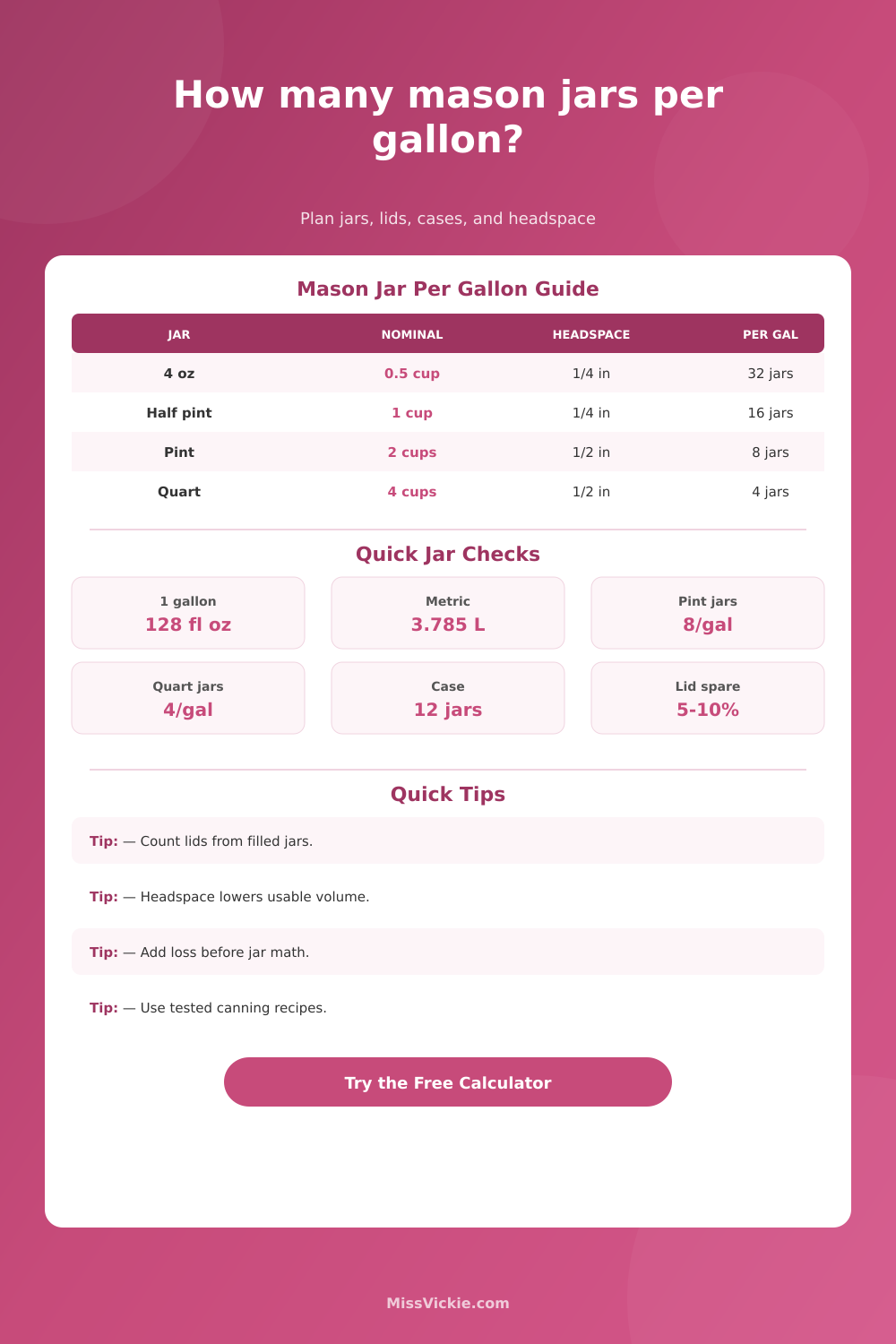
Gallons, jar capacity, headspace, product type, loss, cases, lids, and metric conversion
Mason Jars Per Gallon Calculator
Calculate how many mason jars fit a gallon or a full batch after headspace, product thickness, transfer loss, case packing, spare lids, and metric volume conversions.
📌Jar Planning Presets
Choose a common canning or kitchen storage batch, then adjust jar size, headspace, product type, losses, case count, and lid extras.
⚖Batch, Jar, Headspace, And Loss Inputs
Jar plan ready
Adjust inputs to calculate the batch.
Volume Breakdown
Jar And Supply Breakdown
Planning Notes
🧾Quick Capacity Snapshot
After headspace and fill margin.
Converted finished batch volume.
Last jar volume if not even.
Extra jar volume after rounding up.
🫙Mason Jar Capacity Table
| Jar Size | Nominal Capacity | Metric Capacity | Exact Per Gallon | Common Use |
|---|---|---|---|---|
| 4 oz jelly jar | 0.5 cup / 4 fl oz | 118 ml | 32 jars | Jelly, gifts, samples |
| Half-pint jar | 1 cup / 8 fl oz | 237 ml | 16 jars | Jam, mustard, small sauce |
| 12 oz jar | 1.5 cups / 12 fl oz | 355 ml | 10.67 jars | Preserves, salsa, gifts |
| Pint jar | 2 cups / 16 fl oz | 473 ml | 8 jars | Pickles, salsa, broth portions |
| Pint-and-a-half jar | 3 cups / 24 fl oz | 710 ml | 5.33 jars | Asparagus, tall vegetables |
| Quart jar | 4 cups / 32 fl oz | 946 ml | 4 jars | Tomatoes, broth, dry storage |
| Half-gallon jar | 8 cups / 64 fl oz | 1.89 L | 2 jars | Dry storage or refrigerator use |
| 1 liter jar | 4.23 cups / 33.8 fl oz | 1 L | 3.79 jars | Metric batches and storage |
Headspace and practical fill margin reduce usable capacity, so the calculator often recommends more jars than the nominal per-gallon table.
📏Headspace And Product Reference
| Product Type | Typical Headspace | Default Loss | Pack Factor | Planning Note |
|---|---|---|---|---|
| Jam, jelly, preserves | 1/4 in / 0.6 cm | 3% | 98% | Foam skim and sticky ladles create small losses. |
| Pickles or relish | 1/2 in / 1.3 cm | 4% | 94% | Vegetable pack changes how much brine fits. |
| Salsa or chutney | 1/2 in / 1.3 cm | 5% | 96% | Chunky mixtures need a little jar cushion. |
| Tomato sauce or puree | 1/2 in / 1.3 cm | 4% | 98% | Thicker sauce clings to pots and funnels. |
| Broth, stock, soup base | 1 in / 2.5 cm | 2% | 99% | Pressure-canned liquids usually need more headspace. |
| Dry goods storage | 0.5 in / 1.3 cm | 1% | 92% | Settling and irregular pieces lower practical fill. |
📦Case Count And Lid Planning Table
| Filled Jars | 12-Jar Cases | 6-Jar Trays | Suggested Lids | Useful For |
|---|---|---|---|---|
| 1 to 6 | 1 case | 1 tray | 7 lids | Small test batch |
| 7 to 12 | 1 case | 2 trays | 14 lids | Single recipe run |
| 13 to 24 | 2 cases | 4 trays | 27 lids | Double batch |
| 25 to 36 | 3 cases | 6 trays | 40 lids | Harvest afternoon |
| 37 to 60 | 4 to 5 cases | 7 to 10 trays | 10% spare | Large preserve run |
| 61+ | Round up | Round up | 10% spare | Event or pantry batch |
💡Jar Planning Tips
The math seems easy: A pint jar contains 16 ounces, and a gallon contain 128 ounces; thus eight jars per gallon. And then you set up to ladle, and suddenly there’s foam and your sauce stick to the ladle. Oops! The printed volume is not the same as what actualy fits inside the jar. There must be some headroom for expanding in the heat. Too late, you’re out of jars.
No more guessing… That’s why we have a calculator. Enter in the details about your batch size, which is never perfectly filled. Enter the headspace needed and the transfer loss. The math are done for you. You know exactly how many case, lids, and jar to buy for any given batch. No more surprises!
How to Count Jars for Canning
What is the single most important thing to avoid as a home canner? You must not fail to leave headspace in your jars. For each jar, you must has space at the top so that when it heat up, there’s somewhere for contents to go. If you fill a pint jar right to the rim, the liquid will push out during processing, which either (A) impairs its ability to make a good seal; or (B) makes a big old mess inside your water bath canner.
What happens? The liquid gets forced back out, which either (A) prevent the jar from sealing properly, or (B) make a big old mess inside your water bath canner. Generally speaking, jams and jellies requires just a quarter inch of headspace; broths and tomato sauces may require up to a half inch or more. That’s going to reduce volume capacity of the jar.
Remember: A jar marked “16 ounces” doesn’t contain 16 ounces of anything. But there’s another factor that impact yield: transfer loss. Something is lost along the way, whether it’s splashed onto counter or left behind in the pot despite your best efforts at pouring. You’re also skimming away foam because otherwise resulting seals will be splotchy.
A home cook can expects to lose three- to five-percent of the total volume of the batch at this stage. That might not sound like much, but when you’re talking about a big harvest, three-percent translates into a whole jar (or even two) of wasted food. Plan for the loss so you don’t end up counting jars and feeling frustrated halfway through because you forgot to include it.
And then there’s the logistics of the supply chain… The math. Jars don’t come one at a time: they’re packed in cases of 12. And if your recipe produces product that will fit into 10 and a half jars, that doesn’t mean you purchase only ten and a half. That means youll have to purchase an entire case.
What about lids? Always purchase extras. Metal lids dent easily, or maybe you didnt get all the air out of a jar and it didn’t seal, so you must reprocess. Experienced canners allows a 10 percent lid buffer. It is cheap insurance against a lost batch.
Choosing the right size is also an important factor. Some things are best in small jelly jars (like a single serving of mustard or a small gift). Salsa and pickles is nice in pint jars. Stock and tomato sauce are quart jar workhorses. And half-gallon jars is typically too large to handle efficienty in a home water bath due to their heat retention. With this calculator, you can quickly toggle back and forth among those sizes.
See which case quantities you need and how many lids will go into that batch… If you change it from pints to quarts, for instance. See your pantry space beforehand, without purchasing anything yet.
A good canning day has a rhythm. Begin by washing warm, empty jars; end with a full pantry and a clean counter. Just a bit of early arithmetic can be the difference between chaos and calm. Knowing precisely how many jar to prep lets you line them up on your counter in a row, and fill them confidently.
You will no longer stress over whether or not you have enough lids. You won’t have to worry about what to do with extra sauce. Let the math solve the worry, and let yourself get lost in the food.
So before you heat that first pan or chop that initial piece of veggie, spend a moment sizing up your batch. What’s the volume? What will inevitably get lost in translation? How much space do you need above it (headspace)? Order the necessary supplies, plus some extras. You’ll feel like you’re on top of things and it only takes a few seconds.
By the time you’re ready to fill those jars they’ll be there, all set and ready to go. Every second spent planning should of been worth that warm fuzzy feeling of having everything under control.