MissVickie leftover potato planner
Mashed Potato Reheating Time Calculator
Estimate reheating time for mashed potatoes by portion weight, reheating method, butter and milk level, refrigerated or frozen start, dish depth, cover style, stirring interval, and target serving temperature.
🥔 Mashed Potato Reheating Presets
Choose a leftover potato scenario, then adjust the portion, depth, dairy level, cover, stirring rhythm, and target temperature. The calculator is for fully cooked mashed potatoes.
🧮 Portion, Dairy, Depth, Cover, and Target Inputs
Your Mashed Potato Reheat Plan
Adjust the inputs to estimate a practical reheating window.
Timing Breakdown
Texture Breakdown
🍲 Practical Mashed Potato Reheat Markers
Probe the center after stirring for a reliable safety check.
Shallow layers warm evenly and need less rescue liquid.
Resting lets heat even out before a final fold and serving.
Plan roughly 4 oz as a side, more for holiday plates.
📋 Mashed Potato Reheating Reference Tables
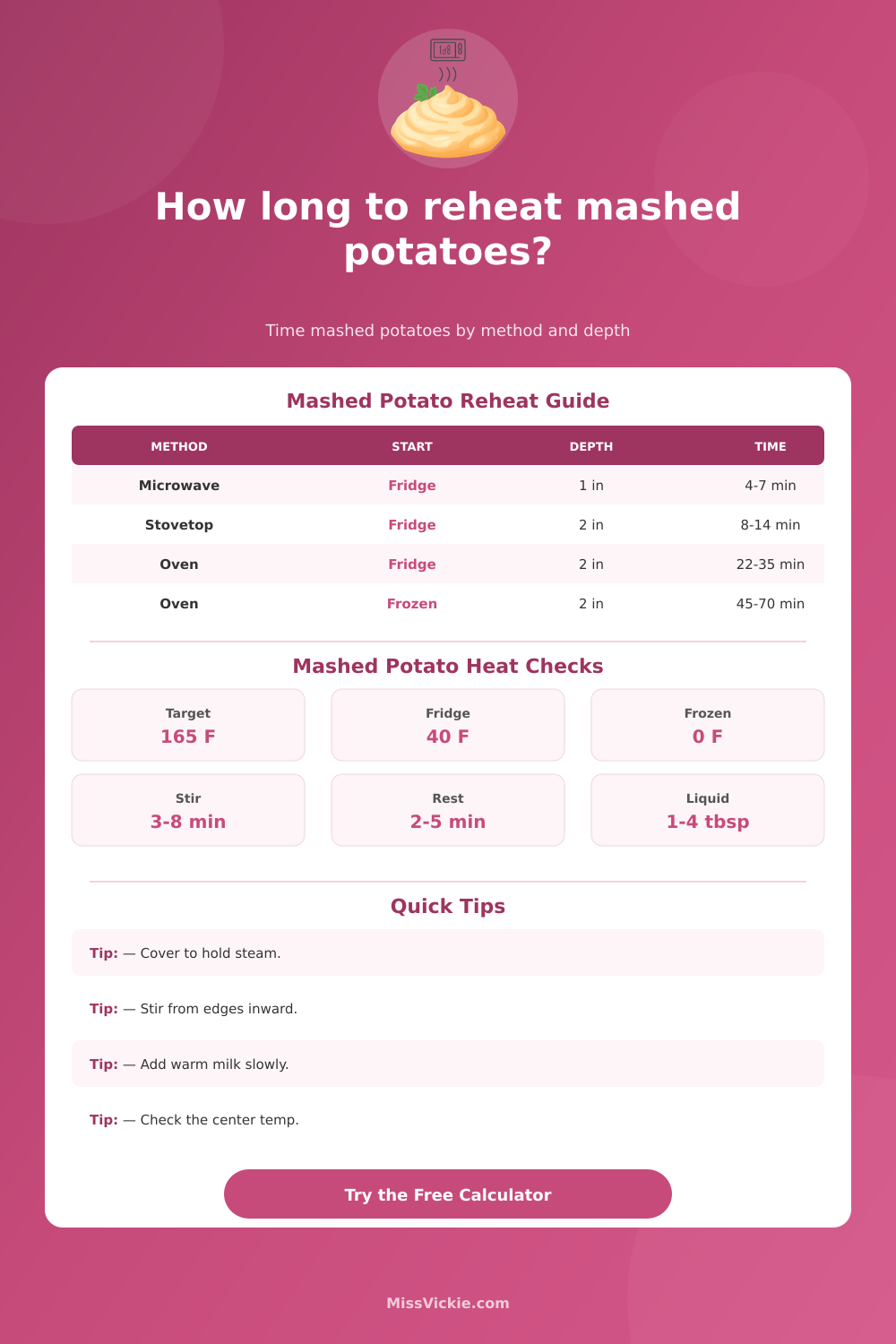
| Method | Best For | Typical Fridge Timing | Texture Notes |
|---|---|---|---|
| Microwave | Single bowls to family dishes | 3-12 minutes | Fastest, but needs frequent stirring to remove cold pockets. |
| Stovetop saucepan | Creamy mash and meal prep | 8-18 minutes | Excellent texture control with warm milk added gradually. |
| Oven | Holiday pans and casseroles | 22-45 minutes | Gentle for large batches; cover first, uncover briefly to finish. |
| Slow cooker | Buffet holding | 80-150 minutes | Slow but convenient; stir and hold on warm after target temp. |
| Steam insert | Covered bowl or pot-in-pot | 12-25 minutes | Moist heat helps dense potatoes without scorching the bottom. |
| Sealed bag water bath | Make-ahead bags | 25-55 minutes | Very even heat if the bag is flattened before chilling. |
| Portion | Approx Weight | Suggested Depth | Stir Pattern |
|---|---|---|---|
| Single side serving | 4-8 oz | 1 inch or less | Stir once halfway, then smooth. |
| Dinner for 4 | 1.5-2 lb | 1-1.5 inches | Stir from edge to center every 4-6 minutes. |
| Holiday pan | 4-6 lb | 1.5-2.5 inches | Fold in quadrants and rotate the dish once. |
| Buffet insert | 6-10 lb | 2-3 inches | Stir deeply before switching to warm hold. |
| Frozen tray | 2-5 lb | 2 inches or less | Cover until soft enough to break up and stir. |
| Potato Texture | Reheat Behavior | Moisture Add-In | Warning Sign |
|---|---|---|---|
| Fluffy russet mash | Heats quickly but dries at edges | Warm milk or broth | Crumbly edges or dull surface. |
| Buttery Yukon mash | Holds moisture well | Small pat of butter | Glossy pools mean stir gently. |
| Loaded mash | Cheese and bacon slow the center | Cream or half-and-half | Hot edges with cool cheesy middle. |
| Instant mash | Rehydrates quickly | Milk in small splashes | Gluey texture from over-stirring. |
| Casserole mash | Dense and slow at depth | Butter under cover | Dry browned top before hot center. |
| Target | Use Case | When To Stop | After Reheat |
|---|---|---|---|
| 140 F | Immediate serving from room-temp mash | Steamy and spoonable | Serve right away. |
| 150 F | Hot plate comfort serving | Center is hot after stirring | Rest 2 minutes. |
| 165 F | Leftover safety target | Thermometer reads center temp | Rest and recheck dense pans. |
| 170 F | Buffet transfer | Hot enough to move into warmer | Hold above 140 F. |
⚖ Method Comparison Grid
Best for small portions if you stir often and cover with a vent.
Lets you add warm dairy gradually and stop before the mash turns gluey.
Works well for wide holiday pans when covered for most of the heating time.
Useful for buffet service after potatoes have reached the target temperature.
💡 Mashed Potato Reheating Tips
For best texture, stop aggressive stirring once the potatoes are hot. Overworking mashed potatoes after reheating can make the starches sticky.
Anyone who’s been burned by the let-down of opening up a tuber-filled Tupperware to find nothing but gummy cold potato paste knows the problem isn’t one of taste. It’s a matter of both the physics of heat distribution as well as starchiness of potatoes which don’t hold onto thermal energy so well after cooling off. Also, when heating them back up aggressively without adding any water to make up for it they’ll cook fast, and dry out fast, too.
A stopwatch guess doesn’t work well here, either. You’re trying to consider the thickness of your layer of potatoes, the initial starting temperature, etc., not to mention amount of dairy you fold into your original mix. That’s where this comes in: Plug in what exactly you’re doing, and the calculator does the rest. You will have no more burnt edges or still-raw middles.
The Best Way to Reheat Mashed Potatoes
Consider also density of the foods being re-heated. Does it matter if it’s a light and fluffy russet mash or a heavy and stodgy combination of mashed Yukon golds filled with bacon and cheese? The denser food, the longer it takes for the heat to reach the middle. If you pile the potatoes up in a big hunk in the middle of the bowl, by the time the middle defrosts the outside will be blackened. You need to spread them out so that they cook evenly. A wider dish means there is more surface exposed to the heat source. It also lets the steam soak into the food instead of just heating the outside.
Oven times increase a lot for deeper pans as opposed to microwave dishes (see below). Why? Because microwaving is quick. But it also creates hot spots, which mess with the texture. When you microwave something, you have to stir it from outside-in every couple of minutes, that spreads out the heat and keeps the starches from getting gluey.
Reheating on the stovetop gives you greater control (if you’re patient), allowing you to fold it gently as you go and add some warm broth or milk slowly. Adding cold liquid will shock the potatoes and may cause them to seize up in a clunky mass. Warm your dairy ingredients first. The temperature difference change the texture completely. Clumpy isn’t good; creamy is the goal.
What about frozen leftovers? That’s another story. The ice crystals damage them and break down their cell structure. The best thing to do is thaw them all the way in the fridge overnight. If you go straight from frozen to hot, you’ll end up with something that’s soggy on the outside but icy in the middle. To account for this, the tool adjusts its timing when starts are frozen. It assumes they need extra time to warm through evenly because of ice pockets.
Best not to trust your eyes (or nose) for whether the middle is done. Instead, use a thermometer. A potato may appear to be steaming hot but remain dangerously chilly in the very middle. One hundred sixty-five degrees F will get you there both safely and texturally. The potatoes are wetted by the re-heated steam trapped under the cover. If not covered they will quickly lose their moisture as it evaporates into the air. This results in a dry crust. For the best results, use either a loose foil or a vented lid. This keeps some moisture to maintain tenderness but lets out any excess pressure.
How often you stir is less important than HOW you stir. Gently folding maintains the original airy texture. Beating it hard release more starch, creating a pasty mess that even adding butter cannot fix. Based off both depth & method, the calculator tells you how many stirs to expect. So you just have to do them instead of thinking about when.
A lot of leftover holiday food is still hanging around after the meal. Maybe it’s a big dish of loaded potatoes leftover from Christmas dinner? Those should be warmed up slowly over low-ish heat, so that they don’t dry out all the cheesy goodness on top. Keep covered for most of the time. If you’d like a little browning on the top, uncover during the last bit.
Slow cookers is great for buffet-style serving because they keep food warm for hours without overcooking it. Just remember to give the potatoes an initial boost in heat before transferring them to the warmer slot. Ideally we want hot, creamy, fresh potatoes, not something recycled from last night’s dinner.
Once you understand that cooking potatoes is more about heat moving through dense starch than anything else, everything shifts. Time is no longer a set amount; it becomes a variable, dependent on moisture and depth. Start with the tool for your ballpark estimate. Then use your senses for the details of achieving that perfect finish. Eliminate all doubt by quickly probing a potato with a thermometer. Toss out that hasty attempt in the microwave, you deserve better! Show some love and make sure your leftover deserves the same.