Maple Bacon Cure Calculator
Plan a maple bacon cure from pork belly weight, syrup grade, maple grams, salt percentage, Cure #1 ppm, wet or dry method, belly thickness, cure days, smoke loss, and finished sweetness target.
🍯Maple bacon presets
Choose a starting cure, then tune the pork belly weight, maple syrup grade, salt, Cure #1 ppm, wet or dry choice, thickness, smoke loss, and sweetness target.
⚖Calculator units
🥩Pork belly and cure method
🍁Maple syrup, salt, Cure #1, and sweetness
🔥Cure days, smoke loss, and finish
Maple bacon cure results
Detailed maple bacon breakdown
Enter your pork belly cure inputs and calculate.
📌Maple cure quick targets
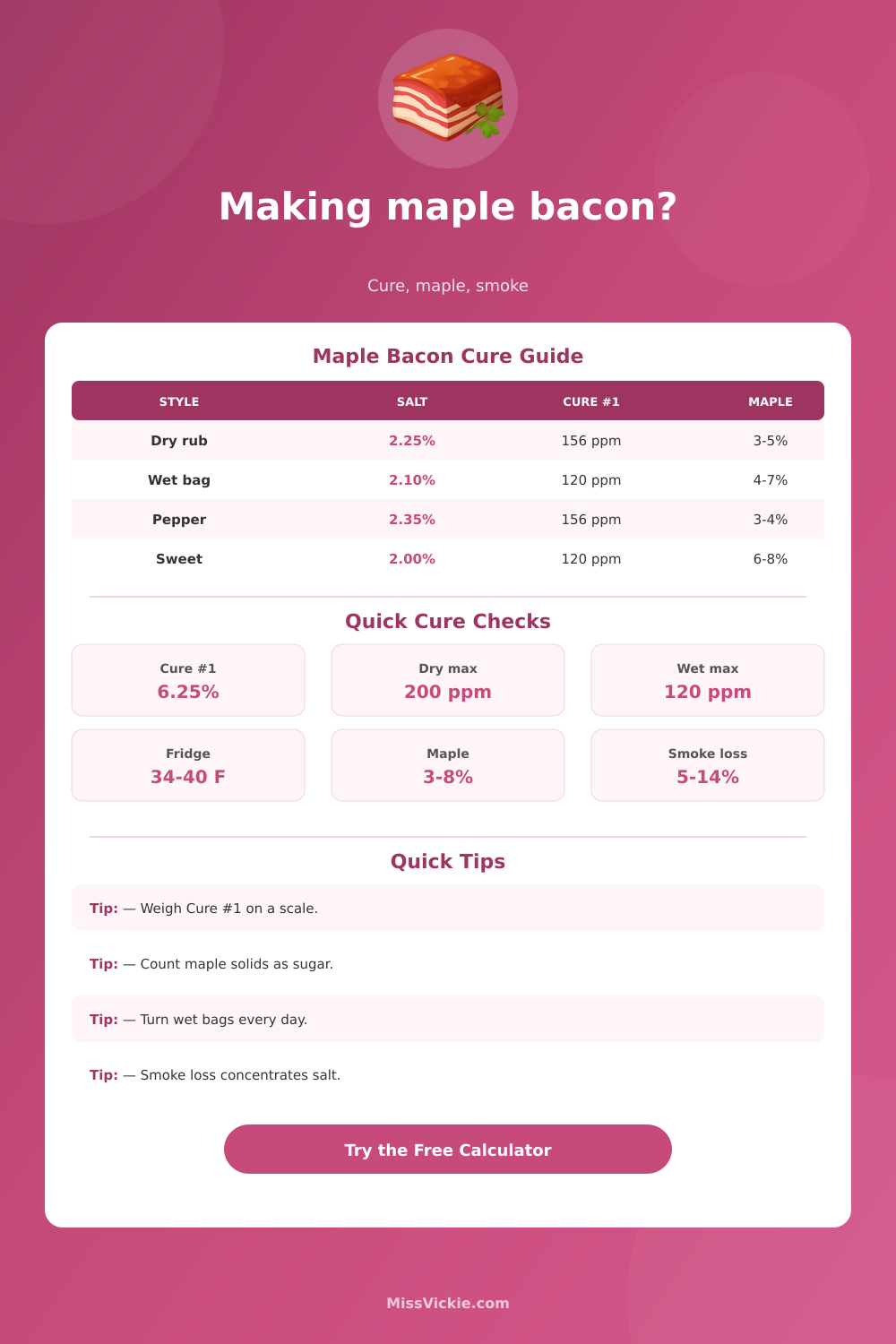
Common maple bacon salt target before smoke concentration.
Syrup by belly weight for mild to sweet maple flavor.
Most bellies need at least a week plus thickness time.
Drying and smoking concentrate salt and sweetness.
📋Maple syrup grade reference
| Maple grade | Approx sugar solids | Flavor strength | Best bacon use |
|---|---|---|---|
| Golden delicate syrup | About 66% | Light | Subtle maple, light smoke, low spice |
| Amber rich syrup | About 66% | Medium | Balanced breakfast bacon and all-purpose slabs |
| Dark robust syrup | About 67% | Bold | Smokehouse bacon, peppered bacon, thicker slabs |
| Very dark strong syrup | About 68% | Very bold | Small amounts for intense maple flavor |
| Maple sugar | About 100% | Clean and dry | Dry cure blends where extra moisture is unwanted |
| Syrup plus brown sugar | About 78% | Round | Sweeter bacon with stronger browning |
🧂Wet and dry cure planning table
| Cure choice | Nitrite check | Maple handling | Turn schedule |
|---|---|---|---|
| Dry rub with maple syrup | Dry target, up to 200 ppm check | Syrup makes a paste; rub evenly on all sides | Turn daily as syrup pulls moisture |
| Wet bag brine with maple syrup | Wet target, 120 ppm check | Dissolve syrup, salt, and Cure #1 fully in water | Turn or massage every 24 hours |
| Equilibrium small-brine bag | System weight check | Count meat, water, and syrup in the cure system | Keep all surfaces coated with syrupy brine |
| Skin-on maple belly | Dry target, slower diffusion | Score fat lightly and extend cure days | Turn daily, especially at edges |
| Maple belly pieces | Dry or wet target by method | Use less time because pieces cure faster | Stir or redistribute every 12 to 24 hours |
🌡Finished flavor reference
| Sweetness target | Retained sugar after smoke | Salt feel | Maple result |
|---|---|---|---|
| Savory with maple aroma | 0.6% to 1.0% | Salt leads | Maple in aroma more than sweetness |
| Subtle maple finish | 1.0% to 1.5% | Balanced-salty | Light sweetness after frying |
| Balanced sweet-salty bacon | 1.5% to 2.2% | Balanced | Clear maple without sticky edges |
| Sweet breakfast bacon | 2.2% to 3.0% | Sweet-salty | Maple is obvious and browns faster |
| Sticky maple-forward bacon | 3.0% to 4.2% | Sweet leads | Strong maple glaze style, watch scorching |
✅Maple bacon calculation notes
Weigh cure carefully: Cure #1 should be measured by scale, not spoons, because nitrite ppm depends on very small gram amounts.
Count maple solids: Syrup is mostly sugar and water, so the calculator separates syrup weight from actual sweetness solids.
Watch browning: Sweeter maple bacon can darken quickly when fried; lower heat helps the sugar brown without scorching.
Keep it cold: Cure in the refrigerator range and discard plans that exceed the ppm check for the selected wet or dry method.
The cure’s effect on belly is key to making maple bacon. First, it season and pulls moisture from the belly via the salt. Cure #1 provide a barrier from any bacteria growth, while maintaining stable color throughout long holding time.
Maple syrup contribute to more than flavor. It adds water and solids that alters the movement of the salt and nitrite in the belly. As the water cooks off during smoke, the solids is left behind.
How to Make Maple Bacon
Enter the weight of the belly, the type of syrup, and your desired nitrate and salt targets to calculate math for your chosen method (see above). Mixing is just the start, the actual decisions are made beforehand.
Wet cures require enough liquid to ensure complete coverage fast. But you must be extra-careful with your weights since amount of water add to the overall system weight.
Dry rubs maintains maximum cure-to-surface contact (good if you desire strong maple flavor on slab exterior). Nitrites migrates slowly because off the thickness. A 4-cm belly needs more days then a 3-cm one. Pieces with intact skin take even longer as it block thorough contact.
Syrup grade also subtlely changes results. Lighter maple is more dilute; it have a smaller flavor impact for each gram of solids. Darker maples are sweeter (with just a bit more sugar) and thus impart a stronger flavor. That comes into play when you are focusing on all that flavor during smoking and deciding how sweet you want the final bacon to be.
The calculator notes how much sugar you’ve left behind, relative to your desired level of sweetness at the end. This way, you can adjust up or down before beginning rather than guessing later on.
Another variable is how much smoke you lose. For every percentage point of weight lost as your belly smokes and dries out, the remaining content will be more concentrated with salt and sugar. Lose a bit more than anticipated, and that perfectly balanced plan on paper turns into something to salty for your tongue. With this tool you can test your desired smoked style against your target to see impact without firing up the smoker first.
The temperature remains critical through all of this. The fridge will do the trick for nitrites. Above that range small fluctuations up will accelerates or retard process. That impacts flavor as well as safety.
Turning the bag or rubbing surface helps move the cure uniformly. This is especially important if you are using a wet method where salt and syrup may settles to bottom.
Of course, it’s not possible for your cooked bacon to weigh more than your uncooked belly. But if you hit the right flavor notes in starting mix, it would of taste more like cured ham (with a sweeter flavor) or more like breakfast bacon. After that, it’s just a matter of checking occasionally and waiting. And even though numbers on the calculator are only a starting point, they’re good ones, so while you wait, it’ll be worth eating.