Age, sex, food sources, supplement form, activity, target, and daily split
Magnesium Intake Calculator
Estimate daily magnesium from common foods and supplements, compare it with an age and sex target, and split the intake across meals for general planning.
Choose a common day, then edit the foods, supplement label amount, activity, and target. This calculator is for general information only.
Magnesium Intake Breakdown
Daily Magnesium Split
Typical absorption estimate for magnesium from mixed foods and beverages.
Generally more soluble forms; label amount still means elemental magnesium.
Often provides a high elemental amount, but tends to be less bioavailable.
Spreads food and supplement magnesium across eating times for planning.
| Age Or Life Stage | Male | Female | Pregnancy Or Lactation |
|---|---|---|---|
| 1-3 years | 80 mg/day | 80 mg/day | Not listed |
| 4-8 years | 130 mg/day | 130 mg/day | Not listed |
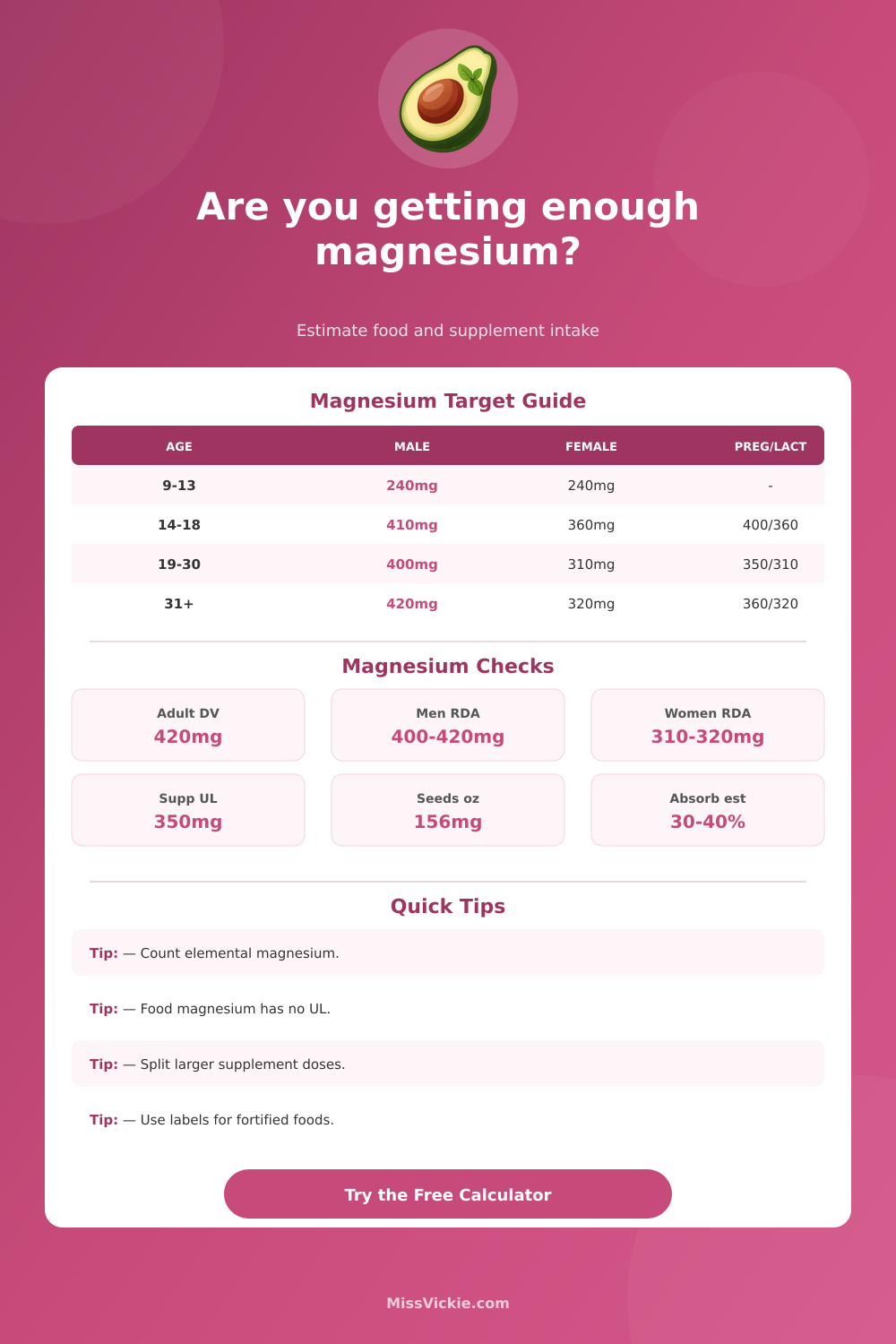
| 9-13 years | 240 mg/day | 240 mg/day | Not listed |
| 14-18 years | 410 mg/day | 360 mg/day | 400 mg pregnant, 360 mg breastfeeding |
| 19-30 years | 400 mg/day | 310 mg/day | 350 mg pregnant, 310 mg breastfeeding |
| 31 years and older | 420 mg/day | 320 mg/day | 360 mg pregnant, 320 mg breastfeeding |
| Food Source | Serving Used | Magnesium | Planning Note |
|---|---|---|---|
| Pumpkin seeds, roasted | 1 oz | 156 mg | Very high magnesium source for small servings. |
| Chia seeds | 1 oz | 111 mg | Often added to breakfast bowls or smoothies. |
| Almonds, dry roasted | 1 oz | 80 mg | Useful snack source with fat and calories. |
| Spinach, boiled | 1/2 cup | 78 mg | Leafy green entry with moderate magnesium. |
| Cashews, dry roasted | 1 oz | 74 mg | Similar planning role to almonds. |
| Black beans, cooked | 1/2 cup | 60 mg | Pairs magnesium with fiber and protein. |
| Soymilk | 1 cup | 61 mg | Use the product label when fortified. |
| Common Source | Serving Used | Magnesium | Calculator Field |
|---|---|---|---|
| Brown rice, cooked | 1/2 cup | 42 mg | Bean or grain source |
| Plain low-fat yogurt | 8 oz | 42 mg | Greens, produce, or dairy |
| Instant oatmeal | 1 packet | 36 mg | Bean or grain source |
| Banana | 1 medium | 32 mg | Greens, produce, or dairy |
| Milk | 1 cup | 27 mg | Greens, produce, or dairy |
| Salmon, cooked | 3 oz | 26 mg | Protein or beverage source |
| Avocado, cubed | 1/2 cup | 22 mg | Greens, produce, or dairy |
| Supplement Or Split | Typical Entry | Calculator Treatment | General Note |
|---|---|---|---|
| Citrate, chloride, lactate | Elemental mg on label | Higher solubility factor | Often better absorbed than oxide. |
| Glycinate | Elemental mg on label | Moderate-high factor | Common gentle supplemental form. |
| Oxide | Elemental mg on label | Lower absorption factor | High label amount does not guarantee high absorbed amount. |
| Hydroxide | Elemental mg on label | Laxative-form warning | Often used in digestive products, not just supplements. |
| Activity buffer | 0-15% food target | Added to planning target | Represents a conservative food-planning buffer. |
| Supplement upper limit | 350 mg adult | Compared with supplement total | Applies to supplements and medicines, not food magnesium. |
Magnesium is a mineral that participates in more than three hundreds enzyme reactions in the body. Magnesium is an important mineral for the body because magnesium help with energy production, muscle relaxation, and nervous system signaling. The body does not store large reserves of magnesium, so a person must consume magnesium every day to maintain the magnesium levels in there body.
An intake calculator is a tool that help a person to track their magnesium intake as the calculator allows a person to see how much magnesium they consume through their diet as well as how much magnesium supplement they consumes daily. The intake calculator require a person to input their age and sex as the requirements of magnesium change with age and sex. For example, teenagers require more magnesium than adults due to the growth of muscles and bone.
How to Track Your Daily Magnesium
Women who is pregnant or breastfeeding may require more magnesium than nonpregnant or nonbreastfeeding women. The calculator will automatically choose the correct reference value for magnesium requirements for a person’s selected life stage. A person can input a custom target for magnesium intake instead of the daily value for magnesium in food.
The intake calculator organizes the foods that contain magnesium into different categories as a person’s meals may contain different types of food. For instance, foods such as seeds and nuts are high in magnesium but may be consumed in smaller portion by most people. Beans and grains contain magnesium and can be consumed in each persons meal.
Leafy green vegetables, potatoes, yogurt and milk contain smaller amounts of magnesium but in larger quantities they can add up to higher amounts of magnesium consumed by an individual daily. Magnesium amount can be entered from the labels on foods that contain magnesium supplement. Magnesium supplements have different considerations in the intake calculator.
For instance, the calculator adjust the amount of supplemental magnesium according to the form of supplemental magnesium that a person takes. The supplement intake calculator also asks how many dose of the supplement the person takes as taking doses throughout the day may be more comfortable for the body then taking a high dose at one time. The supplemental magnesium that is entered into the calculator will compare with the upper limit of magnesium intake for supplements only.
The activity level is another input that is asked of the user of the intake calculator. A person may lose magnesium through sweat through physical activity. Therefore, the magnesium target can be increased to account for this loss.
This adjustment isnt a medical prescription for the person but a way to acknowledge the bodys losses due to activity. The target for magnesium intake is shown in a way that allow the user to decide if the target fits the specific situation of the individual using the calculator. The output of the calculator will display the amount of magnesium that is consume daily and the percentage of the target that is consumed.
The split of the target for magnesium that is consumed through food versus supplements can be seen as well. Magnesium from food and supplements can be better absorbed by the body if take in smaller portions throughout the day. The split of supplemental magnesium and food magnesium can help the individual to understand that the upper limit for magnesium intake only apply to supplemental magnesium.
The two amounts can help the individual to determine if they must consume more food or supplement of magnesium. The calculator includes reference tables to supplement the information provided in the calculator. These tables include magnesium targets according to age and the amount of magnesium in various food groups.
The reference tables will remind the individual that the amount of magnesium from food does not have an upper limit but the amount of supplemental magnesium do have an upper limit. Many days magnesium may be consumed at different amount. For instance, if a person consumes many food high in magnesium one day the intake of magnesium may be higher than the target.
On the other hand, if the individual consumes fewer foods high in magnesium the intake of magnesium will be less than the target. The individual can easily see these changes in magnesium consumption with the intake calculator. Additionally, small change in the foods that are consumed will cause changes in the total amount of magnesium in the body.
Magnesium absorption into the blood is not an exact science. The amount of magnesium that is absorbed from the supplements and food may not be the same as the amount of magnesium that is consume. Therefore, the calculations are only an estimate.
The amount of magnesium that is consumed may be affected by other supplements, health of the digestive system, or the general diet of the individual. Therefore, the output of the calculator is only an estimate of the amount of magnesium that should be consumed daily. If an individual experiences symptom of magnesium deficiency or if tests indicate low levels of magnesium in the blood, the intake calculator is only one piece of information that should be shared with a medical clinician.
While it is not necessary for the body to consume the exact amount of magnesium every day, it is important for the body to consume some amount of magnesium each day to perform its necessary function. The intake calculator is a helpful tool for establishing a steady intake of magnesium daily. Even if a persons routine change the calculator can be used to determine the amount of magnesium that should be consumed daily.
Additionally, using the intake calculator enables a person to turn the process of determining magnesium intake into a simple process of entering data into a screen rather than potentially searching through books to find the information on the amount of magnesium that should be consumed daily.