Shrimp, lobster, sausage, corn, potatoes, pot fill, and cook-stage math
Low Country Boil Calculator
Scale a seafood boil by guest count, appetite, boil style, custom ingredient ratios, pot size, usable fill, seasoning strength, water volume, and the order each ingredient should hit the pot.
Adjust the per-person ratios after choosing a style. Lobster is counted as 5 oz tails, corn is counted as half-ear pieces, and potatoes are raw baby potato weight.
Boil Breakdown
| Boil Style | Shrimp Per Person | Lobster Tails | Sausage Per Person | Corn And Potato Lean | Best Use |
|---|---|---|---|---|---|
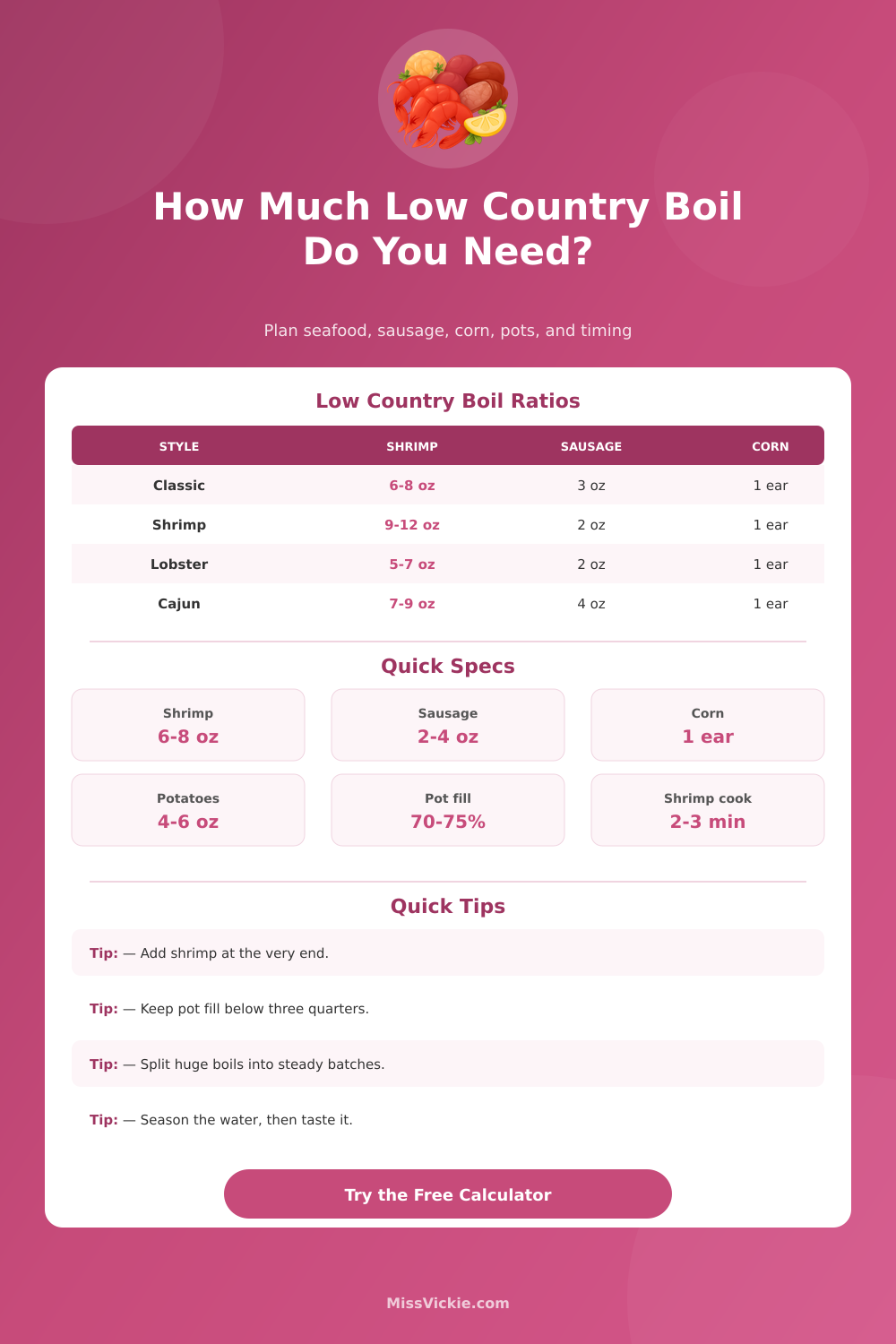
| Classic Low Country | 6 to 8 oz | Usually none | 3 oz | Balanced, filling | Backyard dinners and family gatherings |
| Shrimp Heavy | 9 to 12 oz | Optional garnish | 1.5 to 2.5 oz | Moderate sides | Seafood-first parties where shrimp is the star |
| Lobster Tail Feast | 5 to 7 oz | 4 to 8 tails per 10 guests | 1.5 to 2.5 oz | Light sides | Special occasions with richer seafood portions |
| Cajun Spicy Boil | 7 to 9 oz | Optional | 3.5 to 5 oz | Potatoes absorb heat well | Bold seasoning, beer garden, tailgate spreads |
| Mild Family Boil | 4.5 to 6 oz | Usually none | 2 to 3 oz | More corn and potatoes | Mixed ages, lighter spice, more approachable plates |
| Sausage And Corn Forward | 4 to 6 oz | None | 4.5 to 6 oz | Heavy corn and potatoes | Budget-friendly supper without pricing math |
| Guests | Shrimp At 7 oz Each | Sausage At 3 oz Each | Corn At 1 Ear Each | Potatoes At 5 oz Each | Typical Pot Need |
|---|---|---|---|---|---|
| 4 guests | 1.75 lb / 0.79 kg | 0.75 lb / 0.34 kg | 4 ears / 8 pieces | 1.25 lb / 0.57 kg | 16 to 20 qt pot |
| 8 guests | 3.5 lb / 1.59 kg | 1.5 lb / 0.68 kg | 8 ears / 16 pieces | 2.5 lb / 1.13 kg | 24 to 32 qt pot |
| 12 guests | 5.25 lb / 2.38 kg | 2.25 lb / 1.02 kg | 12 ears / 24 pieces | 3.75 lb / 1.70 kg | 36 to 44 qt pot |
| 25 guests | 10.9 lb / 4.96 kg | 4.7 lb / 2.13 kg | 25 ears / 50 pieces | 7.8 lb / 3.54 kg | 60 to 80 qt pot or batches |
| 50 guests | 21.9 lb / 9.92 kg | 9.4 lb / 4.25 kg | 50 ears / 100 pieces | 15.6 lb / 7.09 kg | 100 qt pot or two stations |
| Pot Size | Usable At 70% | Approx Food Load | Best Guest Range | Batch Note |
|---|---|---|---|---|
| 16 qt / 15 L | 11 qt / 10.6 L | 8 to 10 lb | 3 to 5 guests | Keep corn and potatoes modest |
| 24 qt / 23 L | 17 qt / 15.9 L | 12 to 16 lb | 5 to 8 guests | Good apartment or stove-friendly size |
| 40 qt / 38 L | 28 qt / 26.5 L | 22 to 28 lb | 10 to 14 guests | Common outdoor burner boil size |
| 60 qt / 57 L | 42 qt / 39.7 L | 34 to 42 lb | 18 to 25 guests | Stir gently and lift basket slowly |
| 80 qt / 76 L | 56 qt / 53 L | 45 to 56 lb | 25 to 35 guests | Split seafood if timing matters |
| 100 qt / 95 L | 70 qt / 66 L | 58 to 70 lb | 35 to 50 guests | Use two cooks for smooth staging |
| Stage | Add This | Typical Time | What To Watch | Calculator Role |
|---|---|---|---|---|
| Stage 1 | Potatoes, seasoning, aromatics | 12 to 15 minutes | Potatoes should just begin to soften | Largest starch weight drives early simmer time |
| Stage 2 | Sausage and onions | 8 to 10 minutes | Sausage heats through and flavors the broth | Sausage weight affects pot displacement |
| Stage 3 | Corn and lobster tails | 5 to 7 minutes | Corn brightens; lobster turns opaque | Lobster count is rounded to whole tails |
| Stage 4 | Shrimp | 2 to 3 minutes | Shrimp should curl and turn pink | Shrimp weight is added last to avoid toughness |
A low country boil meal require careful planning to determine how much food to prepare based on the amount of guests that will be eating. The amount of food that is prepared should not exceed the physical capacity of the pots that will be used to cook the boil. Additionally, the different ingredient for the boil require different cooking times, and thus, the ingredients must be added to the pot in a specific order.
If you dont add the ingredients in the proper order, the food will not cook correct; the potatoes may still be hard after boiling, for instance, or the shrimp may become overcooked. The calculator provided above can help you to determine the amount of each ingredient that should be prepared for a low country boil. The calculator include fields for you to enter the number of guests that will be eating, the type of boil that will be prepared, and the dimensions of the pot that will be used.
How to plan a low country boil
You must enter the number of guest that will be eating the boil to calculate the amount of food that will be needed; the number of guests will help to determine the appetite level of the group. You must enter the dimensions of the pot into the calculator to help to determine the amount of space that the ingredients will occupy within the pot. The amount of space for the ingredients to fill within the pot is important to ensure that the pot will not overflow when the boil is make.
Finally, you must also select the strength of the seasoning that will be used in the boil. The strength of the seasoning will impact the amount of water that will be needed to dissolve the seasoning. Each of these variable will impact the other variables within the calculator; if any of these variables are changed, the calculator will update the other variables to reflect the changes.
The seasoning that will be used within the boil require a specific amount of water to properly dissolve the seasoning. The amount of water that is used should allow for the proper dissolution of the seasoning, but the amount should be enough to avoid making the seasoning too weak. The calculator appropriately account for the amount of seasoning that will be used; if stronger seasoning levels (like Cajun seasoning) are chosen, the calculator will account for the need for more water to properly dissolve the seasoning.
Each of the ingredients for a low country boil have different cooking times, and thus, each ingredient should be added to the pot at a specific time. For instance, the ingredients that require the longest cooking times (potatoes) should be added to the pot first. Sauces should be added after the potatoes have begun to cook, and ingredients like corn and lobster tail should be added after the sausage has cooked.
Finally, the shrimp should be added to the pot last because shrimp require the least amount of cooking time (only two to three minute). If shrimp are added too early, they can become overcooked and rubbery. Additionally, if the potatoes are not cooked for long enough, they will be hard to the bite.
These cooking times can change based on the amount of food that is to be cooked, and the calculator include a field for updating this time. The capacity of the pot in which the low country boil will be prepared is another limitation that should be considered in the preparation of the meal. The ingredients will take up the amount of space within the pot, and the water within the pot will rise as a result of the displacement of the water by the ingredients.
Using the usable fill percentage of the pot will ensure that the water will not rise above the rim of the pot when boiling. Many who prepare a low country boil use a fill percentage of seventy to seventy-two percent of the total capacity of the pot. Additionally, if the calculator reveals that the boil will require two batch to be cooked, for example, it is best to cook the two batches of boil rather than attempting to cook the boil in one large pot.
Cooked amounts within one large pot may result in the shrimp, sausage, and other ingredient being steam-cooked rather than boiled, which will prevent the ingredients from being prepared in a correct manner. The appetite setting allow for the total amount of food to be adjusted based on the number of individuals that have specific appetites. Groups of individuals with hearty appetite will require more seafood and corn than groups with individuals with light appetites.
For groups that contain both children and adults, the middle amount setting should be used to cook the boil. This setting accounts for the fact that the children will not have strong appetite for the seafood, but the adults will require more seafood than the children. The appetite setting will impact the total amount of food that is prepared, and thus, the amount of water and seasoning will be impacted by this setting, as well.
The reference table provide an overview of the types of boils that may be prepared, the sizes of the pots, and the amount of food that can be prepared in each pot. Each of these tables can be used to prepare the boil according to the number of guests, the number of batches of boils that must be prepared, and the size of the pots in which the boils will be prepared. The calculator included on this page will provide you with a starting point in planning your low country boil.
However, you will also need to take into account any changes in your environment that may impact the boil. For instance, the number of guest that will be eating may change from your initial planning. Additionally, the size of the shrimp that will be used may be larger than the average size of shrimp.
The number of batches to be cooked is provided as a limit to the number of batches of boils that should be prepared; cooking more than the batch number that is calculated will result in undercooked shrimp. Thus, if you follow the batch number and the cooking times for each ingredient, you will know the number of shrimp that should be purchased, as well as when the shrimp should be added to the pot.