Loose Leaf Tea Per Cup Calculator
Calculate loose leaf tea grams, teaspoons, water volume, cup size, brew temperature, steep time, resteep schedule, leaf expansion, and serving yield for everyday cups or full teapots.
🍵 Loose Leaf Tea Presets
Choose a real tea setup, then adjust the leaf style, cup size, strength, resteeps, and vessel space to match your pot or mug.
⚖ Cup And Leaf Details
Loose leaf tea estimate
Enter your cups and tea type to calculate the leaf dose.
Leaf And Water Breakdown
Brew Schedule
📌 Loose Leaf Measuring Snapshot
📊 Tea Type, Temperature, And Serving Tables
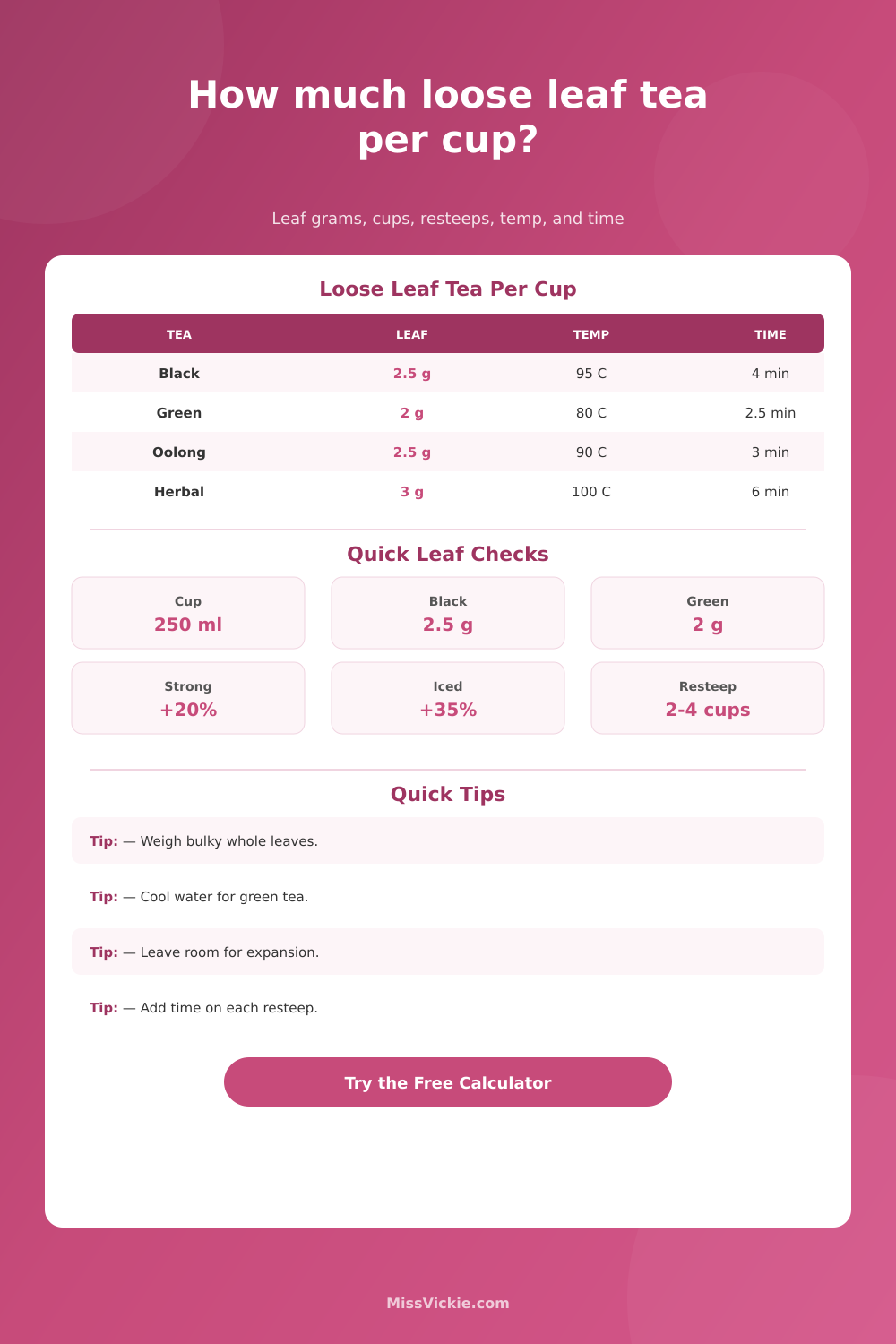
| Loose Tea Type | Balanced Leaf Rate | Approx Teaspoons | Water Temp | First Steep |
|---|---|---|---|---|
| Black tea | 2.5 g per 250 ml | 1 level tsp | 93 to 98°C | 3 to 5 min |
| Green tea | 2.0 g per 250 ml | 1 level tsp | 75 to 82°C | 2 to 3 min |
| White tea | 2.2 g per 250 ml | 1.5 to 2 tsp | 75 to 82°C | 4 to 5 min |
| Oolong tea | 2.5 g per 250 ml | 1.5 tsp | 85 to 92°C | 3 to 4 min |
| Herbal infusion | 3.0 g per 250 ml | 1.5 to 2 tsp | 96 to 100°C | 5 to 7 min |
| Rooibos | 3.0 g per 250 ml | 1.5 tsp | 96 to 100°C | 5 to 7 min |
| Chai blend | 3.5 g per 250 ml | 1.5 to 2 tsp | 96 to 100°C | 5 to 8 min |
| Pu-erh tea | 3.0 g per 250 ml | 1 to 1.5 tsp | 93 to 98°C | 2 to 4 min |
| Yerba mate | 4.0 g per 250 ml | 2 tsp | 75 to 85°C | 4 to 6 min |
| Finished Serving | Black Tea | Green Tea | Oolong Tea | Herbal Tea |
|---|---|---|---|---|
| 1 cup, 250 ml | 2.5 g, about 1 tsp | 2.0 g, about 1 tsp | 2.5 g, about 1.5 tsp | 3.0 g, about 2 tsp |
| 2 cups, 500 ml | 5.0 g, about 2 tsp | 4.0 g, about 2 tsp | 5.0 g, about 3 tsp | 6.0 g, about 4 tsp |
| 4 cups, 1 L | 10 g, about 4 tsp | 8 g, about 4 tsp | 10 g, about 6 tsp | 12 g, about 8 tsp |
| 8 cups, 2 L | 20 g, about 8 tsp | 16 g, about 8 tsp | 20 g, about 12 tsp | 24 g, about 16 tsp |
| 12 cups, 3 L | 30 g, about 12 tsp | 24 g, about 12 tsp | 30 g, about 18 tsp | 36 g, about 24 tsp |
| Leaf Style | Dry Spoon Density | Wet Expansion | Infuser Space Rule | Best Use |
|---|---|---|---|---|
| Standard loose leaf | 2.5 g per tsp | 2.2x dry volume | Leave at least half the basket open. | Everyday black, green, and blended teas. |
| Large whole leaf | 1.6 g per tsp | 2.8x dry volume | Use a wide basket or roomy pot. | White tea, long-leaf green, and premium black tea. |
| Rolled oolong | 2.0 g per tsp | 3.4x dry volume | Use extra space because leaves unfurl dramatically. | Multiple infusion oolong or small-pot sessions. |
| Broken leaf or CTC | 3.0 g per tsp | 1.6x dry volume | Fine mesh helps limit sediment. | Strong breakfast tea, chai, and milk tea. |
| Fluffy herbs or flowers | 1.2 g per tsp | 2.6x dry volume | Use a large infuser so herbs hydrate fully. | Chamomile, mint, hibiscus blends, and white tea. |
| Spiced blend | 2.2 g per tsp | 1.9x dry volume | Stir the dry blend before measuring. | Chai, citrus spice, and mixed herbal blends. |
🌱 Strength, Resteep, And Extraction Notes
Use less leaf and slightly shorter time for white, green, or late evening cups.
Everyday starting point before adjusting for cup size or personal taste.
Better for breakfast tea, milk tea, travel mugs, or bold black tea.
Extra leaf offsets ice dilution without stretching the steep until bitter.
💡 Loose Leaf Tea Tips
Tea figures are practical kitchen starting points. Water chemistry, leaf age, harvest style, cup shape, and personal taste can shift the ideal dose.
Ever pour boiling water over a heaping spoonful of loose leaf into your mug, only to have what results taste more like hot water with a hint of plant? Or worse, does it turn out bitter and astringent enough to leave your teeth feeling weird? Where most home brewers stumble is thinking all tea leaves is the same. They’re not.
One fluffy chamomile flower takes up a different amount of space when dry than a rolled oolong pearl. A rolled oolong pearl also doesn’t extract flavor at the same rate as broken black tea. And the thing that can make the difference between a good cup and a great one typically lives in the ratio of leaf to water. That’s a variable that shifts based off the vessel in your hand.
How to Make Good Tea
So how does it work? The calculator will do that math for you, but knowing the variables behind those numbers will make you a better brewer.
What’s the first variable? The first variable is the type of tea. For black teas, in general, you can use hotter water closer to boiling (sometimes as high as 212F). You can also use a larger dose of tea (two and a half grams per regular cup are common). Green teas are much more delicate. They require a lighter touch with the scoop and cooler water, typically around eighty degrees Celsius. Boiling water on green tea is like putting a pot over fire. You are literal cooking the leaves and extracting tannins before the tea has a chance to extract its aromatics.
So what’s the point of the temperature override? It’s not just about heat; it’s about chemical extraction.
And then there’s the type of leaf. Visual guesswork here isn’t doing anyone any favors. A teaspoon of whole white leaves will be much lighter than a teaspoon of finely ground black tea. The calculator account for this. Big leaves, especially when unbroken, expand when hydrated; therefore, you need more space in the infuser if using big leaves. Otherwise, it’ll be too crowded and the leaf won’t flow freely. They’ll extract unevenly. Fluffy herbs or tightly rolled oolongs may triple in size. When an infuser is too full at first, water cannot flow through. It all gets overextracted on the outside with nothing going on in the middle. This is a minor mechanical problem that determine the entire taste.
Another misconception has to do with strength. If you’re looking for a stronger cup, your gut reaction is often to steep longer. Wrong. Lengthening the brew almost always leads to bitterness and/or astringency in green and black tea particularly. Instead, increase the leaf dose while keeping the time consistent, which is what the tool models. A greater quantity of leaf provide additional surface area for the water to interact with, resulting in a strong flavor without the harsh edge.
This is particularly true for iced tea, where the ice dilutes the concentrate as it melts. To compensate, you need a stronger starting concentration, which is why the calculator increase the leaf ratio to make sure the finished product isn’t watery.
That all changes with resteepable teas. Pu-erhs and single-origin oolongs are designed to be steeped several times. The initial infusion uncovers the bright, higher notes. Later infusions expose other, deeper, sweet layers. The calculator estimates how many cup you can draw from a single batch of leaves. For the planner in you, it’s nice. You’ll know whether you have enough leaves for two rounds (if you’re entertaining), or if you should top up the pot. It turns a guess into a concrete plan.
And it’s all laid out nicely on the page with a reference table that shows the baseline for each one. But then we remember: tea isn’t instruction-following; tea is adaptation. Water chemistry matters. Mineral-heavy hard water can mute delicate flavors. Green tea tastes flat from mineral-heavy water. Sweetness comes from soft water. Altitude adjusts your boiling point, which impacts your temperature.
So: use the tool as a good start, a baseline of minutes and grams. Then tweak based on your water, your leaf, and your palate. At its core, making tea is a conversation between water and leaf. With the help of this calculator, you’re speaking their language appropriately; now all that’s left is for you to listen to what they are saying.
Taste that initial cup. Is it too bold? Is it thin? Okay, no need to adjust the clock next time, but maybe change the amount of leaf? Not by much, though. Attention is more important than precision. Use the calculated dose as your starting point, then trust the process and follow the flavor. Then tweak accordingly.
There’s no such thing as the perfect cup in a strict formula. It exists only in your desire to refine it.