
When you order a martini, you think you’re being reasonable when it comes to your waistline. It is smoother than sugary cocktail and lighter than beer. It is certainly more sophisticated. But remove the mixers, forget the marketing, and what do you discover? Alcohol, in its purest form, has a very simple truth: Seven calories per gram.
That means that nearly every calorie in your beverage originate from the ethanol itself. No need to fret over carb counts in straight vodka or whiskey. Here’s where things get tricky: Proof = Calories. The higher the proof, the more calories. It’s a linear relationship that most of us ignore…until we actualy lay out the numbers.
Alcohol Calories: What You Need to Know
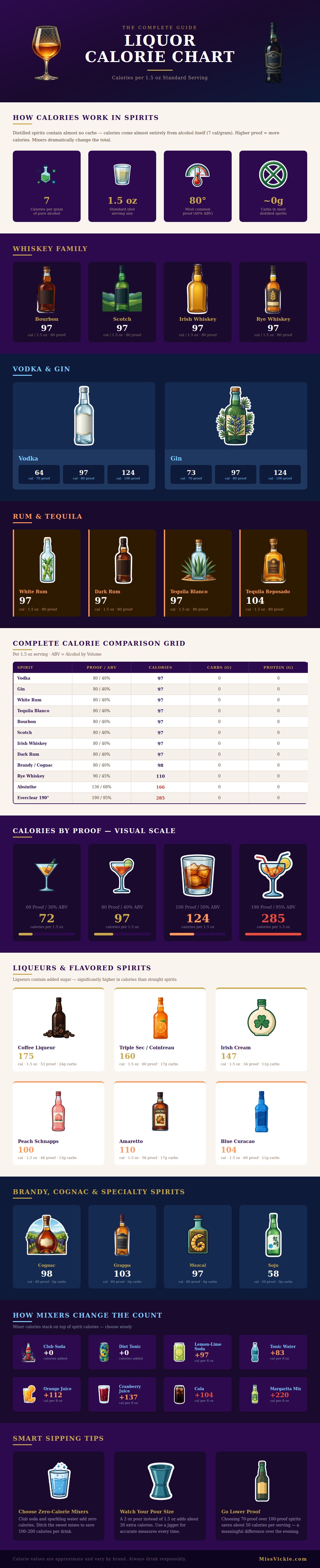
The chart above breaks this all down clearly. It shows that each one-and-a-half-ounce shot of an 80 proof spirit contain about ninety-seven calories. As long as ABV (alcohol by volume) is at forty percent; regardless of whether we’re talking about tequila, gin, rum, scotch, or bourbon (that number holds pretty steady). This is the main point. There’s no reason to fear the clear stuff in the vodka bottle more than the amber stuff in whiskey bottle. The color doesn’t matter: it’s just coming from additives or from aging. What matters is the amount of alcohol: that provides calorie load.
Switching from 80-proof spirits to 100-proof spirits, on the other hand, adds a real dose of energy to your night without altering quantity of booze you put into yourself. But here’s why that jump in proof actualy matters. If we increase that average shot from 80-proof to 100-proof, that same shot come out to roughly one hundred twenty-four calories. That may not seem like much on paper, but consider that during the course of a night you’re likely drinking three or four drinks and those additional twenty-seven calories begins to accumulate. As the infographic points out, the calories for an individual serve can get pushed into the three-hundred-calorie range when consuming extremely high-proof spirits such as 190-proof grain alcohol. No one drink this stuff straight, but it shows just how caloric ethanol is.
Diluting it with something like soda or water will lower the concentration. However, it does nothing to reduce overall calorie content of the original spirit, which is determined by its initial proof. And that’s often where the damage happens with calories: The cocktail itself. Sure, gin on its own is pretty clean. But pour it over ice with an eight-ounce can of regular tonic water, and you’ve just added eighty-three calories. Pour it into one of those sugary margarita mixes and now you’ve got two hundred twenty calories stacked on top of whatever booze are there.
That’s why the math starts getting ugly for most healthy-drinking type. They assume that because the booze has no carbs, everything else must be okay. Except the second they start mixing in regular sodas or other sugar-filled syrups and juices, all bets is off. If we’re talking about club soda, on the other hand, we’re talking zero. Nothing goes into the equation with club soda, except fizz and volume. That’s what folks forget: They’re fixated on bottle, not the pour beside it.
And then there’s an all-new category to be wary of: liqueurs. Liqueurs aren’t actually spirits like rum, whiskey, vodka, etc., but deserve special mention anyway. Because of their high sugar content, something like coffee liqueur may contain almost two-hundred calories per shot! Same goes for Irish cream, which has lots of fat and carbs on top of its creamy appearance and will add more calories then you’d think just by looking at it. Consider them flavorings to your cocktails instead of a primary spirit if you’re watching what you eat… In other words, don’t use ’em as a base when keeping track. That’s why the graphic breaks them out visually; it highlights how those extra sugars completely alter nutritional landscape.
When it comes to smart sipping, you’re only as good as variables you control. With a little research, you can find lower-proof bottles with minimal compromise on flavor/experience. By measuring your pours accurately (instead of guessing), you can get rid of oversized portions. Finally, and perhaps most critically; you can use unsweetened mixers and keep things as simple as possible. The objective isn’t to take away the fun, it’s simply to be aware of what you put into your body so that when you wake up the next morning, you don’t feel like a total mystery happened the night before.
Knowing the numbers makes it easier to make smarter decisions. It’s more about being aware than restricting. Reduce the weight of the mixer, reduce the proof, and realize that booze has its own weight. Your liver may prefer that you never saw the chart, but your body will appreciate the clarity.