How Much Liquid Pectin for Jam Calculator
Estimate liquid pectin pouches, fluid ounces, milliliters, teaspoons, jar yield, and batch risk using your fruit, sugar ratio, acidity, target set, and prepared fruit volume.
Choose a real jam style to load a starting point, then adjust fruit, sugar, lemon juice, and pouch size to match your recipe.
Liquid Pectin Breakdown
| Fruit or Base | Natural Pectin | Typical Prepared Fruit | Typical Sugar | Liquid Pectin Start | Acid Note |
|---|---|---|---|---|---|
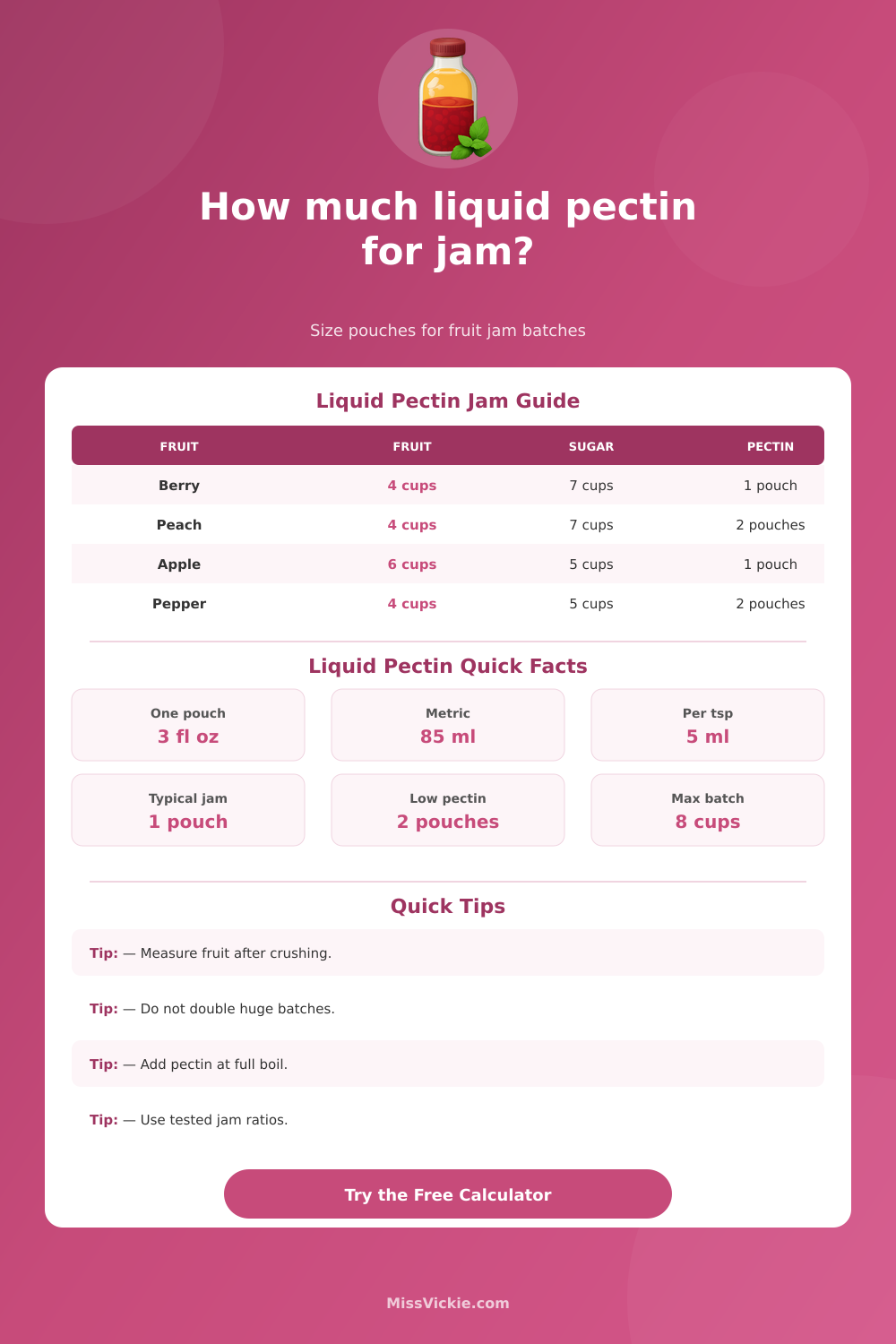
| Strawberry | Low | 4 cups crushed | 7 cups | 1 pouch | Often 2 tbsp lemon |
| Raspberry or blackberry | Medium | 4 cups crushed | 6.5 to 7 cups | 1 pouch | Usually sets readily |
| Blueberry | Low to medium | 4 cups crushed | 7 cups | 1 pouch | Lemon helps clarity |
| Peach or nectarine | Low | 4 cups chopped | 7 cups | 2 pouches | Needs reliable acid |
| Apricot | Medium | 4 cups chopped | 6 to 7 cups | 1 to 2 pouches | Varies by ripeness |
| Plum or damson | Medium to high | 4 cups chopped | 6 cups | 1 pouch | Tart plums need less help |
| Apple or crabapple | High | 6 cups juice or pulp | 5 cups | 1 pouch | Natural pectin supports set |
| Pepper jelly base | Very low | 4 cups liquid base | 5 cups | 2 pouches | Vinegar supplies acid |
| Liquid Pectin | Fluid Ounces | Milliliters | Teaspoons | Tablespoons | Use Case |
|---|---|---|---|---|---|
| 1/4 pouch | 0.75 fl oz | 22 ml | 4.5 tsp | 1.5 tbsp | Small test batch |
| 1/2 pouch | 1.5 fl oz | 44 ml | 9 tsp | 3 tbsp | Half batch |
| 1 pouch | 3 fl oz | 89 ml | 18 tsp | 6 tbsp | Most classic jams |
| 1 1/2 pouches | 4.5 fl oz | 133 ml | 27 tsp | 9 tbsp | Large low-pectin fruit |
| 2 pouches | 6 fl oz | 177 ml | 36 tsp | 12 tbsp | Peach or pepper jelly |
| 3 pouches | 9 fl oz | 266 ml | 54 tsp | 18 tbsp | Split into batches |
| Jam Situation | Sugar per Fruit Cup | Lemon or Acid Cue | Pectin Adjustment | Calculator Signal |
|---|---|---|---|---|
| Classic berry jam | 1.5 to 1.8 cups | 0 to 0.5 tbsp lemon | Base ratio | Good |
| Peach or apricot jam | 1.6 to 1.9 cups | 0.5 tbsp lemon per cup | Add 10 to 30% | Watch acid |
| Low sugar trial | 0.7 to 1.2 cups | Follow special recipe | Not a direct swap | Risky |
| Jelly from juice | 0.75 to 1 cup | Depends on juice pH | Fruit-specific | Check recipe |
| Pepper jelly | 1.1 to 1.4 cups | Vinegar base required | Often 2 pouches | Acid-driven |
Best for 4 cups prepared berries with about 7 cups sugar.
Peach, pepper, and some apricot batches often need more.
Use a low-sugar liquid pectin recipe instead of guessing.
Big jam batches set more reliably when cooked separately.
| Prepared Fruit | Sugar Range | Liquid Pectin | Approx Cooked Jam | Half-Pint Jars |
|---|---|---|---|---|
| 2 cups | 3 to 3.5 cups | 1/2 pouch | 3.5 cups | 3 to 4 |
| 3 cups | 4.5 to 5.5 cups | 3/4 pouch | 5.3 cups | 5 to 6 |
| 4 cups | 6 to 7 cups | 1 pouch | 7 cups | 7 to 8 |
| 5 cups | 7.5 to 9 cups | 1.25 pouches | 8.8 cups | 8 to 9 |
| 6 cups | 9 to 10.5 cups | 1.5 pouches | 10.5 cups | 10 to 11 |
| 8 cups | 12 to 14 cups | 2 pouches | 14 cups | 14 to 15 |
Liquid pectin is the ingredient in the jam-making process that cause the fruit and sugar to become jam and allow the jam to hold its shape on the spoon. To make jam successfully with the liquid pectin, you need to use a correct amount of liquid pectin. The amount of liquid pectin you need to use will depend on the amount of the fruit, the amount of sugar, and the amount of acid in the jam.
To calculate the correct amount of liquid pectin for your jam recipe, you can use the calculator on this page that will ask for the type of fruit you will use, the ratio of sugar to the fruit, the amount of lemon juice, and the batch size of jam you will make. Using this calculator will remove the guesswork of how much liquid pectin to use in the jam-making process. The calculator will ensure that the jam that you make will be the perfect amount of jam that will not be too runny or too hard to eat.
How to Calculate Liquid Pectin for Jam
Many people will begin the jam-making process by using a recipe from a book or an internet. However, the recipe may not use the same type of fruit as the jam you will make. The type of fruit you use will change the amount of liquid pectin you need to use.
Berries contain alot of natural pectin but release their liquid quick when making jam. Fruits like peaches and apricots contain very little natural pectin. For instance, four cups of strawberries will require one pouch of liquid pectin, but four cups of peaches may require two pouches of liquid pectin.
The calculator will account for the type of fruit you use to cook your jam because you want to use the amount of liquid pectin that reflect the ingredients that you are using. Sugar is used in the jam-making process to allow the liquid pectin to thicken to form a gel that will hold the fruit pieces in the jam. If you cook jam with less sugar than the recipe suggests, the liquid pectin will still create jam, but the jam will not hold as well.
The calculator will show you the ratio of sugar to the fruit you will use. Many people will reduce the amount of sugar in their jam recipe for health reasons. However, if you use less sugar than the recipe indicates, you will need to use less liquid pectin.
Another ingredient that is important to the jam-making process is acid. The acid will help the liquid pectin to form the gel that hold the jam together. Lemon juice does two thing for the jam-making process; it lowers the pH levels in the jam and it brightens the flavor of the fruit.
Fruits that are low in acid, such as peaches, will require the addition of lemon juice throughout the jam-making process. Fruits high in acid, such as raspberries or plums, will require less lemon juice. The calculator will ask for the amount of lemon juice you will use in the jam-making process.
The calculator will adjust the amount of liquid pectin that you must use if the level of acid in the jam is too low. Some people will skip this step because they will taste the jam and find that it is acidic enough. However, you must ensure that the level of acid in the jam is the correct level so that the liquid pectin can perform its function.
The batch size of jam you will make affects the way that the liquid pectin will work in the jam-making pot. If you are making a small batch, such as a pot that holds two cups of jam, you do not have to worry about the liquid pectin dispersing even throughout the batch. However, if you are making a large batch of jam, it is likely that the liquid pectin will not reach the right temperature in your jam-making pot.
If you use more than eight cups of fruit in your jam recipe, the calculator will allow you to see a warning message that states that you should split your jam recipe into smaller batches. On this page are the reference tables for the amount of liquid pectin for different type of fruits. These tables are not a replacement for the jam calculator.
However, they do allow you to see why some fruits require more liquid pectin than others. If you understand the reference tables, you will find that using the jam calculator will be faster because you will know the amount of liquid pectin that different type of fruits require. Another factor that will influence the amount of liquid pectin you will use is the cook-down percentage.
The longer the jam simmers, the more water will evaporate from the jam. The evaporated water will allow the pectin to thicken the jam further. The calculator will ask you whether you would like the jam to boil for a light time, a normal time, or a long time.
This will allow the calculator to estimate how many jam jar you will fill with your jam. You may know how many jam jars you would like to fill when you start the jam-making process. The calculator will ensure that the amount of jam you make will provide enough jam to fill these jars without having the liquid pectin and sugar evaporate too much from the jam.
Other than the jam recipe and the amount of jam you want to make, other variables will not change the outcome of the jam-making process. The different brand of liquid pectin may change the outcome of the jam. However, the ratio of the liquid pectin to the jam will be the same regardless of the brand you use.
To ensure your jam set, you should taste your jam. A small spoonful of jam placed on a cold plate will allow you to determine whether or not the liquid pectin performed its function of making the jam. In creating this jam calculator, the intention is to allow people to focus on the parts of the jam-making process that requires human judgment.
While the calculator can determine the amount of measurable ingredient for jam, the human maker must provide the unmeasurable ingredients. If people understand the measurable ingredients and keep them in the proper proportions to the other ingredients, the unmeasurable ingredient will not cause jam in the jam-making process. As people use the jam calculator several times, they will become more understanding of the variables in the jam-making process.
For instance, if someone finds that the fruits that require more liquid pectin also require more lemon juice, they will understand the role of lemon juice in the jam-making process. Additionally, if the person understands that the sugar ratio impacts the amount of liquid pectin needed, they will understand the role of sugar in the jam-making process. These understandings will allow people to make their jams successfully before putting the jam into the jam jars.
When people begin to understand the roles of each ingredient in the jam-making process, the jam calculator will become a helpful tool for people to use to create jams that will hold their shape when placed onto a spoon.