
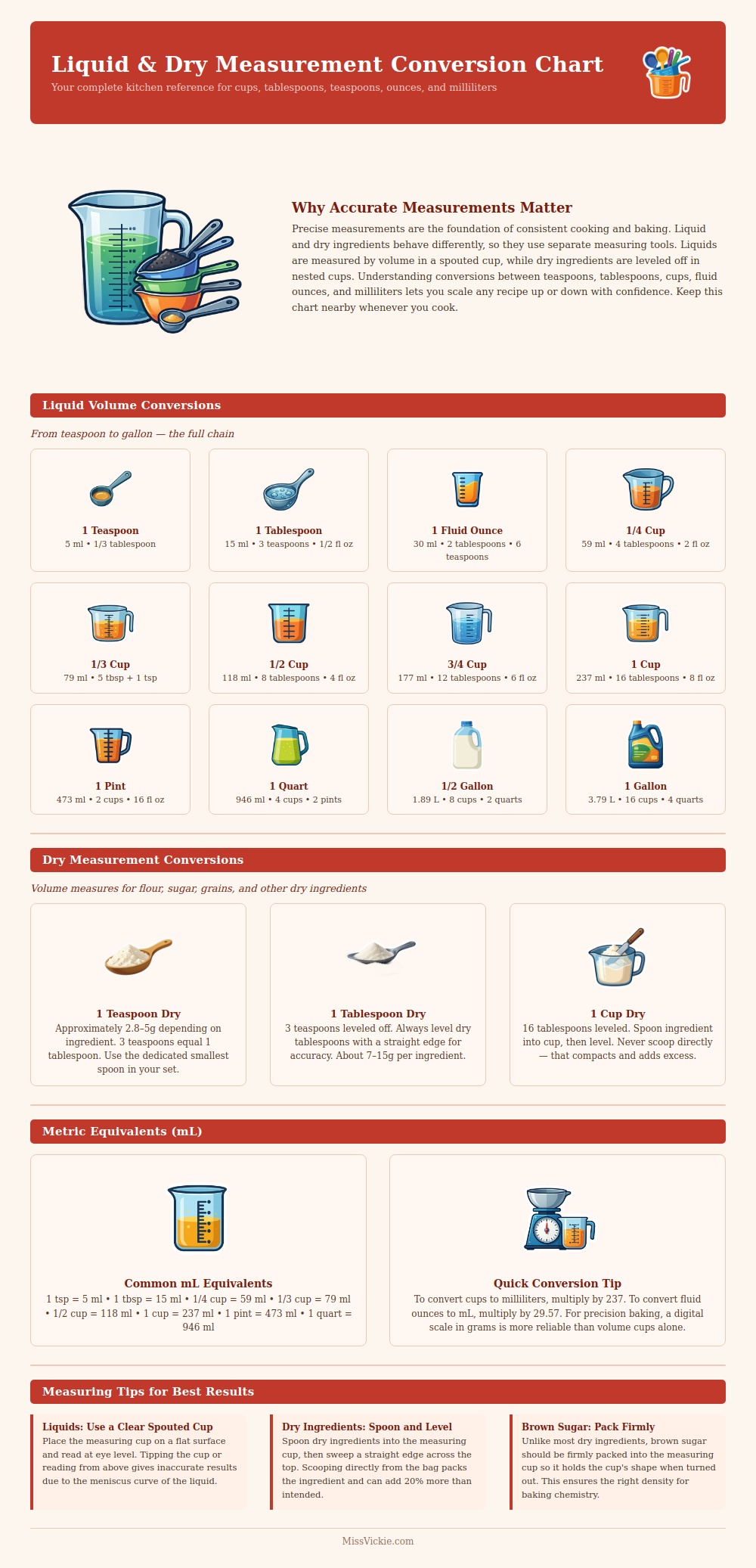
Measuring ingredients correctly are necessary in the kitchen, as incorrect measurements will cause recipes to fail. Incorrect measurements will cause teh food prepared to have the wrong texture. For instance, using the wrong amount of baking powder for a cake will cause the cake to sink.
This issue arise because liquids and dry ingredient have different ways of reacting to cooking tools. Each ingredient category requires a particular technique for measuring the ingredient to ensure accuracy in the recipe. Liquid ingredients use volume measurements when cooking and baking.
How to Measure Wet and Dry Ingredients Correctly
To measure liquid ingredients, use clear measuring containers so the person measuring can view the liquid ingredient. Place the measuring container on a flat surface and read the measurement line on the side of the measuring container at eye level. Reading the measurement line above the measuring container will provide an inaccurate measurement of the liquid ingredient.
The surface of the liquid forms a curve, called a meniscus. Read the measurement line at the center of the meniscus at eye level. Use a conversion chart to assist in measuring teaspoons to tablespoons, tablespoons to cups, and cups to pints, quarts, and gallons.
Dry ingredients is measured differently from liquid ingredients. Dry ingredients can be packed or aerated. When measuring dry ingredients, the way the dry ingredient is packed into the measuring cup will change the weight of that ingredient.
For instance, if you scoop flour directly from a bag of flour, the weight of that flour will be more then if the flour was aerated. The texture of the recipe will change if the dry ingredient is packed. To measure dry ingredients, spoon the ingredient into a dry measuring cup and level the dry ingredient with a straight edge.
Leveling the dry ingredient will remove the guesswork of how much of the dry ingredient was used. Leveling the dry ingredient will ensure consistency in the amount of dry ingredient measured. Brown sugar is a dry ingredient but is different than ingredients like flour.
To measure brown sugar, pack the brown sugar into the measuring cup firmly. Tablespoons and teaspoons are used to measure both wet and dry ingredients. This is suitable for measuring small amounts of ingredients.
As the amount of ingredient increases, the difference in the ingredient within a tablespoon will make a difference in how the ingredient is measured. For instance, a tablespoon of honey will sit differently within the measuring cup than a tablespoon of granulated sugar. The volume of both ingredients is the same, though.
You can use a conversion chart to convert ingredients with similar volume measurements. Another way to measure ingredients is through metric measurements. Many recipes will use milliliters instead of cups.
One teaspoon is equivalent to five milliliters. One tablespoon is equivalent to fifteen milliliters. One cup is equivalent to two hundred thirty-seven milliliters.
A conversion chart can be used to convert between milliliters and cups. The same conversion chart can be used to convert between milliliters and ounces. Weighing ingredients on a digital scale and measuring the ingredient in grams is another accepted method.
Gram measurements are of the weight of the ingredient instead of volume. Using a digital scale removes the issue of packing dry ingredients into the measuring cup. The weight of the ingredient in grams will remain the same regardless of how well packed the ingredient is within the digital scale.
Some common mistakes in measuring ingredients include reading the measurements on the measuring cup while holding it in one’s hand. Holding the measuring cup will tilt the measuring cup, leading to an inaccurate measurement. Another mistake is scooping dry ingredients like flour directly from the bag into the measuring cup.
Packed flour will weigh more than dry, aerated flour. Using a dry measuring cup to measure liquid ingredients like oil will leave a film of oil inside the dry measuring cup. This will make it difficult to accurately measure the amount of liquid ingredient poured into the dry measuring cup.
Having a measurement chart next to you while following the recipe will prove helpful. A measurement chart will prevent the preparation of food from requiring mental arithmetic from the cook. Using a measurement chart will allow the cook to quickly determine that four tablespoons is equivalent to a quarter cup.
Using a measurement chart will allow the cook to easily recognize that two cups of ingredient is equivalent to one pint. This measurement chart will remove the friction in mentally calculating conversions between units of measure. A measurement chart will assist in avoiding calculation errors when cooking a recipe that requires doubling or halving the ingredients listed.
Understanding the relationship between different units of measure will allow a cook to easily move between recipes that list ingredients in cups and recipes that list ingredients in grams.