🍋 Fresh lime count, weight, juice, zest, cups, and recipe coverage
Lime Juice Yield Calculator
Estimate lime juice from Persian, Key, Bearss, Mexican, Rangpur, makrut, sweet, or finger limes with size, squeezing method, room temp, pulp level, recipe use, and zest use.
Choose a common kitchen or bar use, then adjust the lime type, size, temperature, pulp, and zest settings.
Fresh lime yield estimate
Your lime juice estimate updates as inputs change.
Lime Yield Breakdown
All-purpose lime for bars, marinades, and weeknight cooking.
Small, aromatic, and tart; expect many limes per cup.
Large Persian-style fruit with strong juice return.
Small fruit, great aroma, lower juice per lime.
Orange-tinted sour juice for drinks and chutneys.
Leaves and peel are prized more than juice.
Milder acid and more juice from larger fruit.
Used for pearls and garnish, not bulk juice.
| Lime type | Average weight | Juice per lime | Limes per cup | Best use |
|---|---|---|---|---|
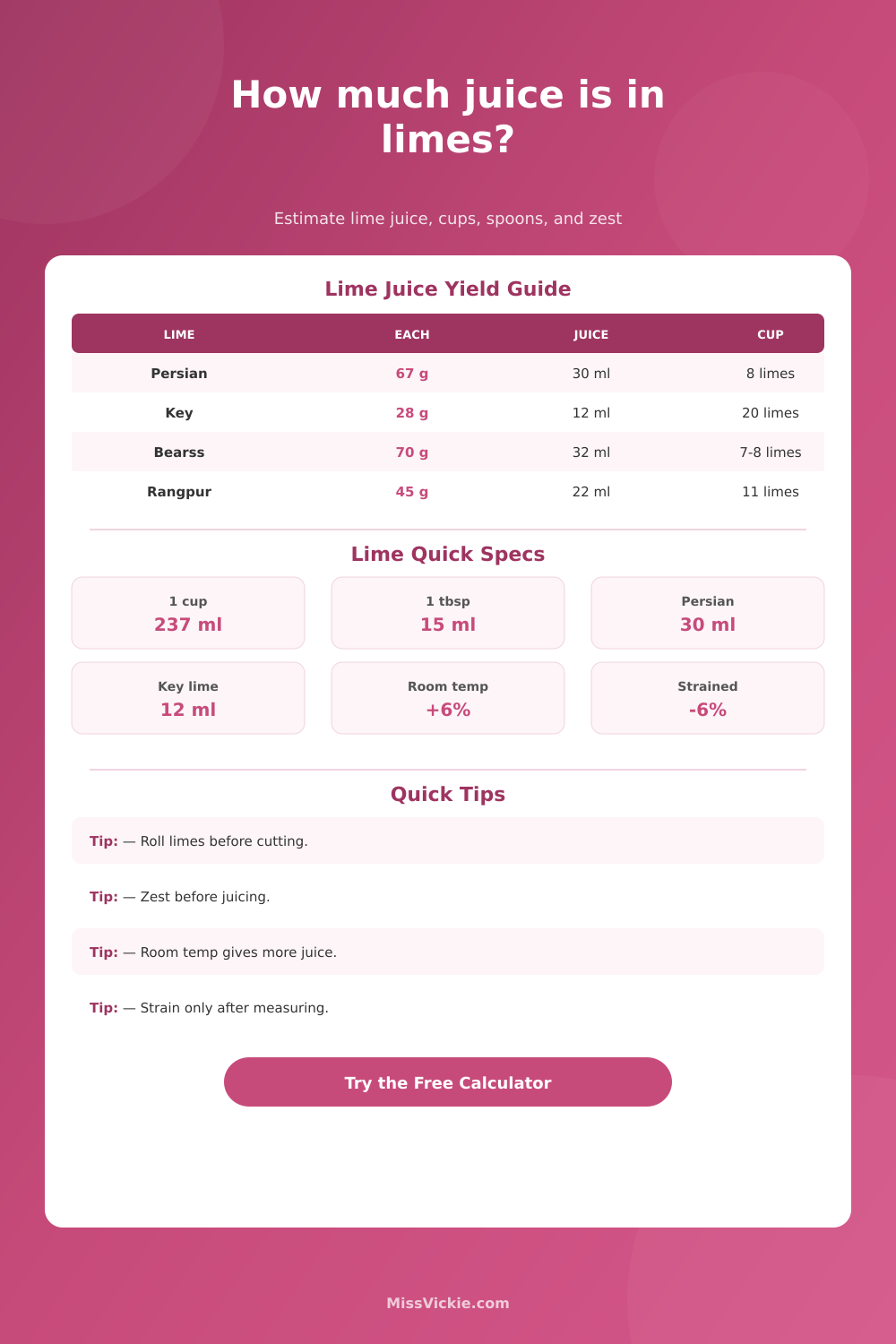
| Persian or Tahiti | 67 g / 2.4 oz | 30 ml / 2 tbsp | 8 limes | Margaritas, salsa, marinades |
| Key or Mexican | 28 g / 1 oz | 12 ml / 0.8 tbsp | 20 limes | Pie, curd, high-aroma juice |
| Bearss | 70 g / 2.5 oz | 32 ml / 2.2 tbsp | 7 to 8 limes | Bar prep and batch cooking |
| Small Mexican | 25 g / 0.9 oz | 10 ml / 0.7 tbsp | 24 limes | Tacos, garnish wedges, salsa |
| Rangpur | 45 g / 1.6 oz | 22 ml / 1.5 tbsp | 11 limes | Chutney, drinks, sour sauces |
| Makrut | 35 g / 1.2 oz | 5 ml / 1 tsp | 47 limes | Peel aroma and curry pastes |
| Sweet lime | 90 g / 3.2 oz | 40 ml / 2.7 tbsp | 6 limes | Gentle drinks and citrus salads |
| Finger lime | 18 g / 0.6 oz | 3 ml / 0.2 tbsp | 79 limes | Garnish pearls and finishing |
| Juicing method | Yield factor | Best for | Kitchen note |
|---|---|---|---|
| Hand squeeze only | 82% | Quick wedges | Fast, but juice stays in membranes. |
| Manual reamer | 94% | Home prep | Good extraction with a little pulp. |
| Hinged citrus press | 100% | Daily cooking | Reliable baseline for halved limes. |
| Electric citrus press | 106% | Large batches | Good for cups of juice at a time. |
| Bar press with firm roll | 110% | Cocktail service | Rolling first loosens juice cells. |
| Recipe use | Planning amount | Common target | Useful yield check |
|---|---|---|---|
| Margaritas or daiquiris | 22 ml per drink | 6 to 12 drinks | 1 cup covers about 10 cocktails. |
| Mojitos | 15 ml per drink | 8 to 16 drinks | 1 cup covers about 16 mojitos. |
| Key lime pie | 120 ml per pie | 1 to 2 pies | One pie uses about 1/2 cup. |
| Ceviche | 30 ml per serving | 4 to 8 servings | Use enough juice to coat evenly. |
| Guacamole | 15 ml per bowl | 1 to 4 bowls | Add more only after tasting. |
| Marinade | 60 ml per batch | 1 to 3 batches | Keep acid balanced with oil. |
| Agua fresca or limeade | 120 ml per pitcher | 1 to 4 pitchers | Adjust sugar after chilling. |
| Freezer juice cubes | 15 ml per cube | Any batch | Freeze in tablespoon portions. |
| Batch goal | Persian limes | Key limes | Juice volume | Spoon amount |
|---|---|---|---|---|
| Small sauce | 2 limes | 5 limes | 60 ml / 2 fl oz | 4 tbsp |
| Half cup | 4 limes | 10 limes | 120 ml / 4 fl oz | 8 tbsp |
| One cup | 8 limes | 20 limes | 237 ml / 8 fl oz | 16 tbsp |
| Quart prep | 32 limes | 79 limes | 946 ml / 32 fl oz | 64 tbsp |
Fresh lime yield varies with variety, age, storage, size, and pressure. Use the calculator as a planning estimate, then measure finished juice for exact baking or preserving.
It’s one of those moments that makes you think maybe you’re doing something wrong: The recipe calls for half a cup of fresh lime juice and you’ve got four limes between your finger. It’s not big enough to derail the cooking process, but it’s there all the same. It is a tiny doubt, one that prevent you from proceeding with the meal. You slice the fruit in half and squeeze your knuckles raw, yet here are two tablespoon where the recipe demanded eight.
The trouble isn’t you. It’s always the fruit. Not all limes is created equal. Some are as small and fragrant as marbles (the kind sold at specialty market). Others are heavy and dripping with water (those you find at supermarkets, typicaly called Persian limes). Different limes will behave different, and thinking they won’t is to do them a disservice.
How to Get More Juice from Limes
After choosing your lime size and type, the site’s handy calculator does all of the math for you. You won’t have to guess whether a bunch of green fruits will provide enough juice for margarita hour. To get best results, use correct inputs. Instead of merely counting number of limes, this tool requires you to input information like temperature and whether you zest before or after squeezing. After?), etc.
Because it’s responsive to physics, lime juice isn’t constant. Tighter cell walls restrict its flow, so if you have a cold lime you’ll get less. However, you can improve your yield up to almost ten percent by letting it rest in some warm water, or by setting it out at room temperature for awhile. It’s a tiny tweak with a big reward: More juice without needing to buy additional fruit.
The main variables is how much juice will come out. Some factors matter a lot. For example, size and variety do. An average Persian lime will give you roughly two tablespoons; Key limes gives barely half that. You’ll need twenty Key limes to make one cup, remember that if you’re planning on baking a Key lime pie. And that’s just from those little suckers. This chart on the page shows the number of limes required per target volume goal (for various kind).
Peel thickness also matters. You want to avoid wasting time peeling larger limes because their thicker membranes makes juicing more difficult, unless you have some kind of press. Ditto with hand-squeezing versus an electric press or a heavy hinged-lever tool, which is best suited for marinade at parties, etc. Closer to maximum juice yield is what we’re going for here.
It turns out that for most recipes zesting order does matter. For example, most instructions says “zest before juicing” since the zest has volatile fragrant oils in it. When you cut open the lime, some of the aroma evaporates off into the air or combines with the bitter white pith of the fruit. If you zest the whole thing, the fragrance stays confined. And the lime will be firmer, making it easier to work with.
If you expect to take a particularly generous pinch of zest, the calculator takes that into account and reduces its estimate of how much juice might result. The adjustment is small… But those lost teaspoons can add up when multiplying by ten for a pie recipe.
The other thing to consider is the pulp level. Do you want a clear, bright liquid (good for sauces or delicate drinks when you care about texture) or do you want it more cloudy with some body (good for casual salsas or margaritas)? While pulp affects the texture, it does have volume and weight. You may pour out a cup of juice and notice it’s smaller than what came out of pulpy side. However, the amount of actual liquid in both containers will likely be the same.
To match your desired outcome with the result in the bowl, you need to know how to set things correctly. The takeaway: Controlling expectations is the name of the game when planning what to buy. A dried-out lime isn’t going to give you anything beyond what’s already inside. But you can get it warm, find out which lime is best for your needs, pick the proper tool, and also determine how many are necessary, depending on their variety.
Which transforms your guesswork into math. No more fumbling with your fingers when a recipe calls for freshly squeezed citrus. You’ll always know just how many limes you should of buy and how to most effectively get all that juice. You’ll even know where that elusive extra tablespoon might be hiding in a warmer kitchen. That kind of confidence transforms the experience, taking the juice from variable to dependable element.