Lentil Water Ratio Calculator
Calculate lentil water by lentil type, dry amount, desired texture, soaking and rinsing, cooking method, salting timing, soup or salad use, and cooked yield.
🍲 Lentil Cooking Presets
Choose a real lentil batch, then adjust the type, texture, liquid style, soak, salt timing, cooking method, and final serving plan.
⚖ Lentil and Water Details
Brown lentil water plan
Use the calculator to size dry lentils, added liquid, cooked yield, and texture.
Water Breakdown
Cooking Plan
Simmer gently, check early, and drain extra water for salad lentils.
📏 Common Lentil Ratio Grid
📋 Lentil Water and Yield Table
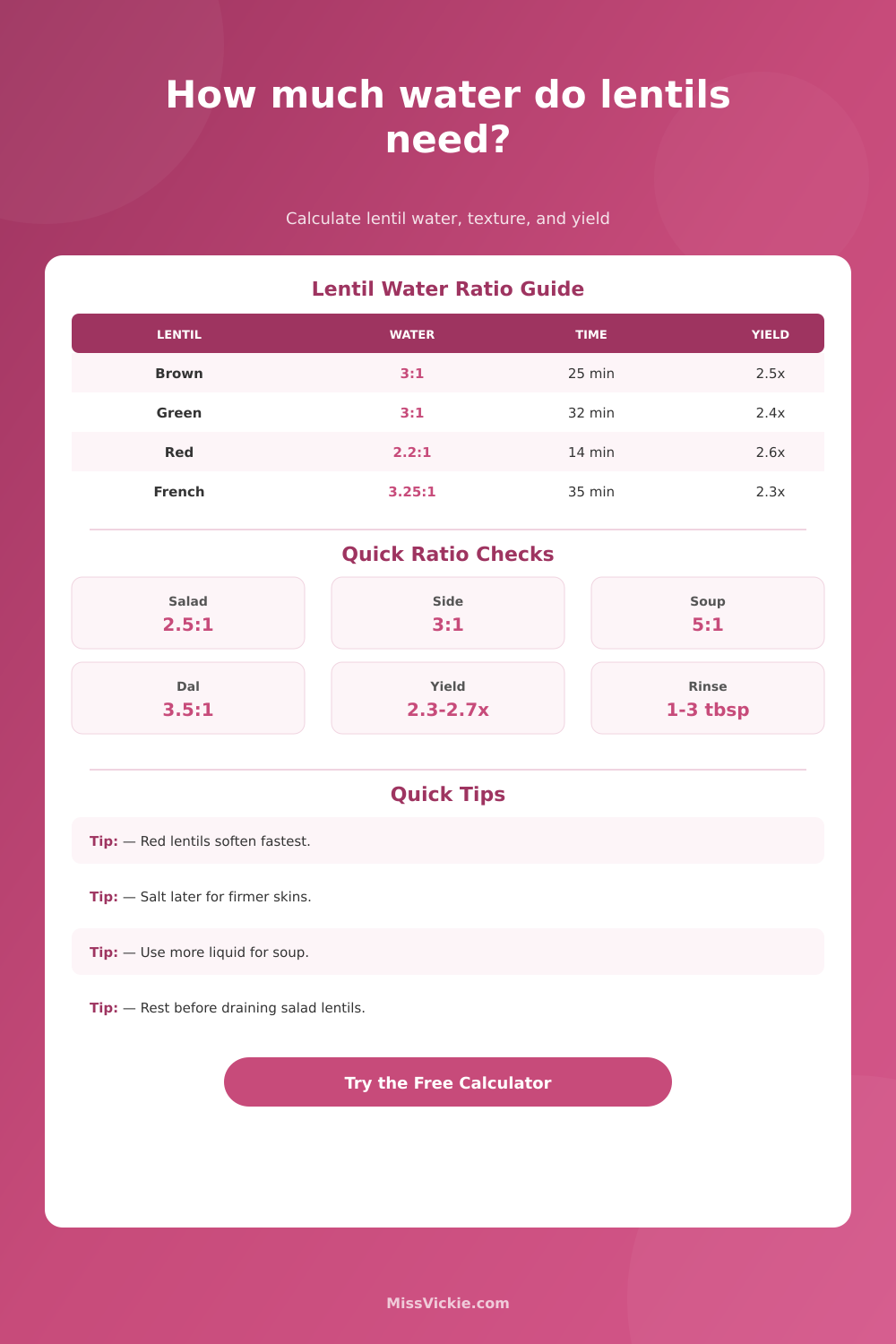
| Lentil Type | Best Use | Base Water Ratio | Typical Time | Cooked Yield |
|---|---|---|---|---|
| Brown lentils | Everyday side dishes, soup, meal prep | About 3 cups water per 1 cup dry | 22 to 28 minutes | About 2 1/2 cups cooked |
| Green lentils | Bowls, stews, and sturdy side dishes | About 3 cups water per 1 cup dry | 28 to 36 minutes | About 2 1/3 to 2 1/2 cups cooked |
| French green lentils | Firm salads and warm lentil plates | About 3 1/4 cups water per 1 cup dry | 30 to 40 minutes | About 2 1/4 to 2 1/3 cups cooked |
| Black beluga lentils | Firm salads, grain bowls, and garnish | About 3 cups water per 1 cup dry | 25 to 32 minutes | About 2 1/4 cups cooked |
| Split red lentils | Dal, puree, thick soups, sauces | About 2 to 2 1/2 cups water per 1 cup dry | 10 to 16 minutes | About 2 2/3 cups soft cooked |
| Split yellow lentils | Dal, soup, puree, pressure cooking | About 2 1/4 to 2 3/4 cups water per 1 cup dry | 14 to 22 minutes | About 2 2/3 cups soft cooked |
🥣 Dry Lentils to Cooked Yield
| Dry Lentils | Firm Salad Water | Tender Side Water | Soup Liquid | Cooked Yield |
|---|---|---|---|---|
| 1/2 cup dry | 1 1/4 cups before drain | 1 1/2 cups before rinse credit | 2 1/2 cups or more | About 1 1/4 cups cooked |
| 1 cup dry | 2 1/2 cups before drain | 3 cups before rinse credit | 5 cups or more | About 2 1/4 to 2 2/3 cups cooked |
| 1 1/2 cups dry | 3 3/4 cups before drain | 4 1/2 cups before rinse credit | 7 1/2 cups or more | About 3 1/2 to 4 cups cooked |
| 2 cups dry | 5 cups before drain | 6 cups before rinse credit | 10 cups or more | About 4 1/2 to 5 1/3 cups cooked |
| 4 cups dry | 10 cups before drain | 12 cups before rinse credit | 20 cups or more | About 9 to 10 2/3 cups cooked |
🍽 Serving Size Reference
Works beside rice, meat, vegetables, or several other dishes.
A comfortable cooked portion for dinner plates and meal prep.
Useful for warm bowls, salads with toppings, and packed lunches.
Includes broth, vegetables, and lentils in the finished serving.
💡 Lentil Ratio Notes
This calculator estimates practical kitchen ratios for dried lentils. Age, brand, pan width, lid fit, burner strength, soaking time, and added vegetables can change the final water need.
You need a bowl, some dry brown lentils, and one cup. How much water do you put in it? Too little, and you get crunchy, un-softening, lentils. Too much, and it’s a slurry of water and slop.
It happens all the time: People think all lentil are the same thing. And they’re not. They has different physical properties. But how do I know what type of lentil and which texture? The calculator does that math, up top. And it’s not just because cooking is easier when you know the number: It’s because knowing the reason behind those numbers make you a better cook.
Why Lentil Ratios Are Important
First, the type: Some, like split red, break down fast. Cook them as if they’re hearty brown ones and they’ll turn to mush. Dense, firm whole French or green (Puy) lentils stays intact. They require a bit more water and time to soften that tough outer layer. Generally a 2.2 to 1 ratio for split lentils. For whole ones, the ratio is sometimes even 3 to 1 or more. That alone alter the timeline of the meal.
And there’s texture, too: Maybe you desire creamy lentils in your dal and firmer ones for your salad. That’s where home cooks gets hung up. Separate, distinct lentil work best in salads. Thickening, breaking-down lentils is best in dal. For this reason, the calculator will adjust amount of water. A creamy choice increases the volume; a firm one decreases it. The amount of water matter just as much for the structure. Fewer ounces mean less water needs to be boiled off to concentrate flavors. And it means less wiggle room when you leave the stovetop unattended.
Salt timing matters. Whole lentils will get toughened skin if added to begin with. They may go too long and stay firmer then desired. Salt added at midway point (or later) will make sure they softens evenly. The variable is accounted for by the tool. It just requires a bit of adjustment to water absorbed or cooking time. Not a huge change, but when every minute counts, those additional minutes accumulates.
And… it all depends on how you cook them. If sealed inside a pressure cooker, the steam stays contained. You need less added water because none gets out. If cooking slowly, in a cooker with a loose lid, steam escapes. Then you want to have a buffer of water. If cooking in an Instant Pot, the ratio go down. If cooking in a big pan without a lid on top, the ratio goes up. That’s why the calculator asks what kind of heat/what kind of lid you’re using.
Or maybe soak it? It is not as necessary with lentils as it is with beans. Quick soaking, or even just rinsing, does something: it hydrates that outer layer and shaves time off cooking. You require less water overall. You’re closer to the finish line. And if they’ve been soaked, then you’ll need less water; no watery side dish here. The tool subtracts what’s subtracted: pre-hydrated before adding water.
Then there’s yield. Cooked, one cup of dry lentils will triple in size (ish). That is a general rule, though different types varies. Red lentils will expand more than French lentils. And how many servings can you expect? You’re making something for a group, do you have two cups or three going into the pot? The calculator provides an estimate of the cooked yield based off what you input. This helps you plan your side dishes. It always helps to know you have enough food before beginning.
It’s all about the heat and the water. And it’s not really a recipe; there’s no hard-and-fast method for cooking lentils. It’s more like guiding them into gelling their starchy goodness without leeching out the flavor along the way. The tool sets you on a path. Your sense of taste and touch guide you home. Believe in the ratio, but keep an eye on the pot.
Success is when the lentils feel tender and the broth has reached the level you prefer. That’s where most folks go wrong. It’s not all numbers. It’s not all about math. It’s about the mouthfeel. You should of used a calculator to be sure.