Lemon Juice Per Quart Of Tomatoes Canning Calculator
Calculate bottled lemon juice, citric acid, jar yield, tomato pounds, headspace, and a safety margin for canning tomatoes in pints, quarts, or mixed jar batches.
Choose a common batch, then adjust jar count, jar size, pack style, acid option, tomato pounds, altitude note, headspace, and safety margin.
Your Tomato Canning Acid Plan
Calculated acid amounts will appear here.
Acid Breakdown
Safety And Processing Notes
| Jar Size | Bottled Lemon Juice | Citric Acid | 5 Percent Vinegar |
|---|---|---|---|
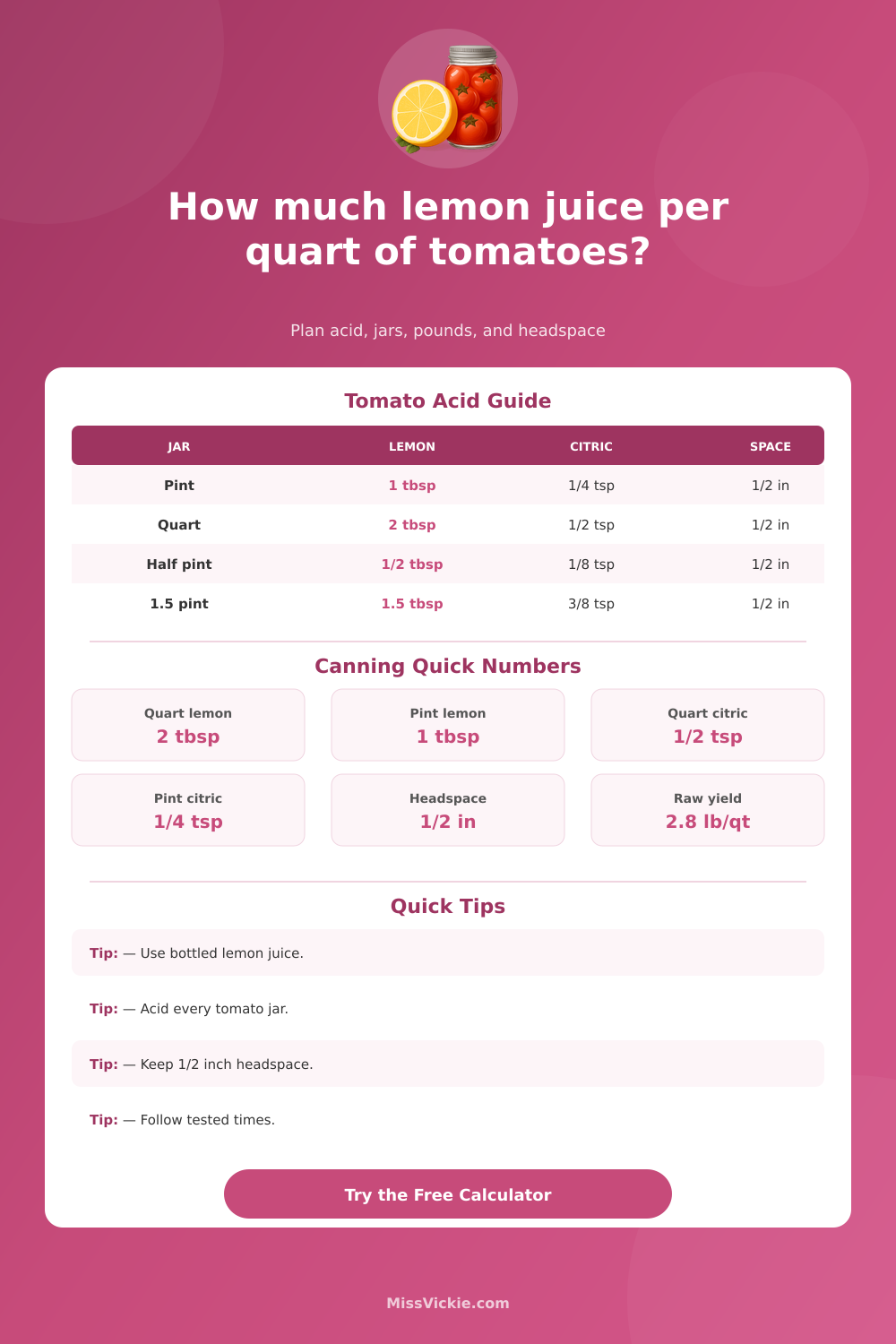
| Half pint | 1/2 tablespoon | 1/8 teaspoon | 1 tablespoon |
| Pint | 1 tablespoon | 1/4 teaspoon | 2 tablespoons |
| 1.5 pint | 1 1/2 tablespoons | 3/8 teaspoon | 3 tablespoons |
| Quart | 2 tablespoons | 1/2 teaspoon | 4 tablespoons |
Add acid directly to each jar before filling with tomatoes. Bottled lemon juice and food-grade citric acid are preferred because their acidity is predictable.
| Product Style | Typical Pounds Per Quart | Pack Style | Calculator Use |
|---|---|---|---|
| Whole or halved | 2.7 to 3.0 lb | Raw or hot pack | Jar yield check |
| Crushed tomatoes | 2.5 to 2.8 lb | Hot pack | Slightly denser fill |
| Tomato juice | 3.0 to 3.3 lb | Hot pack | Higher tomato use |
| Plain sauce | 5.5 to 6.5 lb | Cooked down | Lower jar count |
| Input Choice | What It Changes | What It Does Not Change | Use This Note |
|---|---|---|---|
| Boiling-water canner | Processing time | Acid amount | Adjust for altitude |
| Pressure canner | Pressure or time | Acid amount | Still acidify tomatoes |
| Steam canner | Time and load limits | Acid amount | Use tested recipes only |
| Above 1,000 ft | Time or pressure | Jar lemon dose | Follow altitude table |
Needs the same acid dose per jar; estimate about 2.8 lb tomatoes per quart.
Heating drives out air and may fit slightly more tomato into each jar.
Use 1/2 teaspoon per quart when you want less lemon flavor.
Use only 5 percent vinegar and expect a more noticeable flavor change.
| Batch | Quart Equivalents | Bottled Lemon Juice | Citric Acid |
|---|---|---|---|
| 4 pints | 2 quarts | 4 tablespoons | 1 teaspoon |
| 6 quarts | 6 quarts | 12 tablespoons | 3 teaspoons |
| 7 quarts | 7 quarts | 14 tablespoons | 3 1/2 teaspoons |
| 9 pints | 4 1/2 quarts | 9 tablespoons | 2 1/4 teaspoons |
The pH level is what makes or breaks your preserves. It determine whether they’re safe to eat or if they’ll cause food poisoning.
With canned tomatoes in particular it’s important that you get the right level of acidity. Moddern tomato varieties tend to be less acidic than their ancestors. This means the resulting jars won’t always be shelf stable without adding an acidifying agent, such as bottled lemon juice or citric acid which will drop the pH level to under 4.6.
Why You Need Acid for Safe Canning
Why? Because without proper acidification, the heat of processing won’t kill all those potentially fatal botulism spores. Remember: the acid isn’t just there for taste; it’s a safety thing first then a taste thing second. Boiling the jars for any length of time doesn’t make the food safe if you omitted this step.
Depending on the size of your batch and how many jar it will fill, this calculator figures out just the right acid amount. If you are scaling up for a big harvest it isn’t worth guessing; you’ll want accuracy. And don’t guess that using a little bit of lemon juice (for flavor) is enough.
First of all, it’s not about flavor but rather creating a hostile environment for spoilage organism. Just look at the calculator and follow instructions: a quart jar gets two tablespoons of lemon juice, and a pint jar gets one tablespoon. When I’m doing multiple batches at once, it can be too easy to forget how many is getting under- or over-acidified!
There are two options: dry citric acid and bottled lemon juice. Because the second one is standardized by the manufacturer its acidity will be reliable. That’s great news when you’re preserving something like salsa or jam.
However, fresh lemons differ in pH from one orchard to another and even within same orchard from season to season. If you don’t wish your sauce to have a pronounced citrus flavor, use citric acid powder. Either way, the calculator takes into account what you choose and calculates how much you’ll need. You never have to guess again whether each of your jars is safe.
Leaving a bit of headspace (roughly half an inch) between the tomatoes and top of the jar is important: Not only will it expand when heated, but leaving some room also creates a better vacuum seal once the food has cooled. Remember: if there’s no room in the jar, there’ll be no place for any boiling liquid to go, meaning no good seal on the lid.
Based off this spacing, the calculator provides an estimate of how many quarts/jars your tomatoes will produce. One quart of packed tomatoes equals roughly two point eight pounds of fruit. That way, you can plan accordingly when going out to harvest, you won’t have leftover pulp or mismatched jar.
The elevation alter the cooking process; it doesn’t alter how much acid you need. Because of the higher elevation, your water will boil more rapidly and require shorter cooking times. It won’t make a difference in the amount of acid needed, such as with lemons, as an equal amount of acid is required regardless of altitude. Cooking at a high altitude simply requires a different length of cooking time (or pressure), depending on where you are relative to sea level. Failure to take this into account could of resulted in safe but improperly cooked food.
Salt is an addition of flavor, not safety. Salt isn’t necessary, and it doesn’t affect safety even when you add the right dose of acid. You can now turn salt amounts on or off. This helps you keep track of what’s going into the brine without affecting any safety variable in the calculator.
We also give you some room here by adding a little buffer in our calculations. In other words, you know you need X amount of acid but because of potential uneven distribution or spillage, you might want to measure a little extra. That way, the pH will be low enough that your pickles won’t have any anaerobic bacteria in them and will be safe to consume. So yes, get exact with those measurements!