MissVickie leftover pasta planner
Lasagna Reheating Time Calculator
Estimate lasagna reheating time from slice or pan size, layer thickness, fridge or frozen start, oven or microwave method, foil cover, sauce moisture, cheese browning, and your target center temperature.
🍝 Lasagna Reheating Presets
Pick the closest leftover lasagna situation, then fine-tune thickness, pan size, moisture, foil, browning, and target temperature. The calculator is for fully cooked lasagna.
🧮 Portion, Thickness, Method, Foil, Sauce, and Temperature Inputs
Lasagna reheat plan
Enter your lasagna details to calculate covered time, browning time, first check, and target temperature.
Time Breakdown
Setup Breakdown
Reheating Sequence
📏 Slice and Pan Size Reference
Most lunch portions are 1.25 to 2 inches thick and reheat best covered first.
Separate slices if possible so edges do not overheat before centers warm.
Needs a covered oven phase and a center temperature check before browning.
Slow reheating protects noodles and cheese; rest before cutting clean squares.
📋 Lasagna Reheating Tables
| Lasagna Portion | Typical Thickness | Oven Covered Time | Uncovered Finish | Best Check Point |
|---|---|---|---|---|
| Single fridge slice | 1.25 to 2 in | 15 to 22 min | 3 to 6 min | Center of slice |
| Thick corner piece | 2 to 3 in | 22 to 34 min | 4 to 8 min | Cheese-covered middle |
| Quarter pan | 1.75 to 2.5 in | 28 to 42 min | 5 to 8 min | Middle of section |
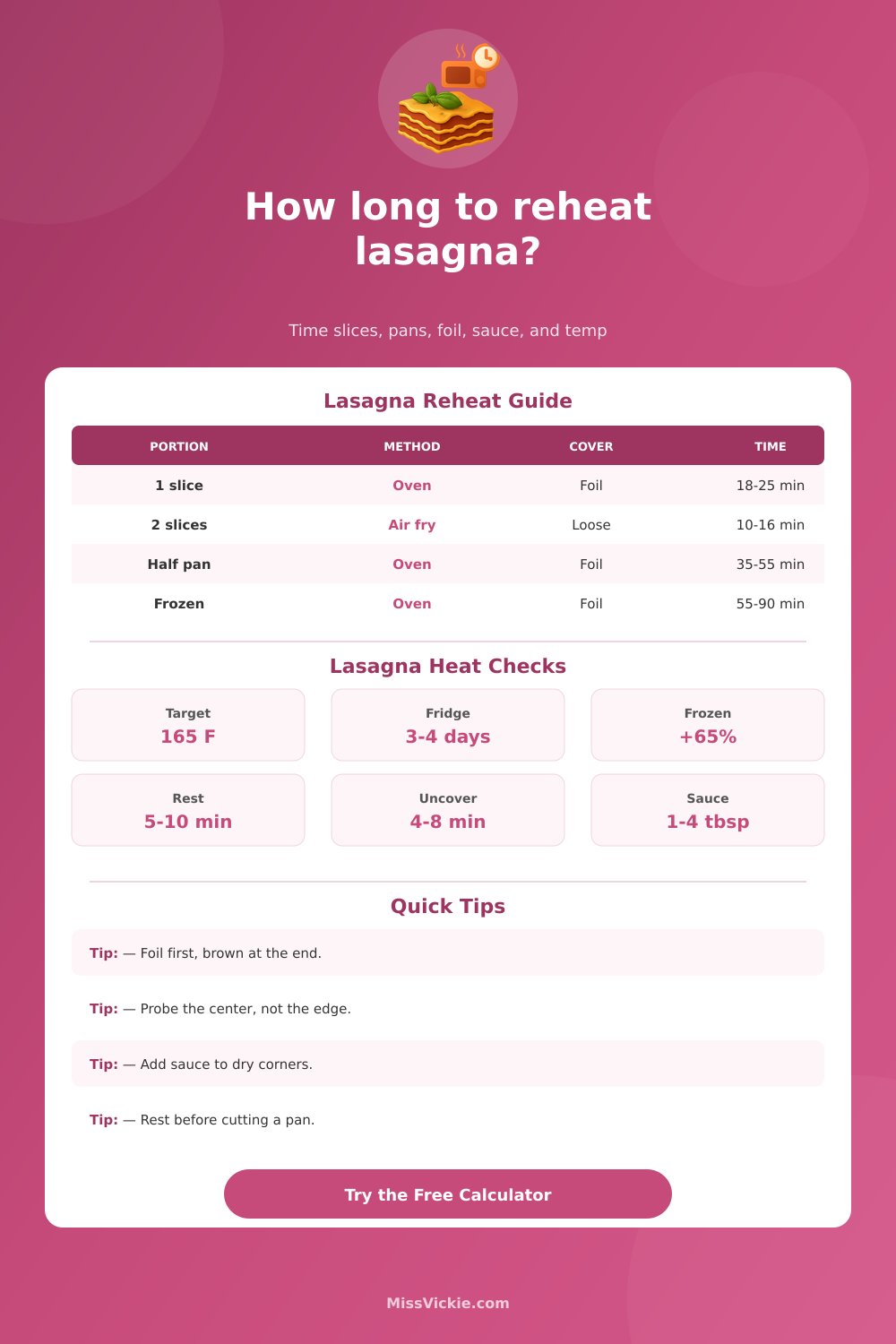
| Half pan | 2 to 3 in | 35 to 55 min | 6 to 10 min | Thickest center |
| Full pan | 2.25 to 3.5 in | 50 to 80 min | 8 to 12 min | Center square |
| Starting State | Calculator Effect | Cover Advice | Moisture Move | Safety Note |
|---|---|---|---|---|
| Room-temp, under 30 min | Shorter estimate | Cover if edges look dry | Usually no extra sauce | Do not leave out for long |
| Refrigerated | Standard timing | Foil first, uncover late | Add sauce to dry corners | Probe 165 F / 74 C |
| Very cold fridge | Adds about 10% | Tight cover helps center heat | Use a spoon of sauce | Check before browning |
| Partly frozen | Adds about 40% | Keep covered longer | Steam-bake works well | Cut open or probe center |
| Frozen solid | Adds about 70% | Foil tightly until thawed | Add sauce under foil | Expect uneven centers |
| Moisture and Cheese Goal | Best Cover | Heat Behavior | Finish Step | Watch For |
|---|---|---|---|---|
| Dry meat sauce or exposed noodles | Parchment plus foil | Edges dry before center | Add sauce before heating | Hard corner noodles |
| Balanced red sauce | Tight foil first | Most predictable | Uncover 4 to 7 min | Center lag |
| Extra saucy | Vented foil | Moisture conducts heat | Vent steam near finish | Watery bottom |
| White sauce or bechamel | Loose foil | Can scorch if uncovered | Gentle browning only | Split sauce |
| Crisp browned cheese | Cover then uncover | Needs two phases | Broil only after hot | Burnt cheese spots |
| Target Temperature | Use When | Texture Result | Risk | Calculator Note |
|---|---|---|---|---|
| 145 F / 63 C | Freshly cooked, quick warm-up | Very soft cheese | Not enough for leftovers | Use only when appropriate |
| 155 F / 68 C | Same-day portions | Hot eating temperature | May miss cold spots | Probe several spots |
| 165 F / 74 C | Reheated leftovers | Thoroughly hot center | Can dry if uncovered | Default safety target |
| 170 F / 77 C | Frozen or deep pans | Very hot center | More carryover drying | Rest before serving |
| 175 F / 79 C | Party pan holding briefly | Firm set layers | Brown top quickly | Keep covered after heating |
Table times assume fully cooked lasagna. Appliance strength, pan depth, cheese load, and actual starting temperature can shift results.
⚖ Method Comparison Grid
Best for slices and pans when foil protects the pasta before a short browned-cheese finish.
Best for lunch portions, especially with sauce added and a brief rest before cutting.
Best for a browned top on one or two firm slices, but protect exposed noodles from drying.
Best for frozen, full, or deep pans because gentle covered heat reaches the center more evenly.
💡 Lasagna Reheating Tips
When you reheat leftover lasagna, you have a familiar dilemma. You need to heat the lasagna through so sauce is hot and cheese melts. You also need to do this without drying out the noodles or causing them to stick to the pan. Part of the problem are the density of lasagna: there are thick layers of pasta, meat, cheese and sauce, which all have different heating rates. You might end up with a rubbery texture or overcooked edges and a still-cold center. Guessing won’t work; a methodical approach is your safest bet.
With help from the calculator, it’s easy to figure out when, depending on your location (hint: use the calculator). You don’t have to fumble with conversions or coefficients. Most of critical information goes in as “what condition was it?” Was it defrosted and in the fridge? Or did it cool down slow in refrigerator after dinner? That makes a big difference, and the calculator factors it in (thermal mass is critical). Did you start with a frozen block? That takes longer; if you hurry up and try to brown it, you’ll get a burnt cheesy mess instead of fully defrosting the interior. Oops.
How to Reheat Leftover Lasagna Perfectly
It’s all about moisture control, too. A lot of folks like lasagne with a crispy top. So they put their lasagne in oven, uncovered, immediately. That can be a mistake, since dry air will pull steam (heat) off surface and prevent the insides from warming while the top browns. Because it takes heat longer to penetrate thick layers, the lid must transmit heat throughout; if it’s too loose, the warmth escape along with the steam. The tool assumes you are using foil, because a tight lid holds in steam and spreads heat evenly through the layer. And again, once the center has reached the desired temperature, typically around one hundred sixty-five degrees Fahrenheit… Uncover it, perhaps just for a few minutes to brown edges. Then enjoy.
But it’s more than that; it’s controlling not only what goes on in the oven, but how things interact within the baking dish itself. The second factor is thickness. A thick slice of a home-baked lasagna re-heats more slow than a thin one. And a thick, ricotta-rich corner will take longer than a thin one. This means that the heat has to penetrate deeply, which takes time. Think about a whole pan versus just a slice; your reference tables (on the page) gives rough ranges for various portion sizes. They show how a half-pan differs from a single slice. You’re trying to reach balance: the cheese melts smoothly without the noodles turning into paste, and the sauce bubbles gently.
Last, let’s talk about the rest after cooking. Waiting a few (or up to 10) minutes before eating sounds like it would ruin everything, but it really helps set the texture. During the resting time, everything will finish cook through while still staying moist, allowing the temperature to even out. Resting lets the flavors meld again, allows the sauce to thicken back up, and sets the cheese so it doesn’t ooze all over your plate. When you try to cut right away, all of that steam comes rushing out and it just won’t hold up anymore. What you’re going for is clean slices with well-defined layers. Not soup.
So next time you re-heat some leftovers, cover them tight, check the temp, and let them rest. They’ll be just as delicious as when they were first cooked.