Laminated Dough Ratio & Layer Yield Calculator
Model detrempe strength, butter block lock-in, fold architecture, and baked yield for croissant, danish, or puff production shifts.
🥐Production Presets
Use a preset, then fine-tune hydration, lock-in, folds, and temperature around your room conditions.
⚖Detrempe and Lamination Inputs
🧮At-a-Glance Batch Snapshot
📊Application Comparison Grid
Croissant Focus
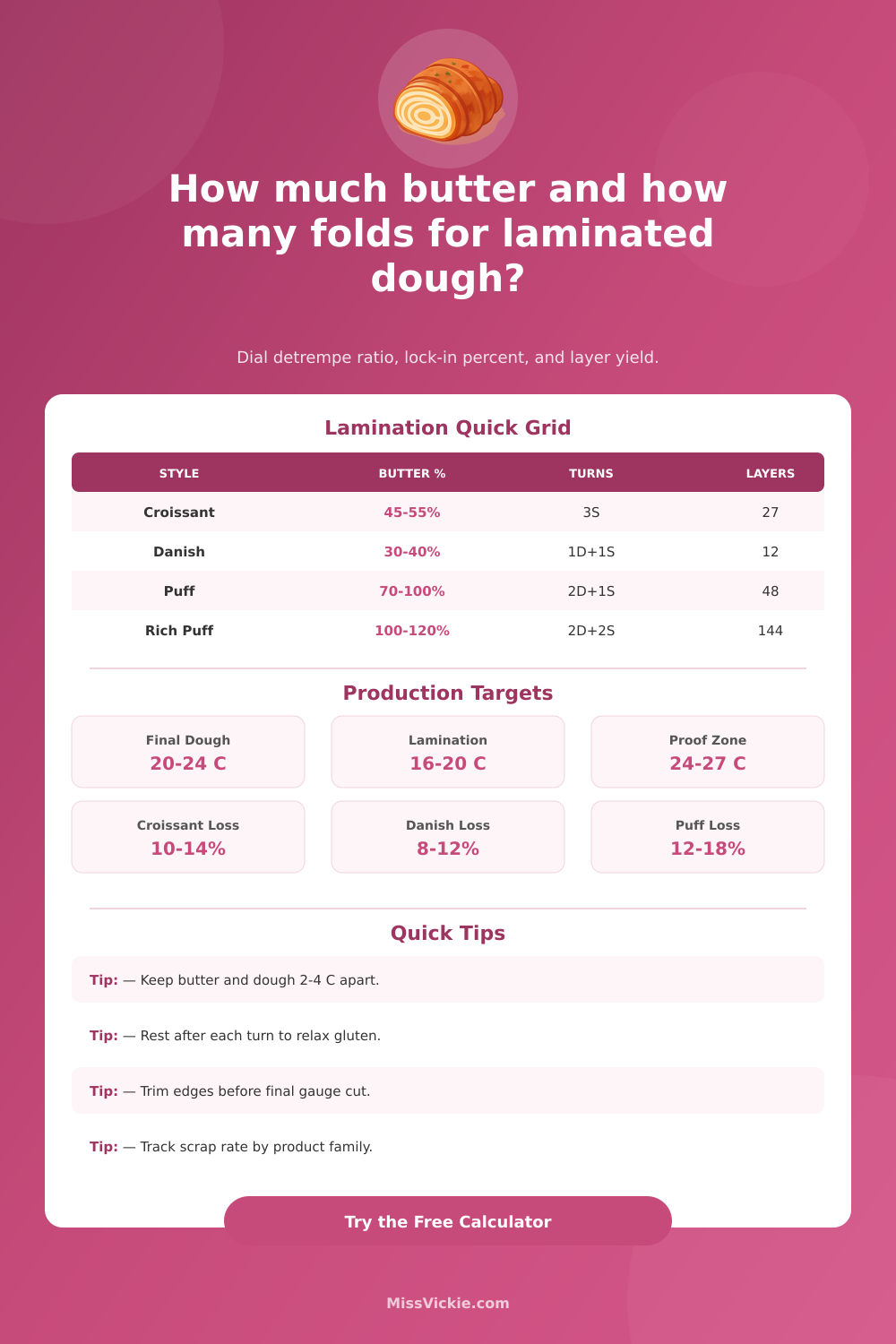
- Butter usually 45-55% of flour.
- Common fold map: 3 singles for 27 layers.
- Final proof often 24-27 C with humidity.
- Bake loss generally around 10-14%.
Danish Focus
- Butter often 30-40% of flour.
- Typical fold map: 1 double + 1 single.
- Sugar and inclusions reduce expansion.
- Bake loss usually 8-12% from moisture.
Puff Focus
- Butter can run 70-120% of flour.
- Layer-heavy map: 2 doubles + 1 to 2 singles.
- Low yeast formulas rely on steam lift.
- Bake loss often 12-18% with crisp finish.
📑Reference Table: Detrempe Formula Targets
| Application | Hydration % | Sugar % | Yeast % | Salt % | Notes |
|---|---|---|---|---|---|
| Croissant (classic) | 52-58 | 6-10 | 1.8-2.8 | 1.8-2.2 | Balance strength for long sheeting. |
| Danish (sweet) | 50-56 | 10-16 | 2.0-3.2 | 1.6-2.0 | Higher sugar slows proof pace. |
| Puff (yeasted) | 48-54 | 2-6 | 0.5-1.5 | 1.8-2.2 | Designed for lift and crisp layers. |
| Puff (lean) | 46-52 | 0-3 | 0-0.8 | 1.8-2.2 | No yeast, expansion from steam. |
❄Reference Table: Temperature and Handling Bands
| Stage | Celsius | Fahrenheit | Why It Matters | Corrective Move |
|---|---|---|---|---|
| Post-mix dough | 20-24 C | 68-75 F | Supports gas retention and extensibility. | Adjust water temp next mix. |
| Lock-in window | 16-20 C | 61-68 F | Keeps butter plastic, not brittle. | Short chill if butter smears. |
| Final sheeting | 18-22 C | 64-72 F | Prevents tearing and fat migration. | Rest 10-20 min between turns. |
| Final proof | 24-27 C | 75-81 F | Stable lift without butter leakage. | Lower heat if butter sweats. |
🧮Reference Table: Fold Architecture and Layer Count
| Turn Plan | Math | Theoretical Layers | Use Case | Risk Signal |
|---|---|---|---|---|
| 3 Single | 3 x 3 x 3 | 27 | Croissant baseline | Too few rests can shrink sheet. |
| 1 Double + 1 Single | 4 x 3 | 12 | Danish with richer fillings | Filling weight can compress lift. |
| 2 Double + 1 Single | 4 x 4 x 3 | 48 | Puff shell production | Overworking raises fat smear risk. |
| 2 Double + 2 Single | 4 x 4 x 3 x 3 | 144 | Very fine puff textures | Needs strong chill discipline. |
🍞Reference Table: Yield Factors by Application
| Application | Typical Trim Loss | Bake Loss | Effective Yield | Operational Comment |
|---|---|---|---|---|
| Croissant | 6-10% | 10-14% | 77-85% | Triangular cuts increase edge waste. |
| Danish | 5-9% | 8-12% | 80-87% | Square layout improves pan yield. |
| Puff pastry | 7-12% | 12-18% | 70-81% | Docking and re-sheeting alter lift. |
| High-butter puff | 8-14% | 13-19% | 67-79% | Warmer rooms drive smear losses. |
Formula note: this calculator treats lamination layers as theoretical sheet multiplication (single fold = x3, double fold = x4). Real layer definition can vary by production method and counting convention.
Lamination is an process of making alternating layer of fat and flour. To make these layers, it is necessary to manage the temperature of the fat and the flour. If the fat and flour elements merges together, the result will be a product like brioche.
If the fat elements crack before they are fully combine with the flour elements, the layers will not be even in the resulting product. Thus, lamination is a process that require the management of both temperature and geometry. The base dough, referred to as a detrempe, must have enough strength to hold the fat elements.
Making Layered Pastry Dough
The detrempe should not, however, be so elastic that it shrinks when rolled. Factors like hydration and sugar levels effect both the stickiness of the detrempe and the strength of the gluten in that dough. If there is too much water in the detrempe, it will be stickily and may tear.
Too many sugar will soften the gluten in the detrempe. Finding the proper balance in the detrempe is important for the success of the process of lamination. During the lock-in phase, the fat and detrempe must have the same level of plasticity.
The fat and detrempe should behave similar to each other. If the fat is too cold, it will shatter and destroy the layers in the dough. If it is too warm, the fat will smear into the detrempe.
The lock-in percentage will allow you to ensure the correct amount of fat to add to the dough. The amount of fat for the dough will determine if the result will be crisp puff pastry or croissant. Through each fold and double fold, the amount of layers in the dough increase.
The number of folds should be limited, however, or the dough will compress. Compressed dough will not have the open crumb structure that is desiring for most baked goods. The theoretical layer count will inform the baker of when to stop folding the dough.
It is also necessary to manage the temperature of the dough and the environment in which the lamination occur. The temperature of the kitchen can impact the fat and the dough. In addition, the dough must be rested in between steps.
By resting the dough, the gluten will relax and the fat will firm up. Otherwise, the dough will fight against the baker. The yield of the baked product must be accounted for.
The amount of trim loss and moisture loss will impact the final yield. Dividing the total mass of the dough by the number of portion will not provide the proper number of portions due to these losses. By modeling the bake loss and trim factors, bakers can accurately model the batch size for lamination processes.
Bakers can prepare a variety of products through lamination by adjusting the percentages of the ingredients and altering the folding sequence. Lamination can be used to make mille-feuille item or Danishes. Precision in each of these variable is required for bakers to achieve professional results with lamination techniques.