🥩 MissVickie lamb calculator
Lamb Roast Cooking Temperature Calculator
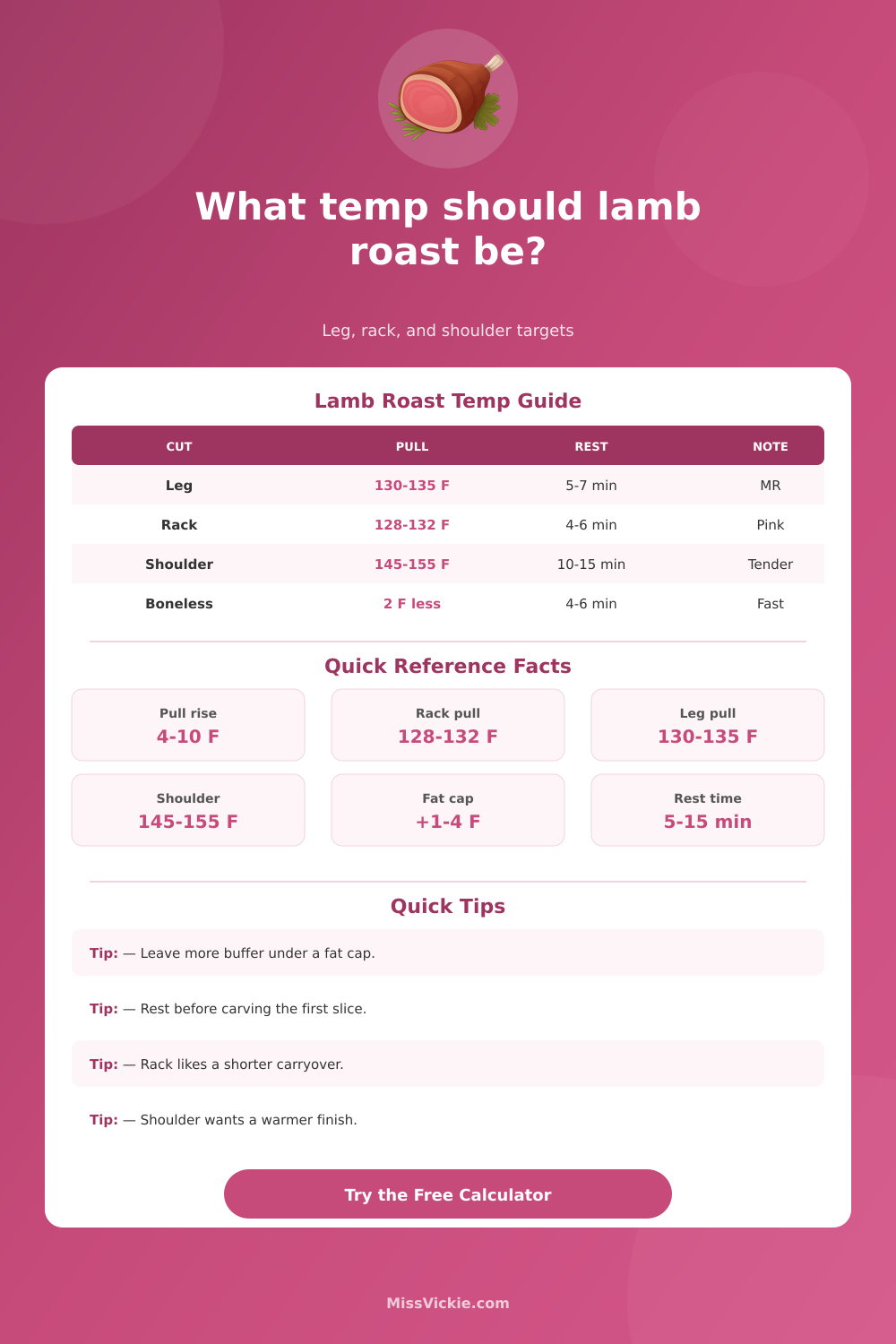
Dial in leg, rack, and shoulder roast temps, then account for fat cap carryover, rest, and carve timing for medium-rare slices.
Each preset loads a real lamb roast scenario with cut, doneness, bone style, roast weight, fat cap, and timing so the calculator starts on target.
Leg and rack roast happiest in medium-rare territory, while shoulder usually needs a warmer finish. Fat cap thickness nudges carryover and carve timing.
Medium-rare is the sweet spot for many lamb roasts.
Calculation Breakdown
Best medium-rare slice
Short rest, pink center
Warmer finish works best
Even shape, quick carve
Use the tables below to compare medium-rare lamb targets, cut behavior, fat cap effects, and carve timing in one glance.
| Doneness | Pull Temp | Rest Rise | Best Fit |
|---|---|---|---|
| Rare | 120-125 F | 4-5 F | Rack |
| Medium-rare | 128-132 F | 5-7 F | Leg |
| Medium | 138-142 F | 6-8 F | Leg / shoulder |
| Medium-well | 148-152 F | 8-10 F | Shoulder |
| Cut | Target Shift | Carryover | Roast Rate |
|---|---|---|---|
| Leg roast | -1 F | 5-7 F | 17 min/lb |
| Rack | -3 F | 4-6 F | 14 min/lb |
| Shoulder | +10 F | 8-11 F | 26 min/lb |
| Boneless leg | 0 F | 4-6 F | 16 min/lb |
| Fat Cap | Carryover | Pull Shift | Note |
|---|---|---|---|
| 0-0.25 in | +0-1 F | None | Crisp quickly |
| 0.5 in | +2 F | -2 F | Good balance |
| 1 in | +3-4 F | -3 F | Tent lightly |
| 1.5 in+ | +4 F | -4 F | Rest longer |
| Method | Carryover | Time Adj | Best Fit |
|---|---|---|---|
| Conventional | Base | 0 min | Leg |
| Convection | +1-2 F | -8 min | Rack |
| Sear then roast | +1 F | -5 min | Boneless leg |
| Low and slow | +3 F | +10 min | Shoulder |
Carrying over cooking refers to the phenomenon of meat roasts continuing to cook even after being removed from an oven. Many cooks tends to fail to reach the target temperature due to the belief that the meat is done when it reaches the target temperature. However, the meat will continue to cook as the heat from the outer layers of the roast will continue to reach the center of the meat.
This carrying over cooking can ultimatey alter the doneness level of a roast. The pull temperature for lamb roasts will be the temperature at which the cook removes the roast from the heat source. The roast will not reach the target temperature as the pull temperature as this will be the temperature of the roast after it has rested.
Why roasts keep cooking after you take them out
Instead, the pull temperature will be lower than the target temperature to allow for the carrying over cooking to even the roast up to the target temperature. Different cuts of lamb will have different pull temperatures. Rack of lamb cuts is lean and cook quick due to the thin cut of the rack of lamb.
Because of the thin nature of the rack of lamb, there is a small window to cook the rack of lamb to the target temperature as any additional cooking will result in overcooking of the rack of lamb. Lamb shoulders contains more connective tissue as well as more fat than rack of lamb cuts. The connective tissue must be cooked through to the higher temperature to allow the connective tissue to become tender; otherwise the lamb will feel different than the center of the cut to the outside of the roast when chewed.
A thick fat cap on the roast will act as insulation for the roast. The insulation cause by the fat cap will result in a higher rise in internal temperature of the roast compared to a roast with less fat. The fat cap should of been accounted for in the calculation of the pull temperature.
The method in which the roast is cooked will affect the rise in the internal temperature of the roast. If a convection oven is used, the fans that circulate hot air around the roast will cause the internal temperature of the roast to reach the target temperature at a faster rate compared to a conventional oven. If the cook sears the roast prior to cooking, the high external temperature of the roast will contribute to the rise of the internal temperature of the roast.
If the cook takes the roast straight from the refrigerator to the oven, the outside of the roast will cook faster than the internal temperature of the roast. Allowing the roast to rest for five minutes will allow the muscles in the roast to relax. As the roast was cooking the muscles in the roast cooked and pushed the juices towards the center of the roast.
If the roast is carved while hot the juices will exit the roast and onto the cutting board. If the roast is allowed to rest the muscles will relax and the juices will re-distribute throughout the roast. This resting process will allow the roast to remain moistly.
A thermometer should be used to assess the doneness of the roast as opposed to a timer. A timer will allow the cook to track time while the roast is cooking while a thermometer will allow the cook to measure the internal temperature of the roast. The internal temperature of the roast is the most accurate way of determining if the roast is done.
By measuring both the pull temperature and the internal temperature of the roast, cooks can account for the carrying over cooking and ensure the roast reaches the desired doneness level.