
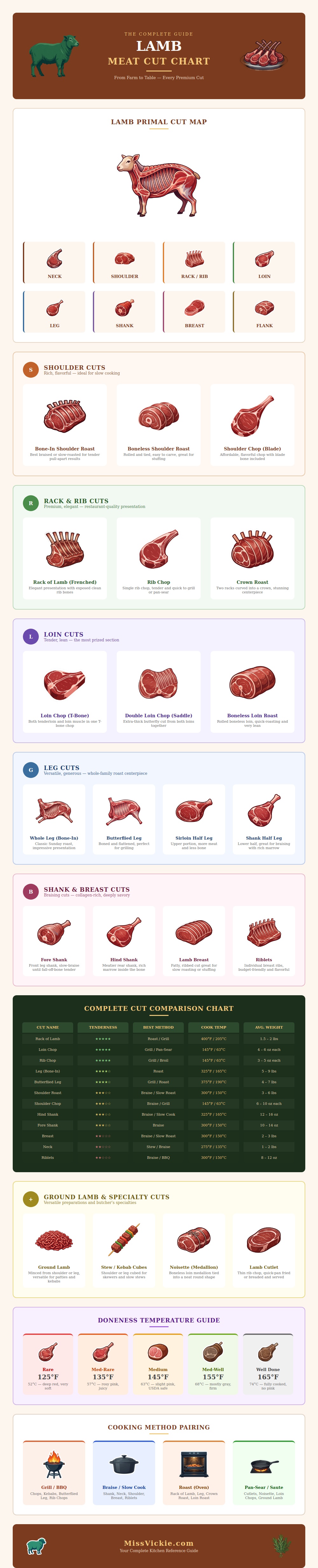
Next time you visit your local butcher shop and stroll past the lamb counter, you’ll be faced with a dilemma: How exactly do you prepare that rack? Or how about this shoulder? Or this shank? If you’re like most home cooks, you stick with what’s already been cut up for you (chops) or what has been ground. But knowing where each cut originates on the animal will give you clue about how to treat it during cooking, how to react to heat. For those who want to cook with intention rather than guesswork, here’s a look at all the primal sections of a whole lamb, using this chart above.
On the other end, the neck and shoulder regions is workhorse muscles. On a living animal, these muscle are constantly moving. This gives them flavor and connective tissue. However, they can be tough if you rush the cooking. Because they’re not going to tenderize after being cooked at high heat in, say, twenty minutes, don’t sear a shank or braise a breast over high heat. This is where low and slow comes in to save your day. By braising these cuts long enough for their collagen to melt into gelatin, what was once chewy becomes fall-apart easy. Problem isn’t that the meat is inedible; it’s just that it requires time.
How to Cook Different Cuts of Lamb
The middle is more tender. Lean and tender from doing no work at all, the loin and rack areas of the animal is favored. These are great items for a quick sear in a pan or roast in the oven. Because these cuts cook quickly if you watch them closely they stay moist and pink in the middle. Don’t be afraid to eat this cut medium rare. It’s worth the time spent; and unlike the tough shoulder cuts, people tend to overcook them as if they’re going to end up tough anyway. Trusting your thermometer, not just guessing based off appearance, is key.
Between those two types lies leg of lamb. It is more structured than the loin but not as fatty then the shoulder. If you’ve got room in your oven, roast a whole bone-in leg on Sundays; if not, have the butcher butterfly it and grill away. This versatility makes it one of the most versatile pieces of meat around. As the chart above points out, butterflied legs is great on the grill because their flat shape provides an even cooking surface. Without butterflying, the center cooks while the edges burn. Temperature charts don’t address this issue, but simple preparation tweaks do.
The cut’s important too, of course, but so is doneness. Most of us are trained to believe that well-done lamb just tastes like well-done lamb because of its strong gamey flavor. However, if you cook it beyond medium rare, the flavor will hide the subtle details that make it special. For me, one-hundred thirty-five degrees fahrenheit (a medium rare finish) makes the meat both juicy and rich, improving its naturaly character while not burying it beneath a wave of overcooked flavor. Finding that sweet spot requires some practice; thankfully, an accurate instant-read thermometer takes any guesswork out of the process. Soon enough, you’ll know: letting the meat rest redistributes its juices, creating evenness from bite-to-bite.
But there’s room for the less glamorous cuts as well. Kebabs or burgers made with ground lamb are incredible, they add depth to whatever you’re making that ground beef alone can’t achieve. The riblets may seem imposing and raw, and the breast meat may too. But cooked properly, both are deeply savory and budget friendly. There isn’t an inch of this animal you should of afraid to cook. All you have to do is pair the muscle to the right method.
If you understand how each cut will respond to heat, cooking becomes less like a chore and more like a string of little kitchen experiments. Get comfortabley with something simple, perhaps a shank that’s been braised, or a chop (and build up your confidence from there). The farm-to-table journey leads to your stove, and it’s much more forgiving than you’d expect.