Dry brine and seasoning-by-weight math
Kosher Salt Per Pound of Meat Calculator
Calculate kosher salt by meat weight, cut style, salt brand, rest time, bone or skin adjustment, and serving count. The calculator gives grams, teaspoons, tablespoons, sodium estimate, and a practical rest plan.
🧂Kosher Salt Presets
Choose a real meat-salting situation, then adjust the cut, brand, rest time, piece count, and salting percentage before cooking.
⚖Meat, Salt, and Rest Inputs
Your Kosher Salt Plan
A weight-based salt plan will appear here after calculation.
Calculation Breakdown
Portion and Timing Detail
How to Apply This Salt
- Calculate first, then sprinkle evenly over all exposed sides.
📌Per-Pound Salt Benchmarks
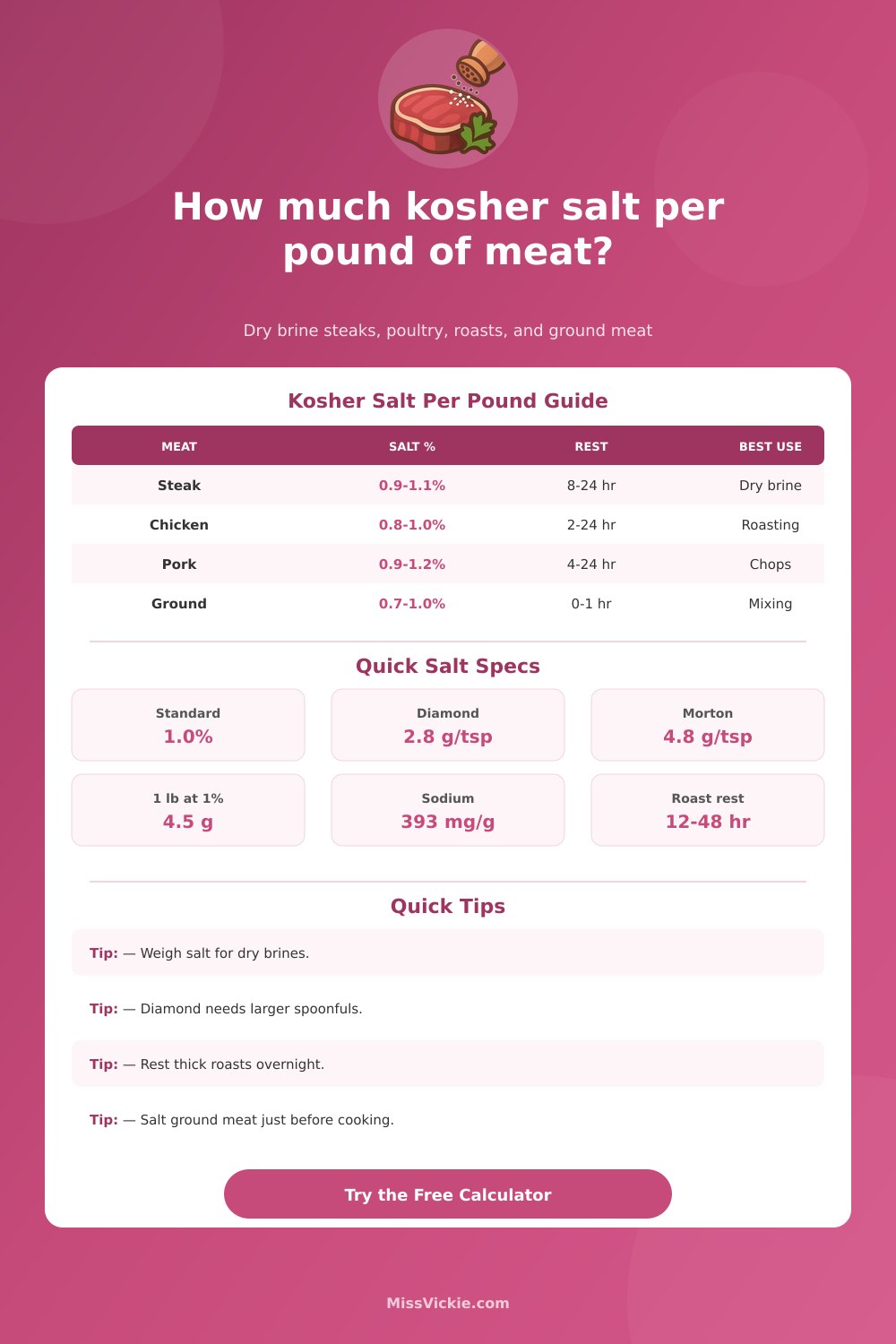
These benchmarks use 453.6 g per pound and sodium at about 393 mg per gram of sodium chloride. Spoon amounts are approximate because flakes settle differently.
🍴Recommended Salt Percent by Meat Type
| Meat or Cut | Typical Salt % | Grams Per Pound | Common Rest Window | Best Notes |
|---|---|---|---|---|
| Steak, 1 to 2 inches | 0.9% to 1.1% | 4.1 to 5.0 g/lb | 8 to 24 hours | Dry uncovered for a browned crust. |
| Chicken pieces | 0.75% to 0.95% | 3.4 to 4.3 g/lb | 2 to 12 hours | Use the lower end for small wings or thin breasts. |
| Whole chicken | 0.8% to 1.0% | 3.6 to 4.5 g/lb | 12 to 24 hours | Salt under and over the skin when possible. |
| Pork chops or tenderloin | 0.9% to 1.1% | 4.1 to 5.0 g/lb | 4 to 12 hours | Thick chops benefit from overnight rest. |
| Large roasts | 1.0% to 1.25% | 4.5 to 5.7 g/lb | 12 to 48 hours | Give salt time to move inward before roasting. |
| Ground meat | 0.7% to 1.0% | 3.2 to 4.5 g/lb | 0 to 1 hour | Long rests can make burgers springy or sausage-like. |
🧂Kosher Salt Density and Spoon Conversion
| Salt Type | Approx g/tsp | Teaspoons for 10 g | Tablespoons for 30 g | Practical Use |
|---|---|---|---|---|
| Diamond Crystal kosher salt | 2.8 g | 3.6 tsp | 3.6 tbsp | Large flakes, easy to distribute by hand. |
| Morton coarse kosher salt | 4.8 g | 2.1 tsp | 2.1 tbsp | Denser crystals; use less volume than Diamond. |
| Generic coarse kosher salt | 4.0 g | 2.5 tsp | 2.5 tbsp | Middle estimate when the box gives no density. |
| Fine kosher salt | 5.2 g | 1.9 tsp | 1.9 tbsp | Closer to table salt by volume. |
| Fine table salt | 6.0 g | 1.7 tsp | 1.7 tbsp | Not kosher salt, but useful for comparison. |
⏱Dry-Brine Rest Timing Table
| Cut Thickness or Style | Minimum Rest | Strong Window | Upper Limit | Texture Note |
|---|---|---|---|---|
| Thin cutlets, wings, small chops | 30 minutes | 2 to 6 hours | 12 hours | Salt quickly; avoid over-drying small pieces. |
| 1 inch steaks or chops | 1 hour | 4 to 12 hours | 24 hours | Good crust and even seasoning. |
| 2 inch steaks or thick chops | 4 hours | 8 to 24 hours | 36 hours | Enough time for the center to season. |
| Whole poultry or turkey breast | 8 hours | 12 to 24 hours | 36 hours | Air-dry skin uncovered for crispness. |
| Large roast, brisket, pork shoulder | 12 hours | 24 to 48 hours | 72 hours | Large muscles need time, especially with a fat cap. |
📊Comparison Grid: One Pound of Meat
Good for small poultry pieces, quick weeknight seasoning, or lower-salt meals.
Reliable dry-brine target for steaks, chops, roasts, and many poultry cuts.
Best for large roasts, barbecue bark, or meat served with unsalted sides.
Season just before shaping burgers or meatballs to avoid a tight texture.
📋Quick Spoon Reference by Weight
| Meat Weight | Salt at 0.8% | Salt at 1.0% | Diamond at 1.0% | Morton at 1.0% |
|---|---|---|---|---|
| 1 lb | 3.6 g | 4.5 g | 1.6 tsp | 0.95 tsp |
| 2 lb | 7.3 g | 9.1 g | 3.2 tsp | 1.9 tsp |
| 4 lb | 14.5 g | 18.1 g | 2.2 tbsp | 1.3 tbsp |
| 8 lb | 29.0 g | 36.3 g | 4.3 tbsp | 2.5 tbsp |
| 12 lb | 43.5 g | 54.4 g | 6.5 tbsp | 3.8 tbsp |
✨Salting Tips
When you roast a chicken, or sear a steak, there’s that moment just before when you feel that silent panic. Pick up salt shaker. Sprinkle it on generously. Cross your fingers, hoping for the best. Sometimes it goes right. Mostly, though, it’s luck and your palate is not at fault. Salt only has an effect if you can get some onto food; most of what you sprinkle ends up in bottom of pan.
When cooking by weight, all of this guess work dissapears. Seasoning becomes as precise as any other technical task. Instead of estimating ingredient, you measure them. Consistency follows. It’s all very basic percentage math: About one percent weight of meat is what seasoned professional tend to go for. In terms of weight in grams, this means approximately 4.5 grams of kosher salt per pound of pork or beef.
Stop Guessing with Salt
That might sound excessive, but here’s a secret: Most home-cooks seriously undersalt their meats. We’re overtrained to avoid sodium but still expect our meals to be satisfying despite the lack of flavor. If you’ve got your scale handy, the calculator above will do the conversion for you. Simply plug in weight of the raw ingredient, choose your brand of salt, and it will tell you precisely how many grams is required.
People often make mistake of using volume measurements because different brands of salt has different sized crystals. Then there is brand: Most folks don’t appreciate how important that can be. For example, Diamond Crystal kosher salt have bigger flakes with more air inside. This makes it feel lighter than Morton‘s by volume; 1 teaspoon of Diamond Crystal doesn’t weigh as much as 1 teaspoon of Morton. Unless you compensate when you swap them out, you’re likely to over- or under-salt something. This kind of automatic compensation is what the tool provides.
It allows you to compensate for bone-in cut, too. That extra bone adds weight, but it doesn’t take on any seasoning. So if you season a whole bird by its overall weight (including backbone), then breast meat will prove tasteless. Taking away that unused mass means you get the right percentage of tasty tissue.
Quantity matters, but so does time. You need salt to penetrate the muscle fibers… but if you slather your steak in salt immediately prior to cooking, you end up with a bland interior surrounded by a salty crust. Eight to twenty-four hours are the sweet spot for most cuts. That’s the time it takes the salt to dissolve in the moisture the cut releases, distribute itself throughout meat, and be absorbed back in. It’ll tenderize the cut by breaking down protein structure and will also distribute flavor evenly.
Ground meat and thin chops is best done quickly, when necessary, but patience pays off with roasts. The thickness chart in the reference data on the page shows the rest window scaling. A chicken wing? Minutes. A brisket? Days. Getting the time-to-texture match keeps things even and moist.
And then there’s ground meat, which is another beast entirely. Salt gets mixed right into the structure when you’re making meatballs, for example, or patties from ground meat. Ground meat should of be handled with care, as sitting around too much will make it dense and sausage-y (not usually what you’re going for in your burger). A little salt here goes a long way; you’re looking to achieve binding and seasoning while not changing the texture at all. That’s why you’ll see a bit less on this one than some of the other cuts; it’s a hair lower, but that’s realy important for how it affects the final mouthfeel.
Seasoning comes down to control. When I measure my salt, I don’t have to fight with my recipe anymore. If I weigh my salt in grams, then that’s what I get. And when I see that there’s a 1/2 teaspoon of salt in a recipe, I know better than to trust it because crystal sizes is inconsistent. Weighing your salt takes five seconds whether you’re tossing a ribeye on the grill or trying to figure out how much to put into a turkey for dry brining. It’s that little bit of time that pays off in each and every bite. By measuring rather than guessing, you eat better meat.
You know difference between a good dinner and a great dinner? Those couple grams you decided to weigh versus shake.