⚖ MissVickie kitchen math
Kitchen Weight Converter
Convert grams, kilograms, ounces, and pounds for real pantry staples, then see package counts, volume estimates, and per-serving amounts without juggling kitchen charts.
Each preset loads a common cooking or baking job with an ingredient, source unit, target unit, portion goal, and pantry-loss adjustment.
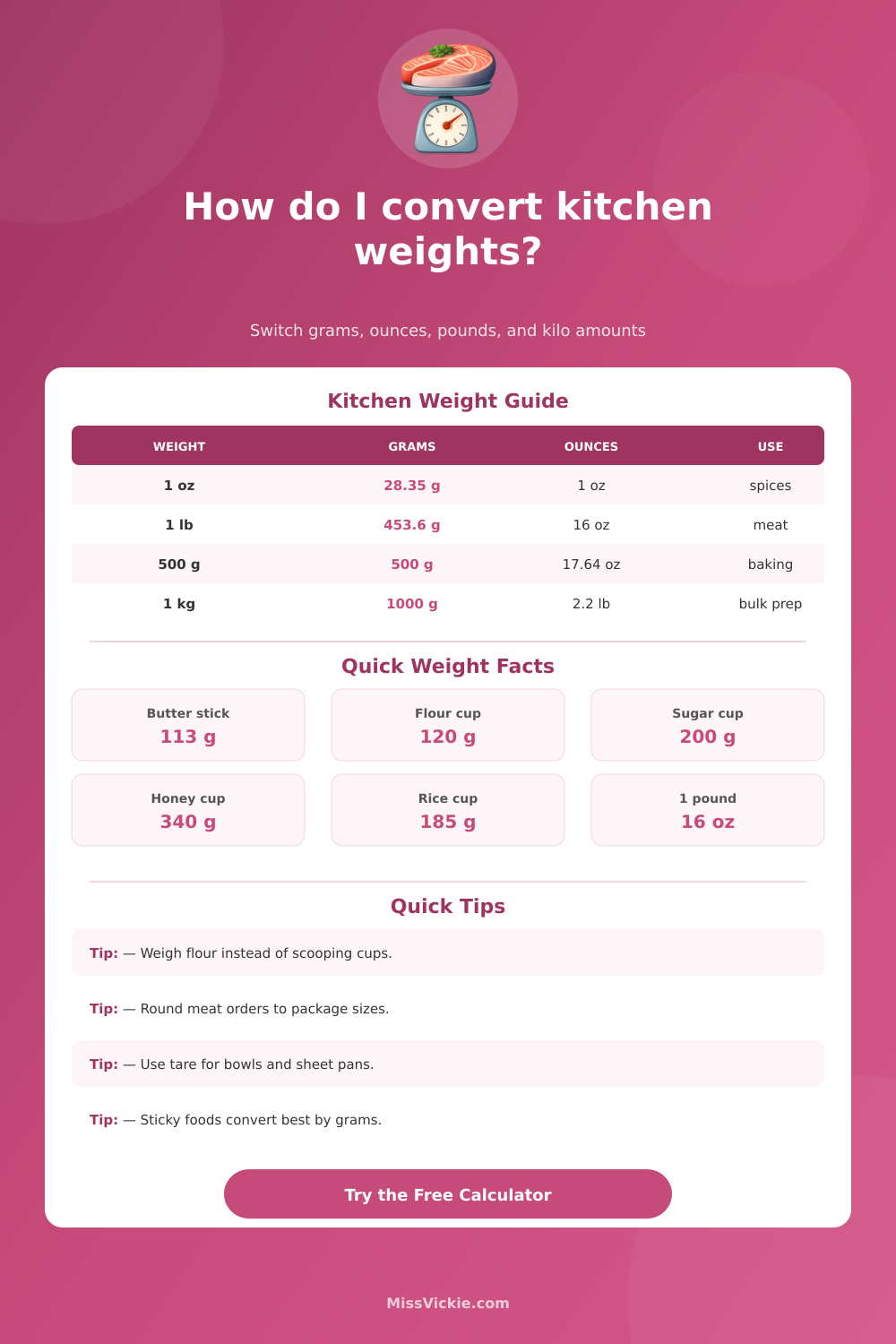
These baseline conversions help when a recipe swaps between metric and imperial package labels.
| Kitchen Weight | Metric | Imperial | Typical Use |
|---|---|---|---|
| 1 ounce | 28.35 grams | 1 oz | Chocolate, spices, yeast packets |
| 4 ounces | 113 grams | 0.25 lb | One butter stick or cream cheese block |
| 8 ounces | 227 grams | 0.5 lb | Butter, shredded cheese, deli packs |
| 1 pound | 453.6 grams | 16 oz | Ground meat, flour bags, bulk produce |
| 2 pounds | 907 grams | 32 oz | Large roasts, family meal prep |
| 1 kilogram | 1000 grams | 2.2 lb | Bulk baking, pantry refill jars |
Weight per cup changes with the ingredient, so cups only work well when the ingredient density is known.
| Ingredient | 1 Cup | 1 Tablespoon | Kitchen Note |
|---|---|---|---|
| All-purpose flour | 120 g | 7.5 g | Spoon and level for the most reliable bake |
| Granulated sugar | 200 g | 12.5 g | Stable for cookies, syrups, and fillings |
| Brown sugar | 220 g | 13.8 g | Pack level for the recipe to match |
| Butter | 227 g | 14.2 g | Great bridge between sticks and grams |
| Honey | 340 g | 21.3 g | Heavy ingredient that converts best by scale |
| Rolled oats | 90 g | 5.6 g | Loose oats settle and change cup volume |
Use this table when the converted amount needs to line up with grocery packaging or portion containers.
| Ingredient | Common Package | Package Weight | Portion Example |
|---|---|---|---|
| Butter | 1 stick | 113 g / 4 oz | 8 tablespoons |
| Flour | 1 bag | 2.27 kg / 5 lb | About 18.9 cups |
| White rice | 1 pouch | 454 g / 1 lb | About 2.5 cups dry |
| Shredded cheddar | 1 bag | 226 g / 8 oz | About 2 cups packed |
| Cooked chicken | 1 tray | 680 g / 1.5 lb | Five 136 g portions |
| Almonds | 1 pouch | 340 g / 12 oz | Twelve 28 g snacks |
Different weight units shine in different kitchen moments, especially when you switch from measuring to buying or portioning.
Best for flour, cocoa, sugar, and any bake where a few tablespoons can noticeably change texture.
Helpful for meat, bulk rice, and produce because supermarket labels and family packs often use pounds.
Great for butter, cheese, chocolate, and spice blends when you want a quick imperial weight without fractions.
Useful for bread production, batch cooking, and pantry refills when totals climb past a few hundred grams.
This ingredient-only snapshot updates from the final converted weight so you can judge how the amount scales nutritionally.
Measuring ingredient can be difficult if the ingredients has varying weight depending on teh system of measurement that is used for those ingredients. For instance, recipe may ask for ingredients to be measure in grams. A kitchen scale, however, may only read in ounce.
Furthemore, the ingredient may be packaged in a quantity that is measured in pounds, but the recipe may ask for gram of that ingredient. The difference in weight between ingredients is due to the fact that ingredients have different density, and the density of ingredients can vary depending on the scooping of the ingredients. The density of ingredients is one of the factor that influence the weight of a measured volume of ingredients.
How to Measure Ingredients Accurately
For instance, all-purpose flour may weigh 110 grams if measured with a light scoop, but may weigh 130 grams if scooped to a heaped scoop. Other ingredients, like sugar, are similar in weight whether measured with a scoop or a heaped scoop, but ingredients like brown sugar may be pack tightly or loosely with the scooped portion of the ingredient. The weight of ingredients that are measure with a scale is more precise than those scooped into measuring cup.
Precision in the measurement of ingredients ensure that the recipe produces the same results each time. Furthermore, the conversion of ingredients from one system of measurement to another is dependent upon the nature of the ingredient. For instance, butter always weigh 113 grams (one stick) or 4 ounces.
Ingredients like honey are sticky, and may not be easily level with a measuring cup. In these instance, measuring tools that account for the density of ingredients will allow the individual to input how the ingredient is scooped so that the tool provide a trustworthy measure of the ingredient. Another consideration that you should make when following recipes is cooking loss.
Cooking loss is the change in the size of ingredients during the cooking process. For instance, chicken may shrink 20 percent during the cooking process. Other ingredients that may lose size include vegetable that are trimmed or cooked.
You may account for cooking loss by adding 3 to 8 percent of the ingredient to the recipe. The packaging of ingredients at grocery store can also affect how ingredients are measured. For instance, many grocery stores may sell meat in 1.5-pound tray, cheese in 8-ounce bags, and flour in 5-pound sacks.
In this case, recipes may need to be round to these weights to make it easier for the cook or home cook to purchase the ingredients. Foods in small quantity, such as spices, may be measured in ounces. Foods in larger quantities, such as dough for baking bread, may be measured in pounds or kilogram.
Another consideration is the total weight and the volume of ingredients that must be measure. For instance, the total weight of an ingredient can help ensure that each container of an ingredient has the same amount of that ingredient. Furthermore, recipe conversion tool may allow cooks to easily determine how many bag or stick of an ingredient will be needed to purchase from the grocery store.
In cooking, it is important to avoid using volume measurement to replace weight measurements for dry goods. For instance, water is a liquid that is easily measured by volume. Dry goods, however, may not have the same weight.
One cup of oats, for instance, may weigh 90 grams when the oats is not heaped. To avoid error in cooking, it is best to weigh the ingredients and to use the tare function to account for the weight of the bowl use to measure the ingredients. Finally, scaling recipe can cause error in the cooking process.
For instance, if a recipe is to be doubled, the amount of leavening agent may not double because the baking pan may change in how the food cook when doubled. Small batch of food should be prepared to ensure that the texture of the food is the same. Furthermore, if cooking in bulk, the total weight of the food may be measured in kilogram, but each step of the recipe may be measured in gram of the ingredient.
Another consideration is the effect that measurement can have on the nutrition of the food. For instance, if cheese is measured in gram, the calories and macronutrient of the cheese can be calculated. If 100 grams of cheese contain 100 calories, the nutrition of the food can be calculated.
Furthermore, understanding the weight of ingredients help the cook or home cook to balance the meals that are prepared. It also allow cooks to avoid unexpected calorie from ingredients that are measured by weight.