Kimchi Fermentation Time Calculator
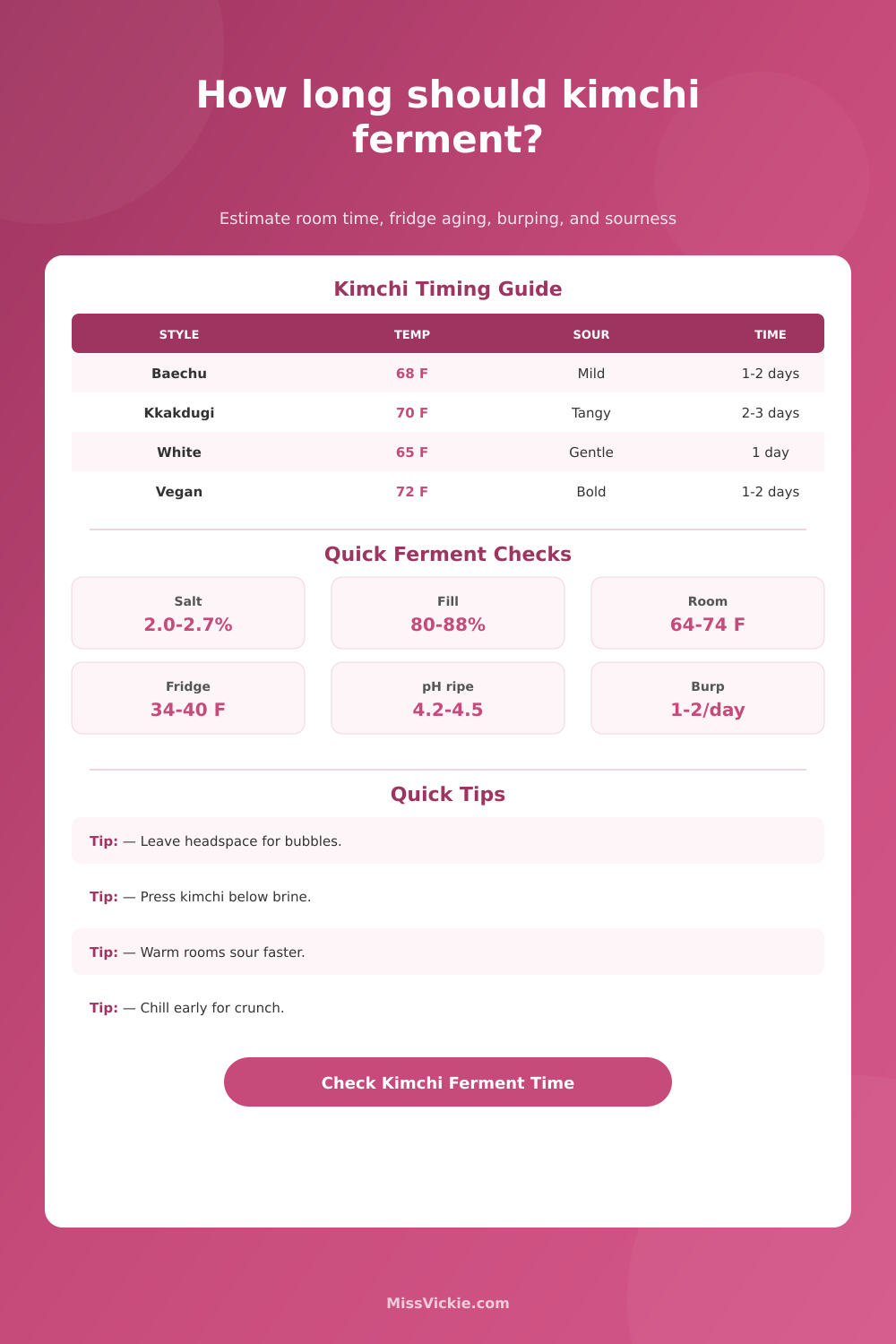
Estimate kimchi room fermentation, fridge aging, burping frequency, sourness, pH direction, salt balance, jar headspace, and texture timing from real batch details.
🥬 Kimchi Presets
Choose a real kimchi batch, then adjust the room, salt, jar fill, paste strength, and sourness target.
⚖ Fermentation Details
Kimchi fermentation plan
Your room stage, fridge ripening, sourness estimate, and jar pressure plan will appear here.
Batch Inputs
Ferment Drivers
Fermentation Breakdown
🧪 Fermentation Snapshot
🌡 Room Temperature Timing Table
| Room Temperature | Likely Activity | Fresh To Mild | Ripe Tangy | Burping Note |
|---|---|---|---|---|
| 55-60°F / 13-16°C | Slow start, very crisp texture | 36-60 hours | 3-5 days | Check once daily |
| 61-66°F / 16-19°C | Steady traditional room ferment | 24-40 hours | 2-4 days | Check daily after bubbles |
| 67-72°F / 19-22°C | Active, balanced souring | 18-30 hours | 36-72 hours | Burp 1-2 times daily |
| 73-78°F / 23-26°C | Fast acid development | 12-22 hours | 24-48 hours | Use tray, check pressure |
| 79-84°F / 26-29°C | Very fast, texture softens sooner | 8-16 hours | 18-36 hours | Burp often, chill early |
Use smell, bubbles, brine rise, and taste alongside time. If a sealed jar bulges hard, vent it carefully over a sink.
🫙 Kimchi Type Reference
| Kimchi Type | Vegetable Structure | Ferment Speed | Texture Risk | Typical Use |
|---|---|---|---|---|
| Napa baechu kimchi | Layered leaves and stems | Medium | Stems soften after long warm ferments | Everyday banchan, wraps, noodles |
| Cut napa mak kimchi | Short cut leaves expose more surface | Medium-fast | Edges soften faster than whole leaf style | Quick household batches |
| Radish kkakdugi | Dense cubes with high crunch | Medium-slow | Center can lag behind outside sourness | Soups, rice bowls, seolleongtang |
| White baek kimchi | Mild brine, little chili paste | Slow-medium | Can taste flat if undersalted | Fresh side dish, gentle ferment |
| Cucumber kimchi | Watery, tender vegetable | Fast | Softens quickly after souring | Eat young and chilled |
| Green onion kimchi | Fibrous stalks with sweet allium | Fast-medium | Sharp aroma builds quickly | Rich meats, rice, noodles |
| Vegan napa kimchi | Depends on kelp, mushroom, or soy depth | Medium | May need extra fridge aging for depth | All-purpose plant-based kimchi |
| Nabak water kimchi | Thin slices in brine | Fast | Brine turns sharp before vegetables soften | Cold broth kimchi |
🧂 Salt, Fill, And pH Guide
| Factor | Low Range | Balanced Range | High Range | What It Changes |
|---|---|---|---|---|
| Final salt | 1.5-1.9% | 2.0-2.7% | 2.8-3.5% | Lower salt ferments faster; higher salt protects crunch but slows souring. |
| Jar fill | Below 75% | 80-88% | Above 90% | Full jars need more burping and overflow space during brine rise. |
| Fresh pH direction | Above 4.8 | 4.6-4.8 | Depends on ingredients | Fresh kimchi is lightly acidic but not deeply sour. |
| Ripe pH direction | 4.4-4.6 | 4.2-4.5 | Below 4.1 | Lower pH tastes sharper and is better for stews and fried rice. |
| Headspace | Loose packed | 1-2 inches | Too tight | Gas, brine expansion, and floating vegetables all need room. |
⏱ Burping Schedule Table
| Jar Situation | Room Stage | Fridge Stage | Pressure Warning | Best Practice |
|---|---|---|---|---|
| Airlock lid | No manual burping unless clogged | Check brine weekly | Blocked airlock or dry channel | Keep vegetables submerged |
| Loose lid | Check tray once daily | Tighten after chilling | Brine creeping down jar | Press solids below brine |
| Tight jar, 75-85% full | Open once daily | Open every 2-4 days early | Hissing, bulging, brine rise | Vent over sink, close gently |
| Tight jar, 90%+ full | Open 2-3 times daily | Open every 1-2 days early | Lid dome or leaking brine | Move some kimchi to another jar |
| Warm room above 75°F | Open morning and evening | Open every 2 days first week | Rapid gas after 12 hours | Chill earlier for crisp texture |
📊 Sourness Comparison Grid
Bright vegetables, light fizz, little acidity, best for very crunchy cabbage.
Balanced table kimchi with aroma, light tang, and a crisp center.
Noticeable sourness, steady bubbles, and strong flavor for daily meals.
Mostly fridge-aged acidity, softer texture, and deep flavor for cooking.
💡 Kimchi Fermentation Tips
The magic of fermentation is when the cabbage tastes like itself. It transitions from tasting like salty vegetable to tasting like what it is going to taste like. This isn’t instant. And staring at the jar while turning up the heat won’t help you hurry it along. The window between raw crunch and overcooked mush has a very small opening, and if you miss it, you’re starting over.
How do you know when? Before you put your fistful of leaves into a crock, this calculator will tell you. It takes all those pesky variables that usually confuse home fermenter and turns them into a calendar you can use.
How to Use the Fermentation Calculator
Bacteria don’t just pay attention to peak temperatures, either; they’re more concerned with averages. So if your kitchen average sixty-eight degrees in the morning, but jumps to seventy-five when the oven turns on, that’s an important factor for acid production. The tool above accounts for this because lactobacillus operates exponentially faster at warmth, and exponentially slower at coolness. This is why the output during the “room” stage shift dramatically with a mere five-degree difference. And contrary to expectations, it doesn’t happen in a straight line: Biological activity speeds up much more faster as it gets warmer. Regardless of the recipe you follow, a jar left next to a running dishwasher will sour twice as quickly than another kept in a shaded corner of the same room.
Salt is the other great equalizer. A final batch with two point four percent salt (though tedious to achieve) removes the guesswork regarding timing. Too little salt and the microbes will race ahead, too fast, often resulting in slimy texture before deeper flavors emerge. If you oversalt, they hesitate; you get pickled cabbage instead of the complex tang of true fermentation. Because the speed of microbes is directly controlled by their salt concentration, the calculator set its own timeline based off that balance.
It’s a bit of a tradeoff, of time, of texture, of safety. You can’t have max crunch and min wait time. So what does the tool do? It helps you choose which you value most for this particular batch.
It’s easy to overlook jar fill level until it’s too late. It makes sense to pack as much into a jar as possible, but then what happens when fermentation gases cause your brine to expand, pushing all contents right out onto your counter? Two inches of headspace gives the gas room to expand while still keeping solids floating where they belong, without any spills. This table on the page demonstrates the relationship between fill level and build up of pressure. You don’t want a jar filled to ninety percent to be tightly sealed because that spells trouble (popped lid, messy cleanup). Release that pressure by burping!
How frequently do you need to do this? That depends on how many gas your particular batch produces. For instance, bigger batches produce more gas, so the tool use weight to calculate how often you should of burp.
The fermentation pace varies from vegetable to vegetable due to cell structure: sliced cucumbers and cubed radishes will all be penetrated by the acids more quickly than the layered interior of napa cabbage shields the heart; the thick, stubborn root vegetable known as kkakdugi take longer to break down (thus retaining more crunch) while it ferments. The calculator accounts for texture, ensuring you don’t give your cukes the same treatment time as napa and wind up with a pile of mush. Choose a container that matches the contents.
After the stage of room temperature, however, your fridge take over as your aging chamber. The flavor will continue to develop (only slower), in the cool temperatures. That’s how the kimchi learns its personality. A fresh batch of kimchi is crisp and bright, while an older kimchi add the deep, savory sourness that makes fried rice and stews what they are. With this tool, you can estimate how long it should take until it’s matured enough in the fridge for you to try it out.
Don’t worry about opening it too soon. Usually smell is going to give you a better sense than time. If it has a clean, sharp odor, then go ahead and have some. Otherwise, something went wrong during the packing or salting phase, and it’ll smell like ammonia or rotten eggs (ew), rather than just being a jar that is simply sleeping. Let the calculator help you set your expectations at first, but trust your nose even more than the algorithm.
Don’t spend a lot of time looking at a jar thinking, “Is this done yet? Am I imagining things?