Limes for Key Lime Pie Calculator
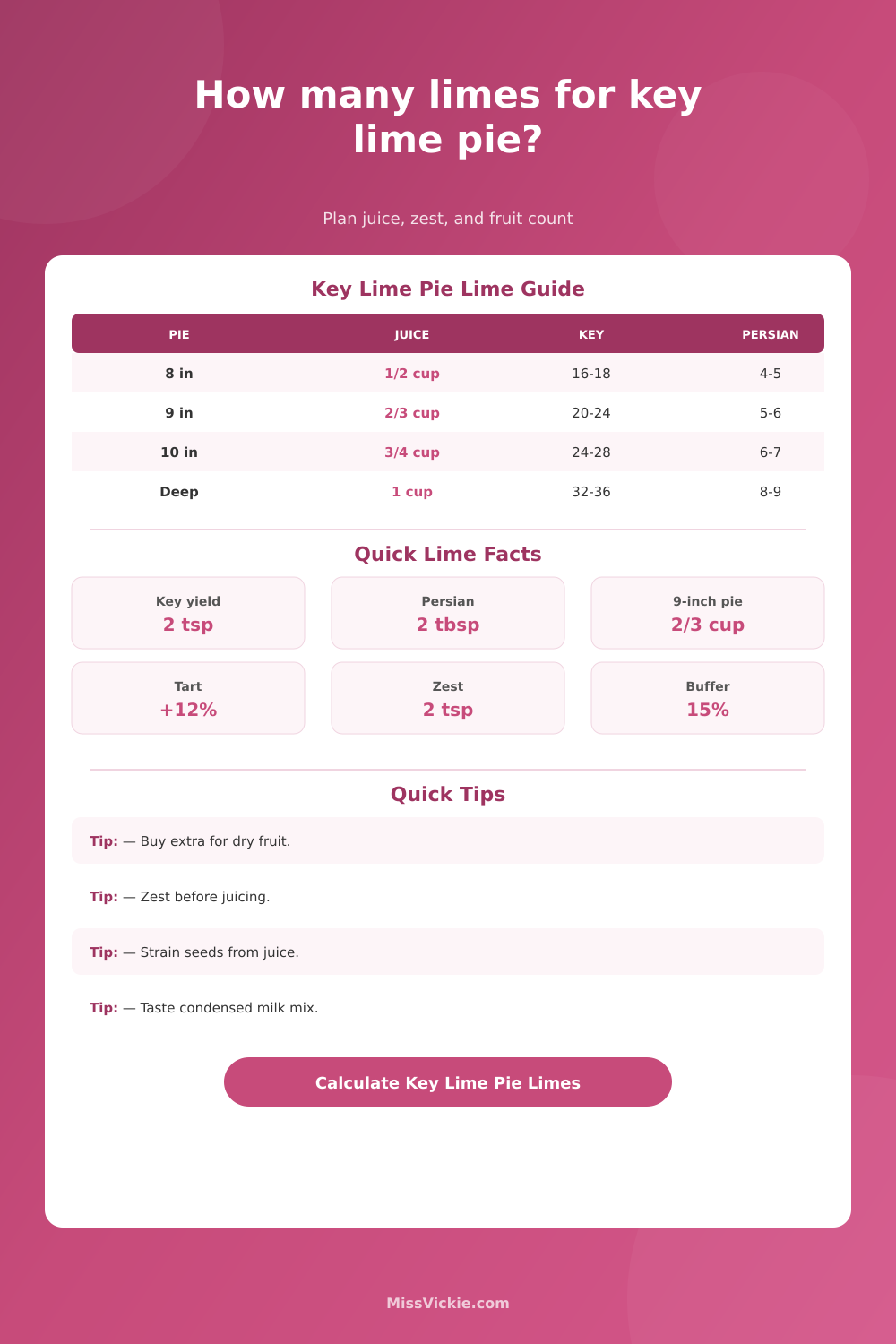
Plan how many key limes or Persian limes to buy for key lime pie using pie count, pan diameter, juice target, lime yield, tartness, zest, and filling depth.
🥧Key Lime Pie Presets
Choose a pie plan, then tune the pan size, lime type, juice target, tartness, zest, and filling depth.
⚖Lime Inputs
Lime Plan
Fresh key limes for one standard pie.
Pie And Juice Breakdown
Lime Yield Breakdown
Prep Route
- Zest clean dry limes before cutting.
- Juice and strain seeds into a measuring cup.
- Measure the target cup amount for filling.
- Hold extra juice for tartness correction.
🍋Lime Yield Snapshot
🧪Key Lime And Persian Lime Comparison
Classic aroma for a 9 inch pie with 2/3 cup juice.
Small firm fruit needs a bigger shopping count.
Heavy fruit reduces squeezing time and waste.
Easy juicing with a milder, less floral flavor.
Useful backup when fresh key limes are poor.
Raises juice for a sharper condensed milk balance.
More filling volume means more lime juice.
More aroma without adding much sourness.
📋Lime Yield Table
| Lime option | Juice per fruit | Fruit for 2/3 cup | Flavor note |
|---|---|---|---|
| Fresh key lime | 2 tsp / 10 ml | 16 to 20 before buffer | Classic floral tang for key lime pie. |
| Small or dry key lime | 1.5 tsp / 7 ml | 22 to 28 before buffer | Higher count protects the recipe from dry fruit. |
| Juicy key lime | 2.6 tsp / 13 ml | 13 to 16 before buffer | Heavy fruit cuts prep time while keeping key lime aroma. |
| Persian lime | 2 tbsp / 30 ml | 5 to 6 before buffer | Convenient swap with bigger, greener fruit. |
| Large Persian lime | 2.5 tbsp / 37 ml | 4 to 5 before buffer | Best for quick pies where aroma is secondary. |
| Bottled key lime juice | Measured by cup | No squeezing count | Use fresh zest if possible for aroma. |
🥧Pie Size Juice Table
| Pie size | Classic juice target | Fresh key limes | Persian limes |
|---|---|---|---|
| 6 inch mini pie | 1/3 cup / 79 ml | 8 to 10 before buffer | 3 before buffer |
| 8 inch pie | 1/2 cup / 118 ml | 12 to 15 before buffer | 4 before buffer |
| 9 inch standard pie | 2/3 cup / 158 ml | 16 to 20 before buffer | 5 to 6 before buffer |
| 10 inch pie | 3/4 cup / 177 ml | 18 to 22 before buffer | 6 before buffer |
| 11 inch tart pan | 1 cup / 237 ml | 24 to 30 before buffer | 8 before buffer |
| 12 inch slab round | 1 1/8 cups / 266 ml | 27 to 34 before buffer | 9 before buffer |
🎚Tartness And Filling Depth Table
| Setting | Calculator factor | Use when | Kitchen cue |
|---|---|---|---|
| Soft and creamy | 0.90x tartness | Dessert table with kids or mild palates | Sweet condensed milk leads the flavor. |
| Classic tang | 1.00x tartness | Traditional key lime pie balance | Sourness is clear but not sharp. |
| Bright bakery tang | 1.12x tartness | Chilled slices with whipped cream | Juice stands up to crust and cream. |
| Sharp Florida-style tang | 1.25x tartness | Very tart pie fans | Use zest carefully to avoid bitterness. |
| Deep 1 1/4 inch filling | 1.25x depth | Deep dish pie plate | Filling rises above a standard shell. |
| Extra deep 1 1/2 inch filling | 1.50x depth | Tall slices or party pies | Chill well before slicing. |
📊Common Batch Table
| Batch plan | Total juice | Fresh key limes to buy | Persian limes to buy |
|---|---|---|---|
| One 8 inch pie | 1/2 cup / 118 ml | 15 to 18 | 4 to 5 |
| One 9 inch pie | 2/3 cup / 158 ml | 20 to 24 | 6 to 7 |
| One deep 9 inch pie | 3/4 to 1 cup | 26 to 36 | 7 to 9 |
| Two 9 inch pies | 1 1/3 cups / 315 ml | 40 to 48 | 11 to 13 |
| Mini tart batch | 1 cup / 237 ml | 30 to 36 | 8 to 10 |
| Three party pies | 2 cups / 473 ml | 60 to 72 | 17 to 20 |
💡Key Lime Pie Lime Tips
Amounts are practical kitchen estimates for key lime pie filling. Follow your recipe for eggs, condensed milk, baking time, chilling, and food safety.
When it’s time to make key lime pie, most home cooks head straight for the nearest bag of limes at the supermarket, hoping for the best but knowing that not all limes are created equal. That’s why juice yield and aroma strength can make all the difference in a bland versus great filling. But it doesn’t have to be a guessing game: With this online calculator, you’ll be able to enter your desired taste (and tartness) level and your pie size, and get a precise shopping list. You can even account for the type of lime you’re using, the size of your pan, and more. This means no more bowls of watery sweetened condensed milk or mushy-juicy filling.
Any good key lime pie starts with one major ingredient: the fruit. Real key limes is aromatic, round, small… but not particularly juicy. You might need to squeeze twenty tiny green spheres just to get enough liquid for a standard nine-inch crust. To reach even the minimum amount necessary for a normal 9-inch pie, you’ll likely end up squeezing two dozen small, green balls into submission.
How to Use the Key Lime Pie Calculator
The Persian lime, on the other hand, is far more manageable (and bigger). Supermarkets mostly call them “limes,” though, they don’t pack quite the same floral punch. With this option, the number cranks down a lot; each of those fruits yields about three times the juice of a key lime. You’ll still wind up with a tangy pie, but its character shifts away from that nostalgic Key West experience towards something slightly fresher and greener. The numbers work if and only if you know what kind of lime you’re working with.
Pan size matter more than bakers realize because depth and surface area scale the volume of filling needed. A 9 inch pie needs roughly two thirds of a cup of juice. An 8 inch tart will need slightly less; a deep-dish plate, much more. To fit this shape, the calculator does some math behind the scenes.
More importantly, you can change the tartness setting. Really, this is just a knob for fighting back against all that sweet, sweet condensed milk. You can turn it down if you want something creamier and softer. You can turn it up if you like the tongue-numbing jolt that you find in many Florida bakeries. The system simply tacks on the percentages onto its base requirement, you won’t have to perform any mental arithmetic when you’re standing over your mixing bowl.
Limes can be really inconsistent (depending on where they’re coming from). Some are juicy; others is pretty dried out after a cross-country journey. Plan ahead: Always expect some waste. The tool calculates with a 15% shopping buffer as a default, so even if most of the bag is under-ripe, or all is dry, you’ll still end up with plenty of fruit. This buffer covers the ones that roll away from your hand, the seeds you strain out, and the occasional dud.
If you’re adding zest as well, there’s an additional layer of complexity since it’s derived from outer peel, which requires cutting the fruit open. The calculator accounts for your desired amount of zest and increases the aroma while not contributing any more acid. If the limes are on the mild side, then use more zest. This reduces the risk of white pith mixing in and making the resulting beverage to bitter.
For example: The embedded table of references gives a quick look at the differences in yield. This is a side-by-side comparison between Persian varieties, fresh key limes, and dried (key) limes. Useful if you’re trying to decide if you really want to go hunt down some elusive key limes or would of just need to make-do with whatever you can find. Fresh Key Limes taste most like the real thing. Takes a bigger quantity and more work to use.
Persian limes are more convenient and less expensive. They are practical for those casual get-togethers or big batch recipes. No right answer here if you adjust your expectations to fit the fruit you’ll be working with and shopping accordingly. The calculator does all the conversion math, so that you can concentrate on the baking.
The same applies to how you prepare them: since whole limes are easier to hold than halved ones (and won’t leave your hands dripping in gooey juice puddles), zest them first. Grate just the pale-green portion (the part with all the good oil), not the white pith beneath, using a microplane. After zesting, give the limes a vigorous rolling on the countertop to collapse any interior membranes, then wring out the juice over a fine-mesh strainer. The pulp and seeds will be held back while the juice goes straight into your measuring cup.
There is no unpleasant grittiness for the creamy filling. No liquid is wasted if you are aiming for an exact ratio of tart to sweet. It all comes down to this: we want a pie that tastes bright instead of too sweet, and we want it to set well. Add too much liquid, and your filling becomes a sloppy runout and drips over your crust. Go easy, and what’s left is a boring, mostly-sugar-custard. That magic sweet spot, where the science of chemistry meets tradition, is where the calculator guides you.
The variables (pan depth, fruit size, personal preference) that ordinarily trip up home bakers are transformed into a coherent plan. There’s no more anxiety about whether you should have bought six or eight limes; you’ll know precisely which ones to pick, and by how much you need to juice. Each slice rewards that level of precision.