
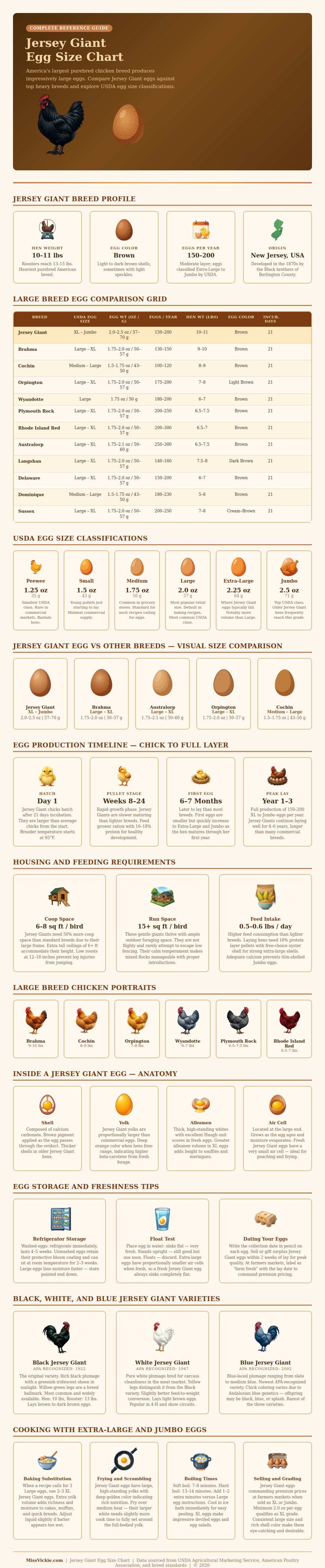
Jersey Giants are America’s biggest purebred chicken. Their eggs is heavy, with large shells that bring you a certain satisfaction. Those brown egg (shown in the infographic next to other breed sizes) are a great selling point at farmers markets. But first they need to come out of coop. And that’s the trade-off: The Jersey Giant has a slower-than-average pace of life but also produce larger eggs. Knowing that matter for your coop and your kitchen.
Owning a lot of chickens doesn’t necessarily mean you have a lot of chicken eggs. Most people who own flock believe bigger equals more egg. Not true. Three brothers developed this breed at the end of the nineteenth century with the goal of creating an efficient meat and egg producing bird. The resulting bird are called a Jersey Giant.
Jersey Giant Eggs: Big and Slow
On average, these hens will produce between one hundred fifty and two hundred eggs per year. In today’s world, where commercial hybrid hens lay many more then this, it sounds like not very much. However, what they lack in numbers they make up for in size. Oftentimes, their eggs weigh out on the USDA Jumbo scale. A single shell weighs as much as two point five ounces. You won’t be getting them every day, but when you do, you’ll feel pretty well fed.
Check out the chart comparing some breeds of chickens such as the Australorp or Rhode Island Red. Those birds lay more eggs, but they’re smaller ones. It’s a case of quantity versus quality. For most home cooks, the bigger egg win on the quality argument.
The fact that it takes patience to raise these birds is something new keepers often forget. These are not fast-maturing birds. Expect to wait until they are at least six months old before you get any eggs from them. That is a bit longer then standard layers, which might start producing at five months. Why? They is building so much bone mass and muscle. They’re just big bird.
And that means being careful about caring for them in the brooding process. Because of their large bodies they require larger amounts of space (compared to typical baby chicks). Without adequate room they can develops leg problems which may cause mobility issues as adults. In addition, because they are taking longer to feather-out and grow up, you’ll want to feed them a high-protein grower ration when they reach “pullet” status. Their large body needs it. If you use a layer diet too soon, you’ll end up with brittle eggs or even kidney issues. Let nature take its course and allow them to grow at their own rate.
Once she reaches maturity, expect her to keep producing well into her fourth or fifth year. These hens last a lot longer then those commercial birds that burn out fast. If you change your expectation about what an egg can do, then you can enjoy them cooked as well.
When cooking eggs, keep in mind that normal recipes expect a Large egg. Two-ounce eggs are called Large eggs. On average our eggs is upwards of twenty five percent heavier than that. So when a recipe asks for three large eggs, you’ll end up with a dense, watery mess if you put three jumbo in. Try one less egg and cut back on some liquid or use a smaller bowl if necessary.
In terms of taste, the bigger amount of yolks make it richer and brighter. Scrambled, a souffle, or custard, these types of dishes where texture is key work great with Jersey Giants. What is the boiling time? You would of want to increase this by a minute or so, since there’s just more to get hot in the first place. It’ll take longer to set because there is simply more material to heat through.
Because their eggs are so large, storage time is also affected by size. Fresh eggs have a small air cell and thicker shells. They are surprisingly good keepers. Just like with smaller breeds, you can count on a float test here. Put one in a bowl of water and a fresh Jersey Giant egg will sink right to the bottom. To help them stay fresh, store them pointed end down. This keeps the yolk central and off the shell.
At the farmers market, where buyers see the big speckled brown eggs, you’ll get top dollar because the perceived richness and novelty appeals to consumers. Demand that top dollar by labeling them clearly with the lay date.
If you’re keeping Jersey Giants, then you must accept the pace. This isn’t an egg factory. This is a farm where you grow heritage chickens that provide quality, not quantity. See the numbers on the chart but feel the stillness of the hen and the heft of her egg: that’s the experience. And it’s that heaviness that tells you to remember there are some things worth waiting for. This applies to something being fully mature or for the perfect rise of a loaf of bread.