Jello Set Time Calculator
Estimate soft set, slice-ready, and unmold-ready chill time from mold shape, jello volume, fridge temperature, gelatin strength, fruit, creamy layers, and the serving deadline.
Pick a common party or dessert plan, then tune the mold, cups, fridge, add-ins, firmness, and serving target to match your bowl.
Your Jello Chill Plan
Results update from your mold and mix.
Formula Breakdown
Timing Adjustments
Chill Timeline
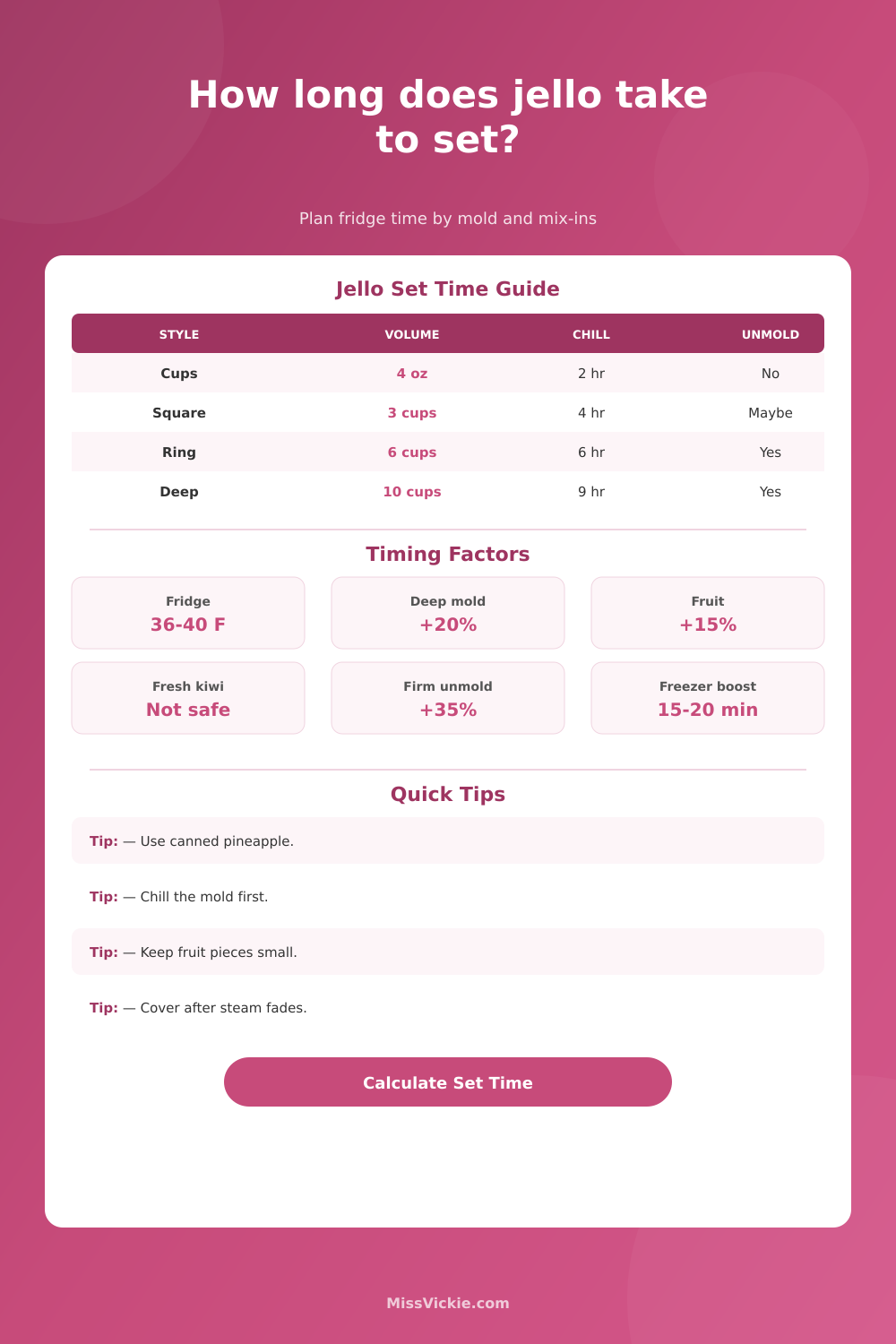
| Mold Style | Best Volume | Usual Slice Time | Unmold Notes |
|---|---|---|---|
| Small dessert cups | 0.5 to 1 cup each | 2 to 3 hours | No unmold step; fastest chill path. |
| Shallow square pan | 3 to 6 cups | 3.5 to 5 hours | Good for cubes, bars, and lunchbox pieces. |
| Ring mold | 5 to 8 cups | 5 to 7 hours | Chill overnight for a clean platter release. |
| Deep glass bowl | 6 to 12 cups | 7 to 10 hours | Center sets last; avoid a short same-day plan. |
| Add-In | Set Effect | Timing Change | Best Practice |
|---|---|---|---|
| Drained canned fruit | Dilutes and cools the gel slightly | Add about 10% | Drain well and fold in during partial set. |
| Fresh berries | Adds cold mass and pockets | Add about 15% | Pat dry so juice does not weaken the network. |
| Citrus juice | Acid slows firmness | Add about 18% | Use a firm gelatin option for sharp flavors. |
| Fresh pineapple or kiwi | Enzymes break gelatin | May never set | Use canned or briefly cooked fruit instead. |
| Fridge Temp | Plain Cups | Shallow Pan | Deep Mold |
|---|---|---|---|
| 34 to 36 F | 1.75 to 2.5 hr | 3 to 4 hr | 5.5 to 7 hr |
| 37 to 40 F | 2 to 3 hr | 4 to 5 hr | 7 to 9 hr |
| 41 to 43 F | 2.5 to 3.5 hr | 5 to 6.5 hr | 8.5 to 11 hr |
| 44 to 48 F | 3 to 4.5 hr | 6 to 8 hr | 10 to 13 hr |
| Gelatin Style | Texture Goal | Strength Factor | Use Case |
|---|---|---|---|
| Standard boxed jello | Soft slice | 1.00x | Everyday bowls, cups, and pans. |
| Firm cut cubes | Clean edges | 0.88x timing | Finger jello and buffet pieces. |
| Extra gelatin | Platter hold | 0.80x timing | Detailed molds and travel desserts. |
| Homemade juice gelatin | Variable | 1.15x timing | Fruit juice, tea, coffee, and custard blends. |
Small portions chill from every side and can be ready for a simple snack.
A shallow square pan gives even thickness for cubes, strips, or layered bars.
A ring mold releases well after a firm overnight chill and a brief warm dip.
A deep bowl has a thick center, so schedule it early for party service.
Food safety note: keep prepared jello refrigerated and avoid long room-temperature display, especially with dairy, whipped topping, cream cheese, or fruit salad add-ins.
A friend invites you over for dinner on a Tuesday night; the meal plan features: jello. You grab the box from your pantry to see whether it’s possible by six pm. Since gelatin doesn’t set until after a period of time, you assume the timeline is flexible. But you’re wrong. That malleability are an illusion. This has as much to do with physics as it does with recipe boxes.
Using a calculator make the guesswork turn into a schedule. It factors in the volume and the shape of mold, not only what instructions on side of box say.
Why Jello Setting Time Varies
The biggest error people makes is thinking jello sets in exactly the same amount of time. Wrong! How fast jello chills depends on how thick your dessert is. If you put the exact same amount in a fancy ring mold versus a shallow square pan, the surface area will be smaller so the heat escapes faster in every direction. But the center stay warm because it is insulated. Since the thickest part must chill much longer before it’s considered safe to serve (as opposed to the edges), the calculator factors in shape here too.
The other reason why folks mess up here is because they feel around and feel a bit of wiggle on the surface, so they think it’s good to go. They only discover that middle hasn’t cooled yet when they unmold it.
It also takes into account temperature. Few of us change our refrigerators’ default setting; few think about what number we’re running our fridge on and how that affects cooking time. Does your fridge run hotter, say, at forty-two degrees? That’s not the same as if it runs cooler, say, at thirty-eight degrees. Do you have a small fridge, or do you often find yourself opening the fridge repeatedly as you prepare food? That means your fridge has to work extra hard to keep everything steady. The tool does just that: it provides a more realistic window for when your cooling environment isn’t perfect. It accounts for the real world. It considers doors swinging open as you chop veggies and fridges getting cluttered with leftovers.
And then there’s what you put into the mix. Proteins forms a mesh when cooled, and one of them is called gelatin. Water molecules gets caught in the mesh. However, certain fruits. Kiwis, pineapples, and papayas, are enzymatic and literal digest the protein structure of that mesh. These are the structural-integrity issues: the protease in those three fruits eats the gelatin before it has time to set up and hold things together. There’s simply nothing you can do to chill your way out of this problem; the molecular network is irreparably broken. The calculator will flag it right away.
If you don’t mind a loss of structure (and want something that holds), stick with citrus and berries, or use canned pineapple/fruit, which was heated enough to kill off the digestive enzymes. It is a little thing, but it makes all the difference between success and failure.
Then there’s the factor of dairy and creamy layers. Yogurt or heavy toppings such as whipped cream all insulate the layers beneath them, cooling them slower still, with different heat properties from clear gelatin itself. Because the inside layers in a layered dish like a trifle are sandwiched by warmer components on both sides, they will take longer to cool than a plain bowl of one layer. Even though the box might claim four hours for little cups, overnight may be your best bet for complicated shapes, even in a larger mold. After all, you aren’t just cooling water; you’re cooling a layered dessert with different densities throughout.
Jello-making isn’t about reading directions; it’s about learning how things work. It stops being magic and starts becoming physics, and all the worry goes away. Some fruits are a major structural problem. The warmth of your fridge slows things down. Deep molds also takes longer to set.
The calculator turns this knowledge into something you can use to plan ahead with confidence. There won’t be any guesswork when your guest arrives wondering if they should of panic. You’ll have a precise idea of exactly when “wobbly” turns into a “solid slice. And that kind of peace-of-mind is more valuable then the time it takes to calculate it.