James Hoffmann Tiramisu Calculator
Scale an espresso-forward tiramisu by servings, dish footprint, ladyfinger layers, mascarpone cream ratio, yolk-sugar balance, soak strength, cocoa, chill time, and optional alcohol.
☕Espresso tiramisu presets
Choose a realistic starting point, then tune the dish size, cream richness, soak time, and alcohol choice for your own pan.
⚖Measurement mode
🥣Servings and dish
🍪Ladyfingers and espresso soak
🥚Mascarpone cream balance
🍷Alcohol option
Scaled espresso tiramisu plan
Dip briefly, build evenly, and chill before slicing.
Batch breakdown
📏Serving and layer reference
Good after a large meal with coffee.
Balanced portion for plated dessert.
Best when tiramisu is the main dessert.
Useful for buffets and tasting portions.
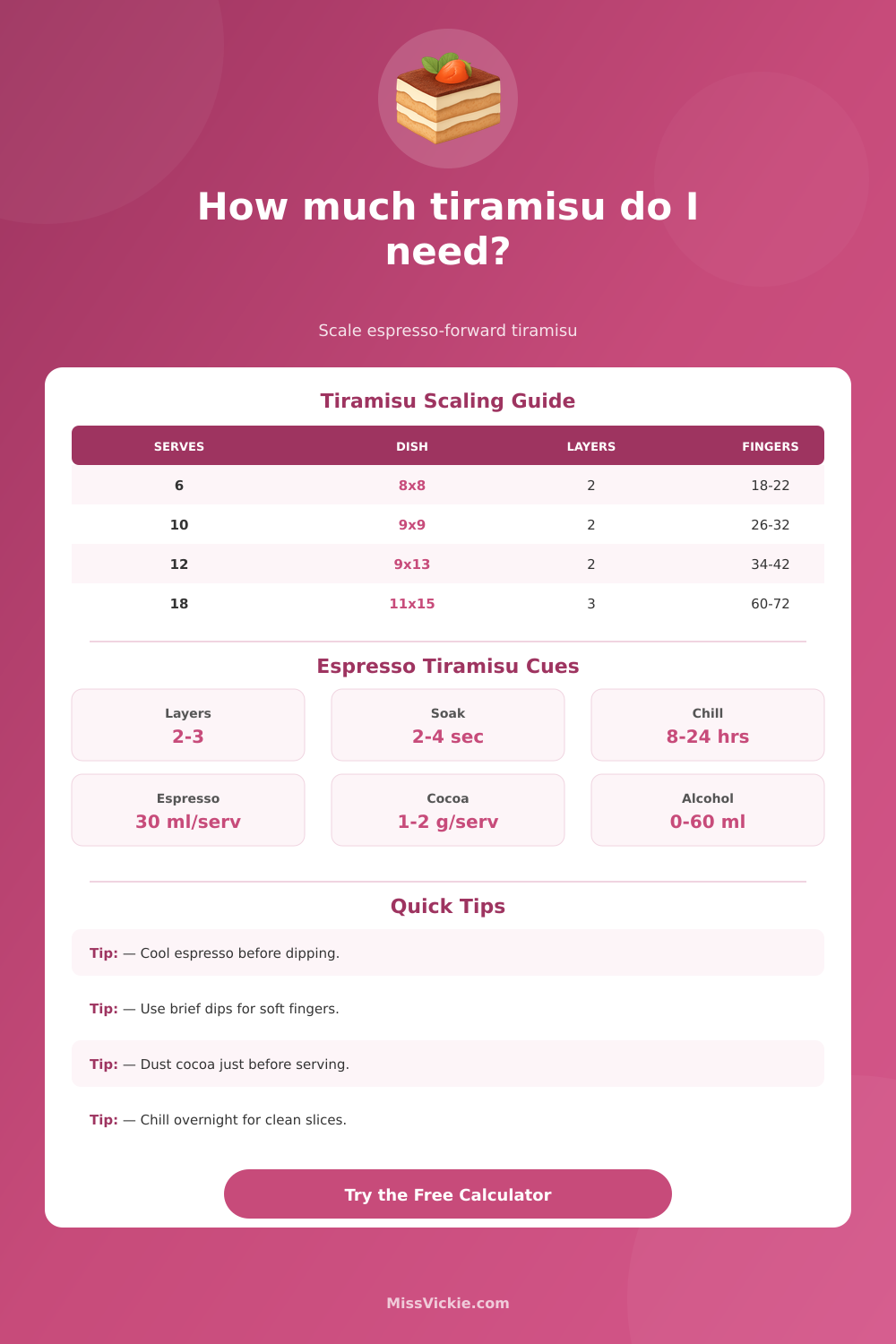
📋Dish, layer, and soak guide
| Dish format | Typical servings | Ladyfinger layers | Espresso dip guide | Chill target |
|---|---|---|---|---|
| 8 x 8 in / 20 x 20 cm square | 6 to 9 slices | 2 layers | 2 seconds per side for dry savoiardi | 8 to 12 hours |
| 9 x 9 in / 23 x 23 cm square | 8 to 12 slices | 2 layers | 2 to 3 seconds per side | 10 to 16 hours |
| 9 x 13 in / 23 x 33 cm rectangle | 12 to 16 slices | 2 layers | 2 seconds per side, with reserve coffee | 12 to 18 hours |
| 11 x 15 in / 28 x 38 cm tray | 18 to 24 slices | 2 to 3 layers | 1.5 to 2 seconds per side | 16 to 24 hours |
| Ramekins or cups | 1 per cup | Pieces, 1 to 2 layers | Brush or quick dip broken pieces | 4 to 8 hours |
🧀Cream ratio guide
| Cream profile | Mascarpone target | Yolk and sugar balance | Texture result | Best use |
|---|---|---|---|---|
| Lighter cream | About 55 g per serving | Lower sugar, fewer yolks | Cleaner coffee and biscuit bite | Small portions after dinner |
| Balanced mascarpone | About 65 g per serving | Moderate sugar with sabayon-style yolks | Soft, sliceable, classic layers | Most square and rectangle pans |
| Lush cream | About 78 g per serving | More sugar and a small cream lift | Thick visible cream bands | Generous dessert slices |
| Sliceable firm | About 72 g per serving | Steady yolks and restrained cream | Neater cuts after overnight chill | Buffets and sheet trays |
🍽Common scaled amounts
| Servings | Ladyfingers | Mascarpone | Espresso dip | Cocoa |
|---|---|---|---|---|
| 6 servings | 18 to 24 pieces | 390 to 470 g | 180 to 230 ml | 8 to 12 g |
| 10 servings | 28 to 36 pieces | 650 to 780 g | 300 to 380 ml | 12 to 18 g |
| 12 servings | 34 to 44 pieces | 780 to 940 g | 360 to 460 ml | 15 to 22 g |
| 18 servings | 58 to 72 pieces | 1.1 to 1.4 kg | 540 to 700 ml | 24 to 34 g |
📊Estimated nutrition per standard slice
Varies with mascarpone and slice size.
Mainly from mascarpone, yolks, and biscuits.
Higher with lush cream profiles.
Mostly ladyfingers and sugar.
💡Espresso tiramisu scaling tips
Keep the coffee cooled. Hot espresso loosens mascarpone cream and makes ladyfingers collapse faster, especially in a tall dish.
Do not chase a wet center. Tiramisu softens while chilling, so a slightly firm build often becomes just right after an overnight rest.
Home-made tiramisu is always a bit of a guessing game. How many will it serve? Roughly. Then how much mascarpone? Espresso? Ladyfingers? It’s all a messy calculation that goes awry as soon as you change any variable: What if I use a bigger (or smaller) pan? Stronger (or weaker) coffee? Soak longer (or shorter)? And then there’s the thickness of the cream, just a smidgen different and the entire dessert veer from soft in the middle to sliceable.
To use the calculator (above), simply enter how large your pan is and how many people will be served from it, and let the calculator do the rest. But you need to know why that matters. Why does it ask for the width and length of your dishes, for example? Because those numbers represent the space available for ladyfingers; too small, and they’ll have to be trimmed down, or worse yet, won’t fit at all.
How to Use the Tiramisu Calculator
Why does it want to know the depth of your dish, as opposed to its total height when full? Because depth affects how much actualy cream you’ll need for each layer. And why does it ask for usable filled height instead of total dish height? Because adding another layer requires dipping less deep into the dish, since the previous layer must remain intact.
Small choices compound in other places too, such as soak time. Room temperature water gets absorbed faster then cold; soft sponge fingers take longer than dry savoiardi; strong coffee permeates more slowly than weak. That’s why the calculator requests how long you’d like each side of the finger to soak in the dip (and why it can predicts if you’ll have a very moist base or one in collapse).
The reasoning works with alcohol as well. It’s easy enough to add a couple of milliliters per serving (but the calculator limits it), so you don’t get an espresso-flavored rum cake but rather one where the espresso remains dominant. Most people gets tripped up by balance in cream. To get a rich texture that can be piped and has enough time to chill before slicing, the cream needs to be more lusurius. Lighter cream will let the coffee and biscuit shine through (great for smaller servings following a full meal).
This tool doesn’t force you to memorize grams of mascarpone per serving, either, you can play around with different cream profiles and then compare side-by-side. It even logs how much the whipped cream expands above its base in the pan, allowing you to adjust to a lighter texture while keeping the same surface area.
The silent factor is whether the dessert will slice cleanly. The answer depends on chill time, which varies based off factors like depth, number of layers, and egg method, and the calculator lets you see where your selected chill time falls in relation to the suggested minimum (and if it’s a low reading, you might expect the middle to remains somewhat soft upon slicing). For best results, most often it’s simply easiest just to wait overnight.
But it’s when you tweak one of those settings and observe the others respond that the calculator shines. Begin with your basic square pan for 10 servings. Want more layers? According to the tool, that means more coffee, a bit less time in the fridge, and a firmer cream layer. These things might seem obvious after the fact, but they are easy to miss when measuring by eye.
The calculator just takes away the math from your head, freeing up space to think about the thing that really matters: did this turn into a soggy compromise between espresso and cream or does it taste like both of them? You should of seen how much easier it is once you use it.