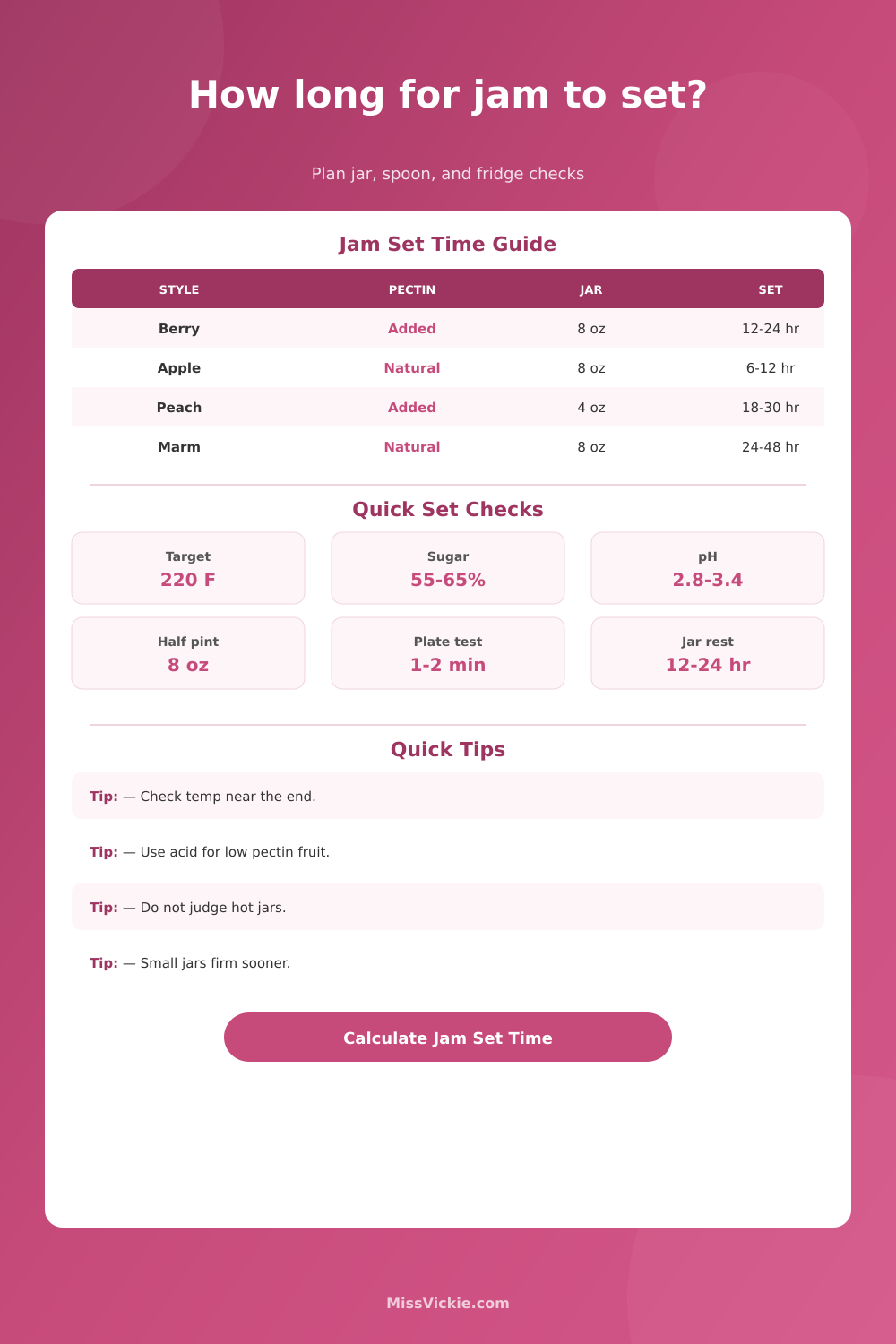
Jam Set Time Calculator
Estimate jam, jelly, preserve, and marmalade firming time from fruit pectin, added pectin style, sugar strength, batch volume, jar size, finish temperature, acid, and your preferred set test.
🫙Presets
Choose a common canning scene, then adjust the details for your own pot and jars.
⚖Jam Inputs
Jam set plan
Your timing will appear after calculation.
Formula Breakdown
Batch Details
Set Stages
📊Set Benchmarks
🍓Fruit Set Profile Table
| Fruit | Natural pectin | Typical set pattern | Best support |
|---|---|---|---|
| Strawberry | Low | Soft early set, firmer after rest | Added pectin plus lemon juice |
| Blueberry | Medium | Fairly steady with enough sugar | Regular or low sugar pectin |
| Peach | Low | Slow jar finish with tender fruit | Powdered pectin and bright acid |
| Plum | Medium high | Good natural gel after cooling | Longer boil or citrus seed pectin |
| Apple | High | Fast jelly set when cooked to temp | Acid balance and skimmed foam |
| Citrus marmalade | High from peel | Late bloom as peel and syrup cool | Long rest before judging jars |
🫙Pectin Style Table
| Pectin style | Sugar need | Common first check | Watch point |
|---|---|---|---|
| Regular powdered pectin | High sugar works best | 12 to 18 hours | Overcooking can make a stiff gel |
| Liquid pectin | Classic sugar batches | 12 to 24 hours | Add near the end of the cook |
| Low sugar pectin | Works with reduced sugar | 18 to 30 hours | Use the pectin maker ratio |
| No added pectin | Needs fruit pectin and acid | 24 to 48 hours | Temperature and fruit choice matter |
| Citrus peel pectin | Moderate to high sugar | 24 to 48 hours | Marmalade can firm slowly |
| Freezer jam pectin | Depends on the packet | 30 minutes to 3 hours | Cold storage is part of the set |
🫙Jar Size Cooling Table
| Jar | Approx size | Cooling behavior | Set timing effect |
|---|---|---|---|
| Sample cup | 2 oz / 60 ml | Cools very fast | Shortens first check by about 20 percent |
| Mini jar | 4 oz / 120 ml | Fast home gift size | Often ready to judge same day |
| Half pint | 8 oz / 240 ml | Standard jam jar | Use as the baseline |
| Wide half pint | 8 oz / 240 ml | More surface area | A bit faster than narrow jars |
| Tall jar | 12 oz / 355 ml | More heat in the center | Adds a few hours |
| Pint jar | 16 oz / 475 ml | Slowest cool down | Judge after a longer rest |
🧪Acid And Sugar Table
| Balance | Set impact | Best use | Adjustment clue |
|---|---|---|---|
| pH 2.8 to 3.4 with 60 percent sugar | Strong and predictable | Traditional jam and jelly | Check once jars are cool |
| pH 2.8 to 3.4 with low sugar | Needs the right pectin | Reduced sugar recipes | Use low sugar pectin |
| Mild acid near pH 3.5 | Soft or slower set | Sweet ripe fruit batches | Add lemon if the recipe allows |
| Weak acid above pH 3.6 | High soft-set risk | Only tested recipes | Do not guess for canning safety |
| Honey blend | Can firm more slowly | Small specialty batches | Expect a longer rest window |
| Very low sugar | Needs specialty pectin | Fridge or freezer jam | Use cold storage guidance |
🔍Comparison Grid
Regular pectin, enough sugar, and half pint jars usually firm after a normal overnight rest.
Natural pectin batches rely on fruit choice, acid, and finish temperature, so the jar check is later.
Reduced sugar can work well with the right pectin, but the set is often softer at room temp.
Cold storage pectin firms faster, but the texture is designed for fridge or freezer holding.
💡Jam Set Tips
This calculator estimates texture and set timing for planning. It does not replace a tested preservation recipe or food safety processing chart.
Sometimes it looks like a disaster: You open up your newly filled jar, and it’s liquid; not that firm jelly-like substance you were aiming for. It is rarely a failure. No; that doesn’t happen during the minutes the pot was bubbling away on the stovetop. The magic moment come after the heat has been removed and pectin chains have had time to link and form their structures.
So why chase the boil? What you realy need to know is all about set time. Once you know what type of fruit and which size jar you’re working with, just enter those into the calculator above, and it’ll do all the math for you (no more guesswork about whether your batch should of cooked for twelve hours or forty-eight). It does this by taking in account the level of acidity and sugar amount in your selected fruit as well as its built-in level of pectin (the natural structural glue that holds everything together).
Why Jam Takes Time to Set
If you’re using low-pectin fruit, such as peaches or strawberries, you must rely on longer cooking time (or added pectin) to develop this network. By contrast, high-pectin fruit (such as apples, or underripe green plums) has the structural glue already, so they sets up quicker. These factors are all part of the algorithm that provides you with an accurate range of time in which to check your jars.
“People think of sugar as only a flavor enhancer, but it’s also a coagulant and a preservative. It binds water molecules, leaving less water available for the pectin to interact with. If you use less sugar in your ingredients, the calculator will show that it take much longer to set. The reason is: Less sugar = more water activity = more dilution of the pectin molecule, which weakens its structure. If the pH is perfectly right, then yes, maybe you’ll get away with it. But margin of error is smaller. More than anything, this is what home jam maker forget to consider when they try even lower-sugar recipes, unless they are already expecting a different texture.
Similarly, acidity supports but does not star. Why? Because of the chemistry: In an acidic environment, hydrogen ions shields the negative charges on pectin molecules, allowing the chains to come close enough to bond. Adding citric acid or lemon juice can be more than brightening, especially if your fruit is inherently mild such as ripe peaches; it’s also about building structure. Indicate an ideal or even brighter-than-ideal acid level on the calculator and it will reduce the estimated wait time accordingly because of that chemical reaction. High-pectin plus high-sugar can produce a runny mess even without it.
The size of the jar matters: Smaller ones cool down fast, which means the chemical-bonding thing happen sooner. A big pint jar holds so much heat; even when the top cools off, there’s still a bunch lingering around in the middle. And because it has a narrower mouth different than a wide-mouth pint, its glassy walls also radiate away heat quickly. The chart on the page explains it nicely: Smaller volumes, wider mouths; faster firming. Bottom line: Making multiple small batches in various jars is not just a way to get your jam done sooner, it’s a valid jam-making strategy if you’re impatient.
But it doesn’t change how your recipe work. Never judge a jam in its hot state. Even when it sets beautifully overnight, the jam will still appear runny and a disappointment at this stage. Every year, people waste good batches because they think that’s what the recipe looks like. Filling the jar, sealing tightly, then walking away: This is the safest bet. Gravity and temperature will take over, with or without your interference.
Perhaps run the plate test early on, only to see that you reach a rolling boil (that would be nice). But wait for the clock. Then let nature have her way. Let it cool down and rest on the counter to breathe and firm up. Liquid turns solid through patience, just as reliably as heat ever could.