Italian Seasoning Per Pound of Meat Calculator
Scale Italian seasoning by meat pounds, meat type, dish style, dried or fresh herbs, garlic, onion, salt included, tomato sauce amount, fennel, chili, batch multiplier, and flavor intensity.
🌿Italian meat seasoning presets
Choose a kitchen scenario, then fine-tune the meat weight, herb form, sauce level, garlic, onion, salt, fennel, chili, and intensity.
⚖Seasoning calculator units
🥩Meat pounds, meat type, and dish style
🧄Garlic, onion, salt, fennel, and chili
Italian seasoning results
Batch and dish breakdown
Seasoning bowl amounts
The calculator will flag herb levels that may taste too faint or too leafy after sauce dilution.
📌Italian seasoning reference cards
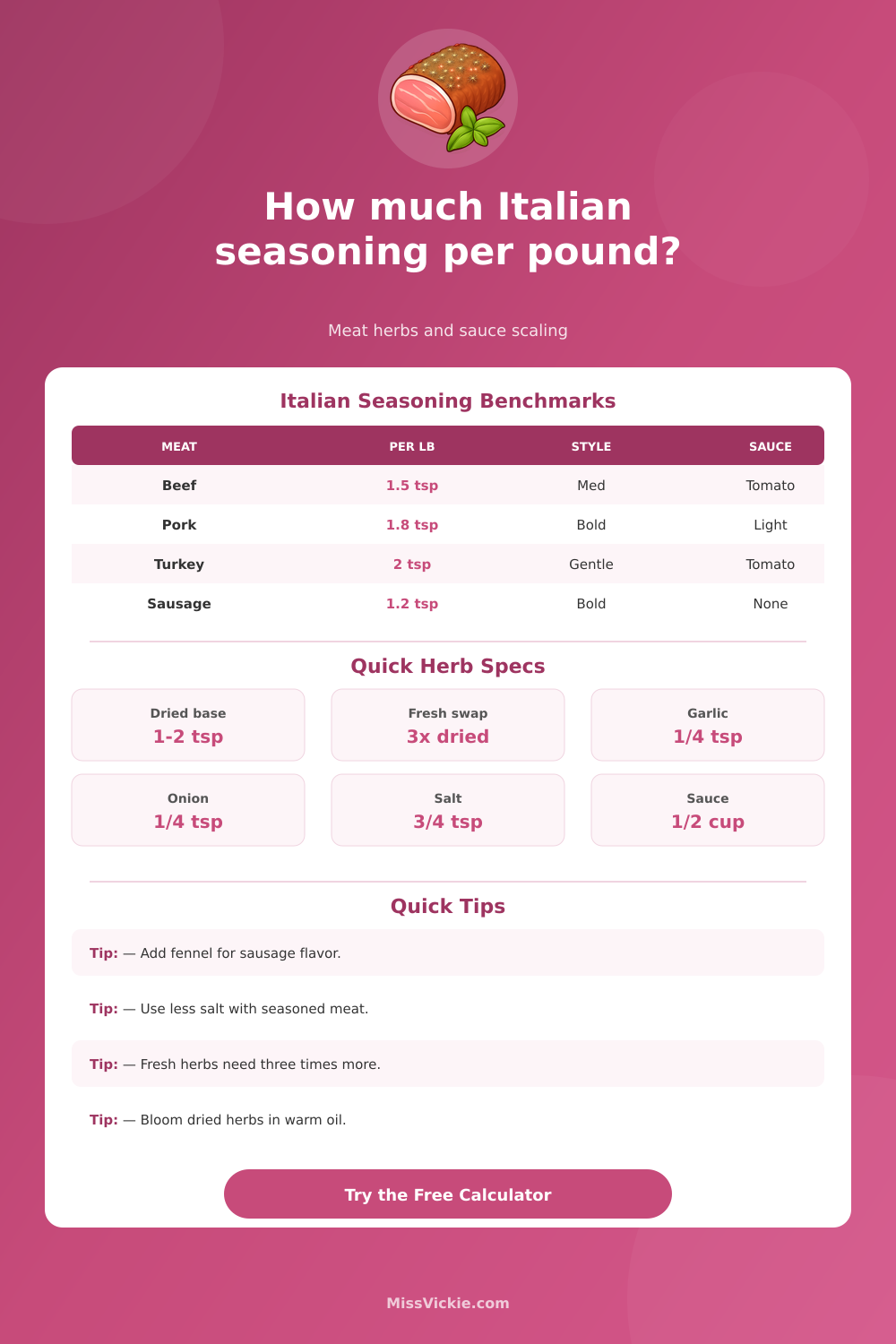
Typical range for ground meat before tomato sauce dilution.
Fresh chopped herbs need about triple the dried volume.
A light meat sauce uses about half a cup tomato sauce per pound.
Garlic powder per pound is a steady starting point.
📊Meat and dish seasoning guide
| Meat or dish | Dried Italian seasoning | Garlic and onion cue | Fennel or chili cue |
|---|---|---|---|
| Ground beef meatballs | 1.25 to 1.75 teaspoons per pound | Classic garlic and onion powder | Pinch chili, no fennel unless desired |
| Pork or sausage-style filling | 1.5 to 2 teaspoons per pound | Bold garlic, classic onion | Classic crushed fennel, mild chili |
| Turkey or chicken patties | 1.75 to 2.25 teaspoons per pound | Classic garlic, light onion | Tiny chili pinch; fennel optional |
| Tomato meat sauce | 1.5 teaspoons per pound plus sauce adjustment | Garlic can be bolder in wet sauce | Chili and fennel bloom well in oil |
| Lasagna meat layer | 1.25 to 1.75 teaspoons per pound | Use reduced salt with cheese | Fennel gives sausage character |
| Slow ragu | 1 to 1.5 teaspoons per pound | Keep herbs lower for long simmering | Add chili late if heat fades |
🧂Conversion and sauce adjustment table
| Ingredient | Per pound baseline | Metric equivalent | Adjustment note |
|---|---|---|---|
| Dried Italian seasoning | 1.5 teaspoons | About 1.5 to 2 grams | Raise for turkey, sauce, or bold flavor |
| Fresh chopped herbs | 1 tablespoon | About 3 to 5 grams | Use roughly 3 times dried volume |
| Garlic powder | 1/4 teaspoon | About 0.8 grams | One fresh clove roughly replaces 1/4 teaspoon |
| Onion powder | 1/4 teaspoon | About 0.6 grams | One tablespoon grated onion replaces 1/4 teaspoon |
| Kosher salt | 3/4 teaspoon | About 3.5 to 4.5 grams | Reduce for salty sauce, cheese, or salted blend |
| Tomato sauce | 1/2 cup | About 120 milliliters | Add extra herbs when sauce exceeds this |
📋Common batch examples
| Batch | Meat amount | Dried herb range | Good dish match |
|---|---|---|---|
| Small dinner | 1 pound meat | 1 to 2 teaspoons | Skillet crumble or patties |
| Family sauce | 2 pounds meat | 3 to 4 teaspoons | Spaghetti meat sauce |
| Meatball tray | 3 pounds meat | 4.5 to 6 teaspoons | Meatballs with marinara |
| Lasagna pan | 4 pounds meat | 5 to 7 teaspoons | Layered meat and cheese |
| Party ragu | 8 pounds meat | 10 to 14 teaspoons | Slow sauce or buffet pan |
| Sausage prep | 10 pounds pork | 15 to 20 teaspoons | Bulk sausage patties |
💡Italian seasoning planning tips
Separate salt from herbs. Many Italian seasoning blends are salt-free, but some all-purpose mixes include salt. Choose the salt-included option if the label lists salt near the front.
Account for tomato sauce. A wet sauce spreads herbs through more volume, so the calculator nudges herbs upward when sauce rises above about half a cup per pound.
Measurements are kitchen estimates for seasoning balance. Salt brands vary by crystal size, so taste a cooked sample before scaling a very large batch.
Getting the seasoning right on ground meat can make all the difference. But it all depends on how well you season it. That’s a matter of what dish (how much tomato sauce), which herb (fresh vs. It depends on how much tomato sauce you use, whether you use fresh or dried herbs, and if you are using a full pound of meat. A sausage patty isn’t like a slow ragu or a meatball. And how big is that batch anyway?
You can also add salt from some prepared marinara. Beginner home cooks typicaly add one to two teaspoons of dry Italian seasoning per pound of ground meat. That’s your starting point; but depending on whether it’s fresh vs. The amounts will change depending on if it is fresh or dry and whether tomato sauce are included. Because of their higher water content and lower concentration of flavor, it take about three times the quantity of fresh herbs relative to dry ones; the former will be less concentrated than the latter.
How to Season Ground Meat
And if there’s any sauce involved, the amount of herb required increases, since a wetter blend will dull the herbs unless they’re bumped up slightly. Those calculations are handled by calculator when you input both type of herb(s) and weight of meat.
Some meats require more seasoning than others. If you’re overseasoning, that’s okay with beef, because it can absorbs seasoning quite nicely. Chicken and turkey is mild; you’ll want more herbs so that their flavor stays strong. For pork, like Italian sausage, you might want even more fennel and/or garlic. You can choose the meat type in the calculator, and rates will change to match, no memorizing different rules per protein required.
The culprit is frequently salt. We use pre-made cheeses and sauces that are already salty, yet we’ll also go ahead and pour a full serving on top. That’s why the tool considers the double dose of salt by choosing low-salt version. This way, once sauce has simmered, it won’t be overwhelmingly salty.
The same applies to onions and garlic. Those aromatics mellow as they cook; meaning a fast skillet meal requires a stronger hit different than one that will have hours on the stove. Otherwise you risk having something that’s either overly sharp or just bland. The tool accounts for this and tweaks proportions according to how much longer food will cook.
Fennel and chili are optional accents, not core ingredients. They don’t need to be used, but they change character of final dish. With beef or turkey, a pinch of fennel brings a sweet sausage note. Small amounts of chili flakes bring brightness, not intense heat. The calculator keeps these as individual toggles, so you would only turn them on when recipe requires it.
The tool doesn’t eliminate your need to taste-test while cooking. It just gets rid of the math. This lets you concentrate on how things taste at this stage and how to adjust them when they’re all in the pan. It frees up space to ask yourself whether you want an extra pinch of salt and if there’s enough resting time left before serving.
You should of tried it first.