🥬 Iron in Spinach Calculator
Calculate iron content by preparation method, serving size, and number of servings
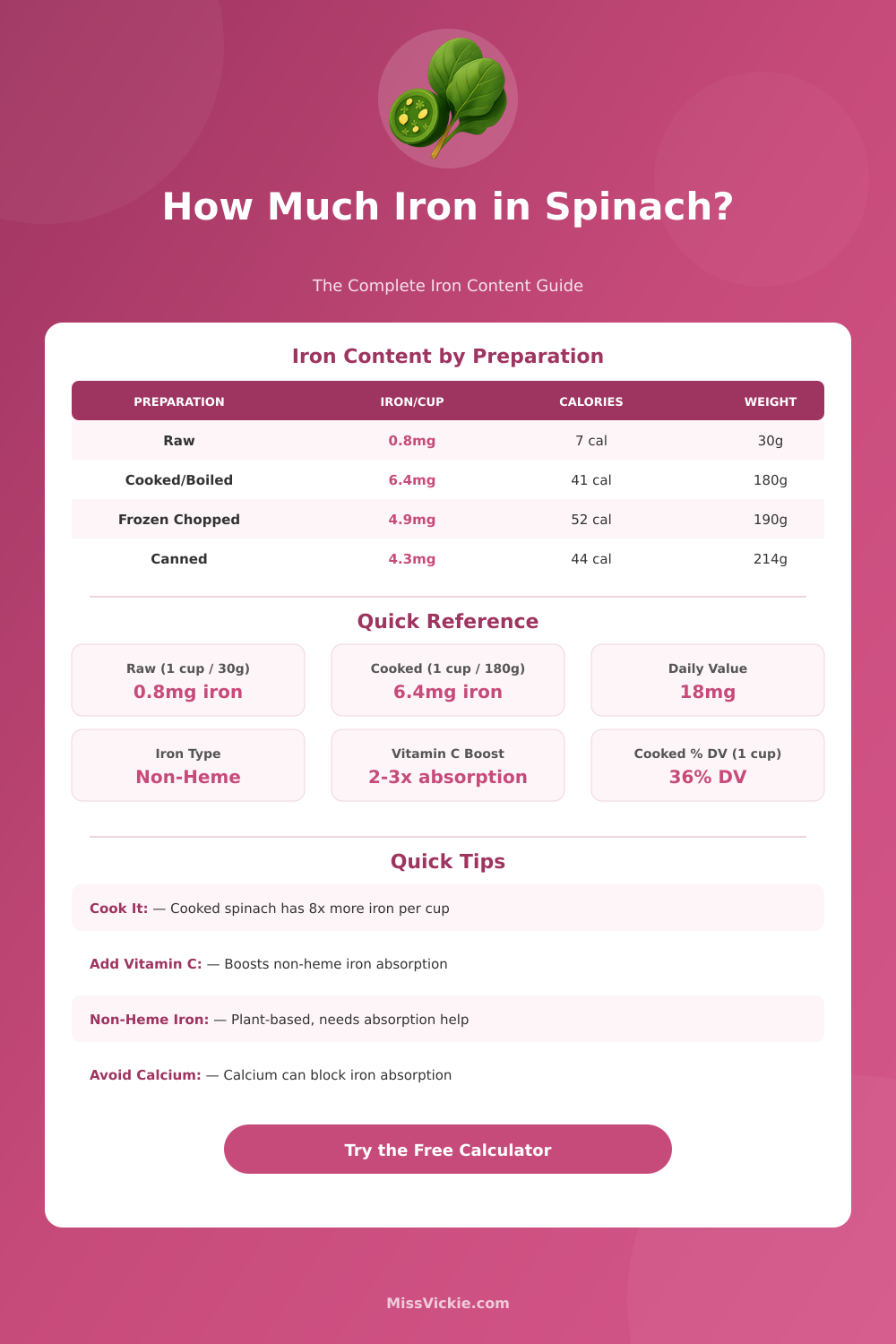
| Preparation | 0.5 Cup | 1 Cup | 2 Cups |
|---|---|---|---|
| Raw | 0.4mg | 0.8mg | 1.6mg |
| Cooked / Boiled | 3.2mg | 6.4mg | 12.8mg |
| Steamed | 3.0mg | 6.0mg | 12.0mg |
| Sautéed | 3.1mg | 6.2mg | 12.4mg |
| Frozen Chopped | 2.5mg | 4.9mg | 9.8mg |
| Canned (drained) | 2.2mg | 4.3mg | 8.6mg |
| Baby Spinach (Raw) | 0.4mg | 0.8mg | 1.6mg |
| Creamed Spinach | 1.8mg | 3.5mg | 7.0mg |
| Food | Iron | Calories | Notes |
|---|---|---|---|
| Spinach (cooked) | 6.4mg | 41 | Highest iron leafy green |
| Swiss Chard (cooked) | 4.0mg | 35 | Good iron alternative |
| Kale (cooked) | 1.2mg | 36 | Lower iron, high vitamin K |
| Collard Greens (cooked) | 2.2mg | 49 | Moderate iron content |
| Broccoli (cooked) | 1.0mg | 55 | Has vitamin C for absorption |
| Lentils (cooked, 1 cup) | 6.6mg | 230 | Top plant-based iron source |
spinach are green leafy plants that come from Persia land in Asia central and west parts. The official name is Spinacia oleracea, and it belongs to the amaranth family. Its leaves form popular food, that one can eat fresh, cooked or kept by means of various methods.
Easy way to prepare spinach is to jump it quickly. Simple recipe for jumped spinach require only olive oil and garlic, and everything cooks in some minutes. One can add salt with garlic and grated parmesan cheese for extra taste.
Spinach: How to Cook It, Why It Is Good, and How to Keep It Fresh
Because spinach have tender nature, it does not require long cook. Naturally it is a bit bitter, hence a little addition somehow eases the good taste. Fresh juice of lemon above the cooked spinach helps well.
One spoon of that juice for one bag of spinach usually works.
Gentle young spinach answer well for salads and raw meals, thanks to its soft structure. After cook it commonly loses its charm. For warm meals older leaves answer better, because they give richer flavor.
Even so raw spinach sometimes has a bit of bitterness.
spinach is present in many kinds of foods. It goes well with sandwiches, egg plates, smoothies and jumped mixes. Putting raw spinach in a smoothie with banana and peanut butter hides its taste well.
Add chopped spinach to soups or stews just before you turn the fire so that it wilts well. Also spinach serves as a base for salads instead of lettuce, because it gives more complete food value. It is used even in baked products like spinach bread or spinach cakes.
In spinach there is good amount of protein, potassium, iron, folate, calcium and vitamins B, C and K. It has little fat and almost no cholesterol. It also stores fiber, niacin, zinc, magnesium, phosphorus, copper and manganese. Eating spinach helps for good sight, for keeping energy, for healthy bones, for heart health and for good skin.
It is useful as a good source for plant protein and iron among vegetarians and vegans.
When buying spinach, one should choose leaves green and crisp, which is normal. One should wash them fully before use, because leaves can carry bacteria. Keep spinach in a sealed tin with paper towel below to extend its freshness.
Lay it between paper towels to help keep the leaves fresh for weeks. Cooking spinach makes it shrink a lot. A serving usually matches too cups raw or one cup cooked.
In raw spinach there is oxalic acid, that can block the intake of calcium and iron. There is a link between oxalates of spinach and stones in kidneys. Better to cook spinach by steam than boil, which is worth remembering.
Boiling can remove nutrients to water. Short cookingtimes and low heat help to keep nutrients more well.