MissVickie kitchen calculator
Ingredient Measurement Calculator
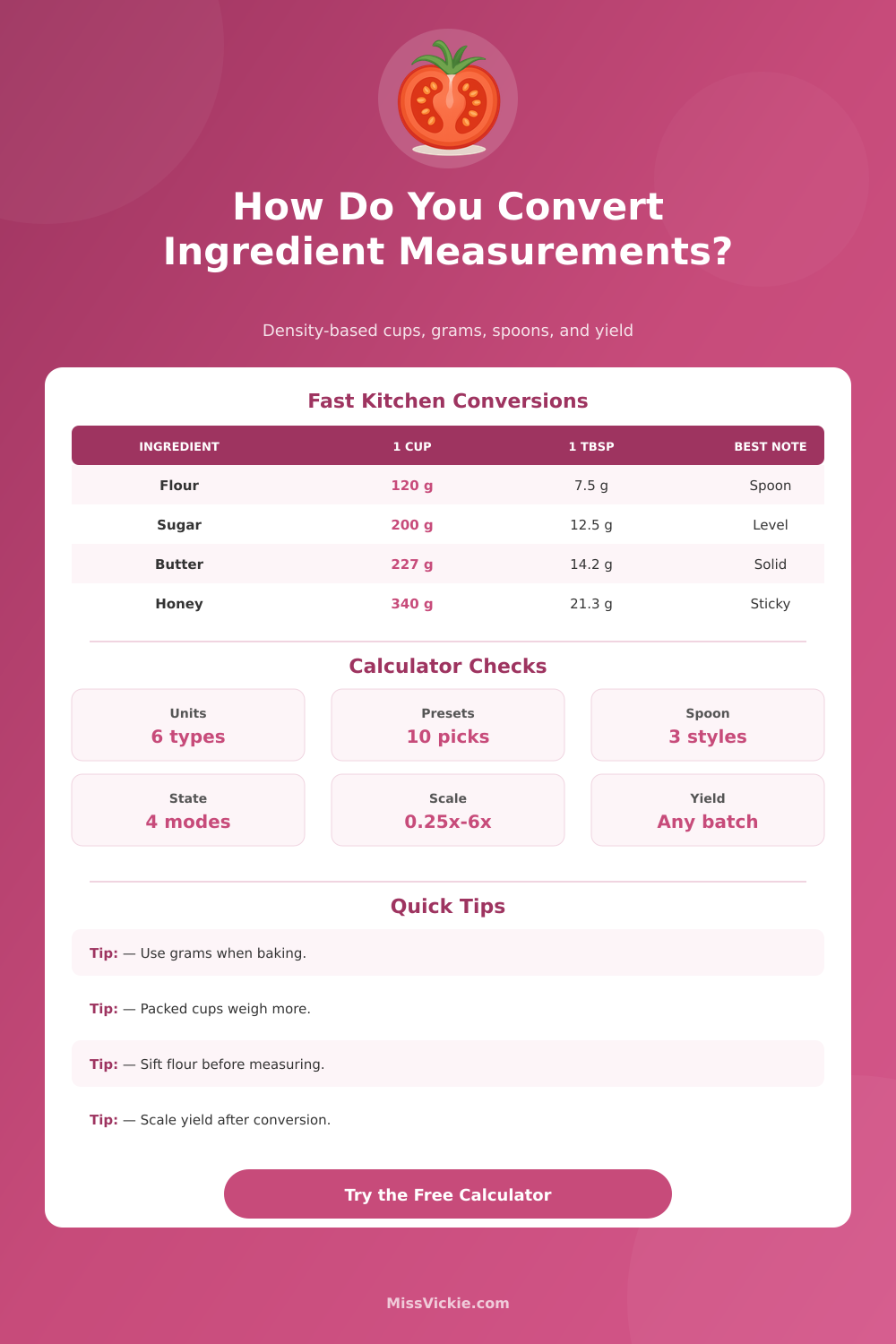
Convert grams, cups, tablespoons, teaspoons, milliliters, and ounces with ingredient density, spoon style, packed or sifted state, recipe scaling, and yield changes in one place.
Choose a real kitchen shortcut
Presets fill the calculator with common baking and cooking situations, then you can fine-tune the amount, unit, density behavior, scale factor, and final recipe yield.
Enter the recipe measurement
Calculation breakdown
Measurement comparison grid
Cups
2.5
Best for quick cooking, less exact for flour and powder.
Tablespoons
40
Helpful when reducing a recipe or checking small batches.
Milliliters
591
Volume reference for liquids, syrups, oils, and spoon math.
Ounces
10.58
Weight ounces, not fluid ounces, for ingredient accuracy.
Density table for common ingredients
| Ingredient | Approx grams per cup | Approx grams per tablespoon | Conversion behavior |
|---|---|---|---|
| All-purpose flour | 120 g | 7.5 g | Changes a lot when sifted, compacted, or scooped directly from the bag. |
| Bread flour | 127 g | 7.9 g | Slightly heavier than all-purpose flour because of protein and milling style. |
| Cake flour | 115 g | 7.2 g | Light and fine, so sifted or aerated measurements can run noticeably lower. |
| Granulated sugar | 200 g | 12.5 g | More consistent by volume than flour, but a scale is still cleaner for baking. |
| Brown sugar | 220 g | 13.8 g | Packing level is the main difference; loose brown sugar weighs much less. |
| Powdered sugar | 120 g | 7.5 g | Sifting matters because lumps and aeration change how a cup fills. |
| Butter | 227 g | 14.2 g | Dense and predictable when measured by stick marks, tablespoons, or weight. |
| Vegetable oil | 218 g | 13.6 g | Volume is usually acceptable, but weight is useful for repeatable dressings. |
| Honey | 340 g | 21.3 g | Very dense and sticky; weigh the jar before and after for cleaner measuring. |
| Unsweetened cocoa | 85 g | 5.3 g | Can compact in the container, so spoon and level for steadier results. |
| Uncooked white rice | 185 g | 11.6 g | Granular and fairly stable, though grain shape changes the cup weight. |
| Milk or water | 240 g | 15 g | Use milliliters and grams almost interchangeably for most kitchen planning. |
| Table salt | 288 g | 18 g | Use exact salt type when seasoning, brining, curing, or scaling rubs. |
Packed, sifted, and spoon-style adjustments
| Setting | Multiplier | Best use | What it changes |
|---|---|---|---|
| Level or swept spoon | 1.00x | Default cups and spoons | Keeps the reference density as listed in the ingredient table. |
| Rounded spoon | 1.15x | Casual cooking | Adds a small mound, so volume-based entries become heavier. |
| Heaping spoon | 1.35x | Loose, non-baking estimates | Adds a larger mound and should not be used for precise cakes. |
| Spooned and leveled | 0.95x | Flour and cocoa | Runs a little lighter than a dense dip-and-sweep cup. |
| Sifted or aerated | 0.88x | Cake flour, icing sugar | Reduces cup weight because more air sits between particles. |
| Packed firmly | 1.12x | Brown sugar, chopped herbs | Increases volume-based weight by compressing the ingredient. |
Recipe scaling examples
| Recipe change | Scale factor | Yield setting | How the calculator handles it |
|---|---|---|---|
| Half a batch of muffins | 0.5x | 12 to 12 | Converts the ingredient first, then returns exactly half the original recipe amount. |
| Double cookies for a party | 2x | 24 to 24 | Doubles the weight and all cup, tablespoon, teaspoon, milliliter, and ounce outputs. |
| Same recipe, more servings | 1x | 8 to 12 | Uses 12 divided by 8 as an extra yield multiplier after density conversion. |
| Triple sauce but smaller portions | 3x | 10 to 8 | Combines the entered scale factor with the yield ratio for the final multiplier. |
| Bakery test batch | 0.25x | 16 to 4 | Keeps tiny quantities readable by showing grams and teaspoons side by side. |
Unit reference table
| Unit | Kitchen equivalent | Metric equivalent | Best for |
|---|---|---|---|
| 1 US cup | 16 tablespoons | 236.588 ml | Fast volume measuring for familiar recipes. |
| 1 tablespoon | 3 teaspoons | 14.787 ml | Small sauce, spice, oil, syrup, and butter amounts. |
| 1 teaspoon | 1/3 tablespoon | 4.929 ml | Salt, leaveners, extracts, and highly flavored ingredients. |
| 1 ounce | Weight ounce | 28.3495 g | Scale-based measuring, not fluid-ounce measuring. |
| 1 milliliter | About 0.203 teaspoon | 1 ml | Liquids and exact metric recipes. |
Two practical measuring tips
This calculator turns ingredient volume into weight with density, measuring style, and batch yield included, so recipe scaling stays more consistent across everyday baking and cooking.
When you use a measuring cup to add an ingredient to a recipe, you are selecting the mass of that ingredient that will be included in the recipe. The way in which you use your measuring cup can impact the amount of air that exists between the particles of that ingredient. The amount of air between the particles of an ingredient can impact the density of that ingredient.
Thus, if the density of an ingredient change, the weight of that ingredient will change, as well. Consequently, if the weight of an ingredient changes, the final result of the recipe may change, as well. For these reasons, measuring methods for ingredients is important to understand, as the methods will impact the actual amount of that ingredient that is included in the recipe.
Why Measuring Ingredients Is Important
A level cup is not the same as a heaping cup of an ingredient. A level cup is a specific amount of an ingredient, while a heaping cup is a cup that contains more mass than a level cup. Furthermore, sifted flour is not the same as unsifted flour.
Sifted flour contains air, which reduces the density of the flour; thus, a cup of sifted flour will contain less mass than a cup of unsifted flour. An understanding of these different measuring method for ingredients is required in order to use the correct amount of an ingredient in a recipe according to the creator of that recipe. Many recipes do not provide the measuring method for an ingredient in the recipe.
For instance, the recipe may ask for one cup of brown sugar, but not whether that brown sugar is packed or spooned. Because packed and spooned brown sugar have different densities, the weight of the brown sugar could be different depending on it’s intended measuring method. Twenty or thirty percent of the weight of the brown sugar could potentially be different for each measuring method.
The calculator described in this article can handle these different possibilities for density of ingredients, as it asks the user for the starting amount of the ingredient, the unit of that ingredient, the spoon style to be used, and the state of the ingredient. Some of the most common reason for altering a recipe is to change the number of servings of the recipe. For instance, one might need to double the recipe to provide food for two dozen people at a party, or perhaps halve the recipe if only a few people will be eating the recipe.
In order to alter the number of servings for a recipe, you must alter each ingredient to ensure that the recipes ratios of each ingredient to the others are maintained. The calculator provides the settings for changing the number of servings in the recipe, as these settings will allow the recipe to automatically adjust the densities of each ingredient according to the number of servings that are to be prepared. Density is the reason why measuring cups may not provide consistent results for individual ingredients.
For instance, liquids have a density similar to that of water. Dry ingredients, however, can have many different densities. For instance, cocoa has a low density when compared to salt, which has a high density.
Additionally, the density of honey is more higher than that of cocoa. Converting the volume of an ingredient to grams is a way to convert that volume to mass. Mass is more important than volume in the kitchen, as the mass of an ingredient will not change based off its density.
Many people prefer the use of weight as a measurement system for its reliability. If you know the weight of each ingredient that you need, you can use simple mathematical equations to adjust the recipe to the amount that you need. The spoon-style options are necessary to account for the impact that spoon type has upon the density of the ingredient.
A level spoon by definition contains the same amount of an ingredient as a spoon that is rounded or heaping that ingredient. These options only matter if the recipe calls for measuring each ingredient by volume; in either case, the weight calculation has already accounted for these differences in the recipe. Some of the most common mistakes that people make in the kitchen include ignoring the fact that not all measuring cups are created equally.
People might not be aware of how the state of an ingredient can change its weight; for instance, dry brown sugar will pack differently than moist brown sugar. Flour that sits in a very humid kitchen may also absorb some of the moisture in the air, which will give the flour an additional weight. The calculator does not account for these variables, but it can still give you a starting point based on the original recipe.
Another potential mistake is in simply scaling the recipe without considering the yield of the baked goods. If you double each ingredient but do not change the yield, the amount of the baked good will be correct, but the nutritional content will be incorrect, as will the sizes of the pans in which each baked good is prepared. By entering both the factor by which you are to scale the recipe and the factor by which you are changing the yield, the recipe calculator can account for both variables to provide you with the correct ingredients and portions.
The reference tables can help you to understand the densities of common ingredients. Each table shows the weight of each ingredient by volume, as well as the impact that spoon style and ingredient state has upon that measured ingredient. While it is not necessary for you to memorize the weights of these ingredients, it is important for you to understand how the density of an ingredient can impact its measurements.
The recipe calculator is simple to use. All that is necessary is for you to choose the ingredient, its original measurement, its spoon style, and its state. Finally, you enter the number of servings (if any) that you are changing the recipe to make.
The calculator will show you the ingredient amount that should be used to prepare the recipe, as well as the weight and the volume of that ingredient. The information about the density and the multipliers of the ingredient will help you to understand how the calculator arrived at its answer. Finally, this type of recipe calculator is especially helpful for those who use recipes from different parts of the world.
Many recipes use cups and liters for volume measurements, while others use grams to weigh ingredients. A reliable recipe converter will allow you to easily change from one measurement system to the other. Thus, with the recipe calculator you can prepare any recipe that you find online or within any cookbook; over time, you will be able to understand which recipes are more sensitive to measuring methods than others.
Additionally, you will no longer have to perform the arithmetic to convert recipes; instead, the calculator will do this for you.