
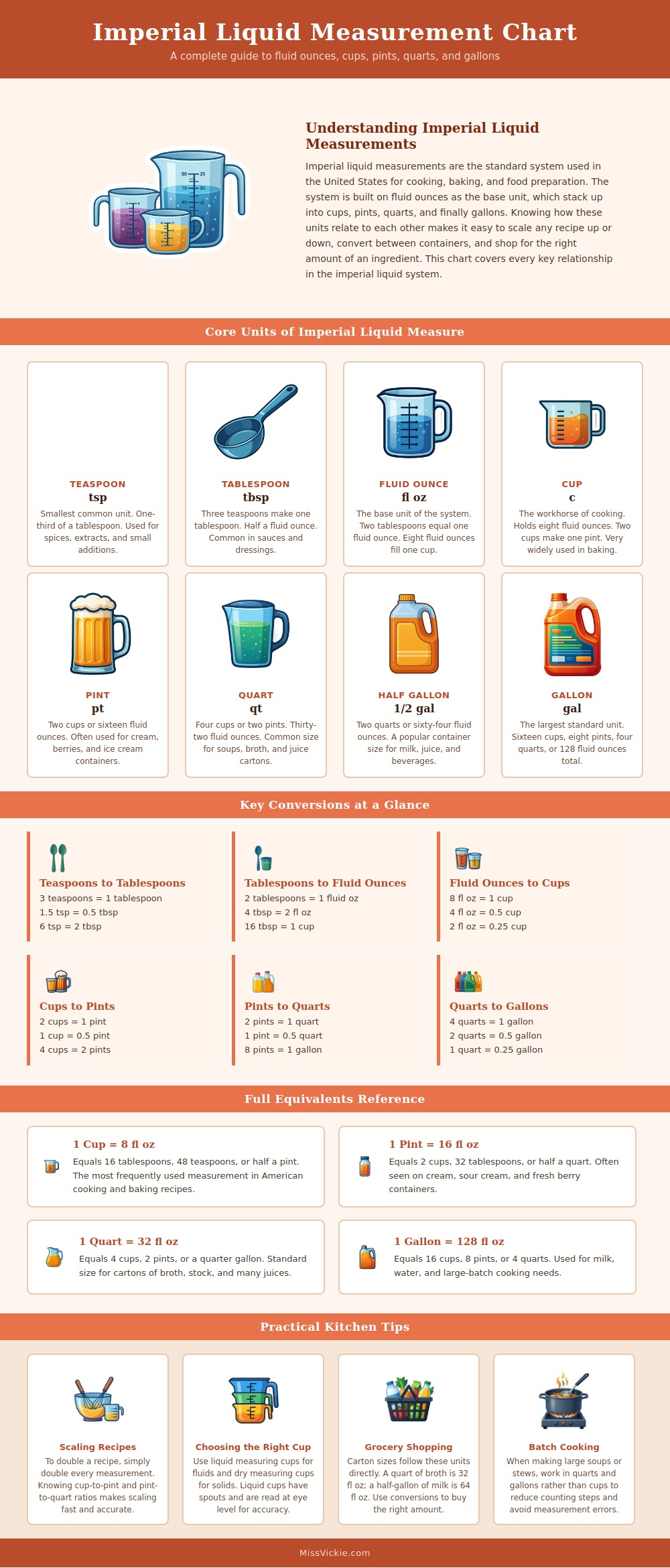
Liquid measurements is the system of units that people use to measure the volumes of the liquids that are in a kitchen. These liquid measurement are based upon the imperial system of units, and they include units like teaspoons, cup, pints, quarts, and gallons. Each of these units can be use to determine how much liquid the ingredient that is to be use contains, and each of the units can be used to ensure that the recipe that is to be prepared use the correct amount of each ingredient for accuracy of the recipe.
The chart that is provided in this article include the different units of measurement that are used for liquids. For instance, one cup are equal to eight fluid ounces. As such, recipes often use this unit of measurement for liquids.
How to Measure Liquids in the Kitchen
However, other units of measurement can also be used to measure the volume of the liquids. For instance, two cups is equal to one pint, two pints is equal to one quart, and four quarts are equal to a gallon. Each of these measurements can be used as a way to convert one unit of measurement to another.
For instance, if it is known that two cups is equal to one pint, then it is also possible to determine that four cups is equal to two pints, and that four cups is equal to one quart. Liquid measurements are slightly different from dry measurements, and the tools that is used for each are different from one another. For instance, a liquid measuring cup have a spout that allows the liquid to exit the measuring cup, and the cup has markings that indicates the amount of liquid contained within the cup.
This tool is used for adding ingredient like milk, oil, or broth to a recipe. In contrast, dry measuring cup have no spout, but have straight edges that allow the ingredient that is being measured to be pour into the measuring cup until it is filled, but these tools are not used for liquids; using these for liquids may introduce error into the recipe. Scaling a recipe is a process that involve increasing or decreasing the amount of ingredients that must be used within a recipe.
As such, the knowledge of liquid measurements make it easier to scale a recipe. For instance, if a recipe calls for three cups of stock, but the individual desire to prepare double the amount of the recipe, the individual will need to double the number of cups of stock, changing the amount of stock to six cups. As such, the requirement of six cups is also equivalent to three pints of stock, so this could also be used as the measurement of stock that would be needed for this doubled recipe.
Additionally, knowledge of these measurements can also help cooks when grocery shopping, as well. For instance, if the amount of milk that is required for a recipe is half of a gallon, it is important to know that this is equivalent to two quart of milk, which may help the cooks to make certain that they purchase the correct amount of milk to satisfy the requirements of the recipe. Other ways to reduce errors in the kitchen include reading the measurements of liquids at eye level to avoid introducing a parallax error into the recipe; the cook creates the parallax error when the cook reads the measurement markings for the liquid while viewing the ingredient from an incorrect point of view.
Additionally, for cooks that are preparing large amount of food, the use of larger units of measurement for liquids, such as quarts, may reduce the number of errors that could occur during the cooking process. Overall, the chart help cooks to remember the different measurements for liquids and the relationship between each of the units of measurement. This provides cooks with a mental map of each of the measurements, so that they dont have to rely upon the performance of mental math in the kitchen.
For instance, if a recipe require one quart of liquid, but the cook does not have any container for liquids that contain a quart measurement, the cook can utilize the information within the chart to determine that two pints will also make up one quart of liquid. Thus, the liquid measurements chart allow cooks to understand each of the units of measurement, and to use those units of measurement within the kitchen with ease and confidence.