Icing Sugar for a Cake Calculator
Estimate the icing sugar needed for a cake from diameter, layer count, frosting type, crumb coat, final coat, filling, decorations, butter ratio, waste, and servings.
Load a common cake plan, then adjust thickness, filling, decoration coverage, butter ratio, and waste for your exact finish.
Icing Sugar Breakdown
| Frosting Type | Icing Sugar Share | Density | Best Cake Use |
|---|---|---|---|
| American buttercream | About 60-65% | 0.82 g/ml | Layer cakes, borders, cupcakes |
| Cream cheese icing | About 45-55% | 0.90 g/ml | Carrot cake, red velvet, spice cake |
| Swiss meringue buttercream | About 28-38% | 0.76 g/ml | Silky wedding and celebration cakes |
| Royal icing finish | About 80-88% | 1.05 g/ml | Details, plaques, firm decorative work |
| Pourable sugar glaze | About 78-86% | 1.12 g/ml | Bundt cakes, loaf cakes, drip finish |
| Fondant undercoat | About 50-60% | 0.86 g/ml | Thin buttercream layer under fondant |
| Cake Plan | Coat Style | Filling | Approx Icing Sugar |
|---|---|---|---|
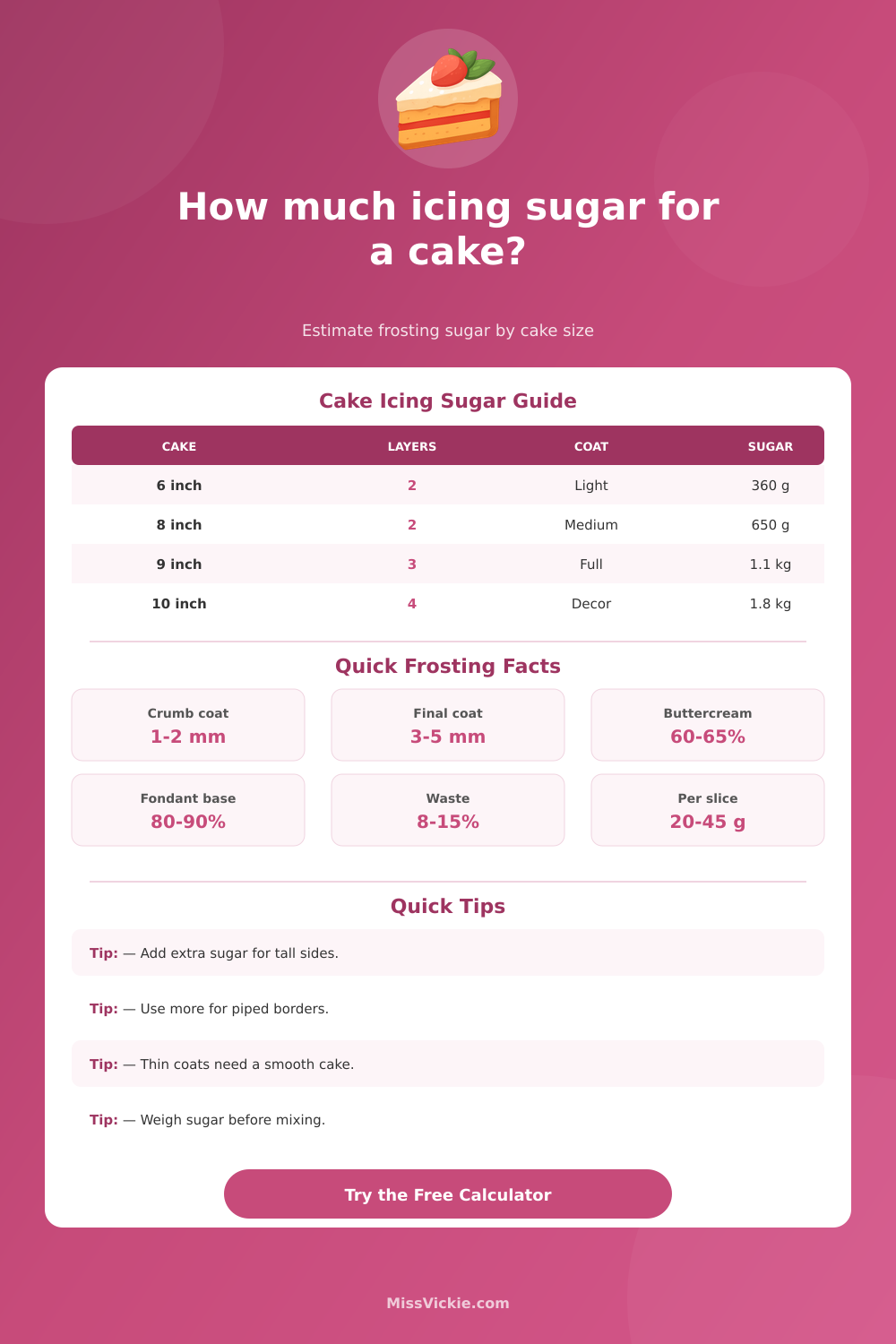
| 6 inch, 2 layers | Light buttercream | Single gap | 320-450 g |
| 8 inch, 2 layers | Medium buttercream | Single gap | 550-750 g |
| 9 inch, 3 layers | Smooth full coat | Two gaps | 850-1200 g |
| 10 inch, 4 layers | Tall decorated cake | Three gaps | 1400-2100 g |
| 9 by 13 sheet | Top coat only | No filling | 450-750 g |
| 12 inch tier | Fondant undercoat | Three gaps | 1600-2400 g |
Use for naked cakes, thin top coats, or a simple scraped side.
Good for top borders, bottom shells, writing, and light piping.
Swirls and rosettes use much more frosting than smooth sides.
Use for piped flowers, tall borders, and heavy celebration cakes.
This is useful for adjusting how much icing sugar you need to cover a cake. It take away the guesswork from the decorating stage. Simply input your variables (number of layers, diameters etc) and you recieve a precise answer.
If there’s not enough icing sugar then the sides will be patchy. There’ll be excess buttercream which won’t match the previous batch.
How the Tool Works
It relies on composition and geometry, such as how many layer there are. What’s the cake diameter? How tall is each layer? How big a piece of side wall do you have to frost? Does it matter that a square cake has more surface along its edges different than a similarly wide round cake? You pick your frosting type, and the tool tweak accordingly.
Since some frosting recipes has more liquid, butter, or sugar than others, you might need less powdered sugar even for the same total volume. Coat thickness is a practical matter that you control. For each layer, filling amount is separate (since each interface require its own coating). That accounts for most of the sugar used: it’s the final coat that determines most of the visual coverage.
Decoration coverage scales with how much additional detail work or piping you intend to do. Smooth scraping requires far less frosting then borders and rosettes. Also, the tool factor in waste. There’s always going to be some stuck-on frosting left on bowls, spatulas, piping bags, etc., and beginner decorator will use up even more than experts. Including a reasonable wastage percentage help avoid the problem of running out of icing mid-decorating session.
It includes butter ratio as well (as more fat mean less sugar ends up in the final frosting). That can make a difference if you’re aiming for sweetness balance. There’s more to it than just the maths, though. The art is in determining how much coating you realy want. A cake might be better off with a thin layer that shows off its inner layers, or perhaps a thick, even coating for lots of piping and detail. Those decisions will change how much icing sugar you use on the same-sized cake. With this tool, you can make these trade-offs clear ahead of time, adjusting to match before you get out the mixing bowl.
After you’ve got the result, consider making it in batches. Flavor and color additions may behaves differently in larger bowls. Large amounts is difficult, if not impossible, to mix evenly by hand. Two medium-sized batch are sometimes more do-able than one extra-large one. The amount produced allows you to gauge how much sugar per serving you’ll have. That’s handy if guests want something less sweet. Once the calculator turns your wishes into a real number, you can decide on thickness of coating and how much decor to use without the guesswork of eyeballing it.