Icing Sugar to Make Buttercream Calculator
Estimate icing sugar, butter, milk or cream, cocoa or fruit powder, and expected finished buttercream by target cups, target weight, frosting style, piping stiffness, batch loss, and cake coverage.
Choose a common decorating job, then fine-tune the sweetness, butter ratio, stiffness, coverage, and flavor powder before calculating.
Buttercream Formula Breakdown
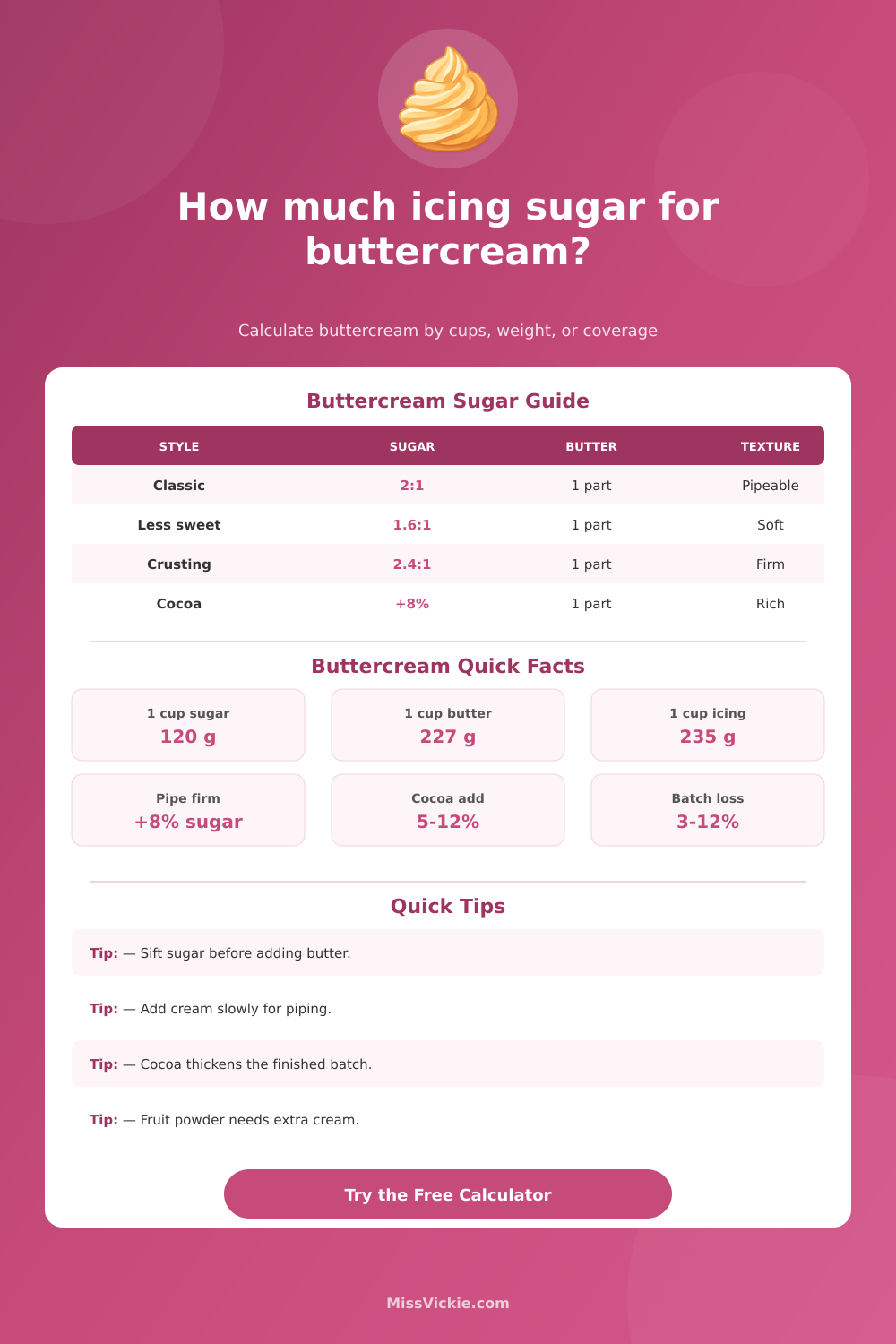
| Buttercream Style | Icing Sugar to Butter | Cream per 500 g Sugar | Best Use |
|---|---|---|---|
| Classic American buttercream | 2 parts sugar to 1 part butter | 35 to 55 ml | Layer cakes, cupcakes, borders, and general piping |
| Less-sweet buttercream | 1.5 to 1.7 parts sugar to 1 part butter | 20 to 40 ml | Soft filling, light coating, and less-sweet cupcakes |
| Crusting decorator buttercream | 2.3 to 2.5 parts sugar to 1 part butter | 55 to 85 ml | Smooth crusting finish, warm rooms, and detailed borders |
| Cream cheese style buttercream | 1.8 to 2 parts sugar to 1 part fat | 0 to 25 ml | Cinnamon rolls, carrot cake, red velvet, and softer spreading |
| Whipped bakery-style buttercream | 1.8 to 2.1 parts sugar to 1 part butter | 65 to 110 ml | Light cupcakes, sheet cakes, and fluffy swirls |
| Decorating Goal | 6-inch Cake | 8-inch Cake | 9 x 13 Sheet |
|---|---|---|---|
| Thin crumb coat only | 1.5 to 2 cups | 2 to 2.75 cups | 1.5 to 2 cups |
| Fill and outside coat | 3 to 3.5 cups | 4.5 to 5.5 cups | 2.5 to 3.5 cups |
| Smooth finish with border | 4 to 4.75 cups | 6 to 7 cups | 3.5 to 4.5 cups |
| Generous piping and swirls | 5 to 6 cups | 7.5 to 9 cups | 4.5 to 6 cups |
| Cupcake swirls | About 1.25 cups per 6 cupcakes | About 2.5 cups per 12 cupcakes | About 5 cups per 24 cupcakes |
Add about 8% of icing sugar weight, then increase cream slightly for a smooth pipeable texture.
Use a little more cream because Dutch cocoa absorbs moisture and darkens as it rests.
Freeze-dried fruit powder gives strong flavor without thinning the buttercream like puree.
Start low, then balance bitterness with vanilla and a modest sweetness setting.
When you’re baking with icing sugar for buttercream, you might think you know how much you need; but if you don’t get the balance between butter and liquid correct, it will be grainy or just not work. What you need depends on whether it should spread easy or just taste sweet rather than sugary.
If you don’t have a recipe that matches these requirements, then whipping it up won’t help, as each home has different butter, different sugars (and even different room temperatures). Adding air alters the volume of what you make making it difficult to eyeball another batch again. A calculator takes away the guessing game of this step so you can achieve result you want for weight or coverage.
Why Use a Buttercream Calculator?
This is why there’s a stiffness setting on the calculator. If your border are going to be really firm (as in standing up in a warm room), you’ll need more sugar; if it’s gonna be a soft spread, you won’t need as much. Increasing the sugar ratio will make your mix firmer, but it will also increase its sweetness, so you can reduce the butter ratio and maintain the balance of flavors. Together, these two adjustment let you dial in the desired texture.
Then there are flavor powders, which also present some tradeoffs: They soak up liquid. Adding a little more milk or cream helps you maintain a pipeable consistency for cocoa and fruit powder. When you choose one of these types, the calculator increases your liquid allowance to prevent overnight tightening of the buttercream. (If you don’t account for this by adjusting liquid amounts, you might wind up with something that looks fine in the mixing bowl but cracks when you attempt to pipe.)
The same applies to your coverage goals. Generous cupcake swirls requires more buttercream than a thin crumb coat. Similarly, the calculator takes your cake size and decorating style as input and turns it into how much butter and sugar you’ll need. That includes the lost amount due to scraping bowls and piping bags (you don’t want to run out of frosting while decorating). So when you mix up the frosting, you mix just enough.
On the same page, there are reference tables showing typical sugar-to-butter ratios for various styles. These aren’t exact rules but rather starting points. They show how far you can push the ratio before the frosting breaks. As you might expect, something with a firmer surface like a decorator buttercream will take more sugar then one made to feel light in the mouth. Looking at these side-by-side help you know whether youve strayed too far from what you want.
What are the common mistakes? When folks don’t treat each batch like a separate thing, mistakes happen. You might not change the sugar level when going from piping to spreading. You might also throw in some cocoa and forget about adding more liquid. It’s either far too soft to pipe detail into (tear up the cake), or way too hard to be spread at all (tears the cake).
Most of those issue is easily avoided by changing one variable, then paying attention to see what happens with the other variables. All this to say, the calculator ultimately makes you view buttercream not like a set number of ingredients but as a system. It gets you thinking in terms off liquid (workability), butter (richness), and sugar (structure).
After that, the math becomes less random. You can scale any recipe up or down with confidence without crossing your fingers that what’s in the bowl will turn out.