
There’s nothing worse than taking one for the team and piping a rose only to watch it immediately slump in on itself forming a shapeless blob. Even seasoned cake decorators who’ve piped hundreds of cakes will tell you: It happened to them too. And it’s never because of your fancy tips or your piping skill. It’s almost always because of the consistency of the icing.
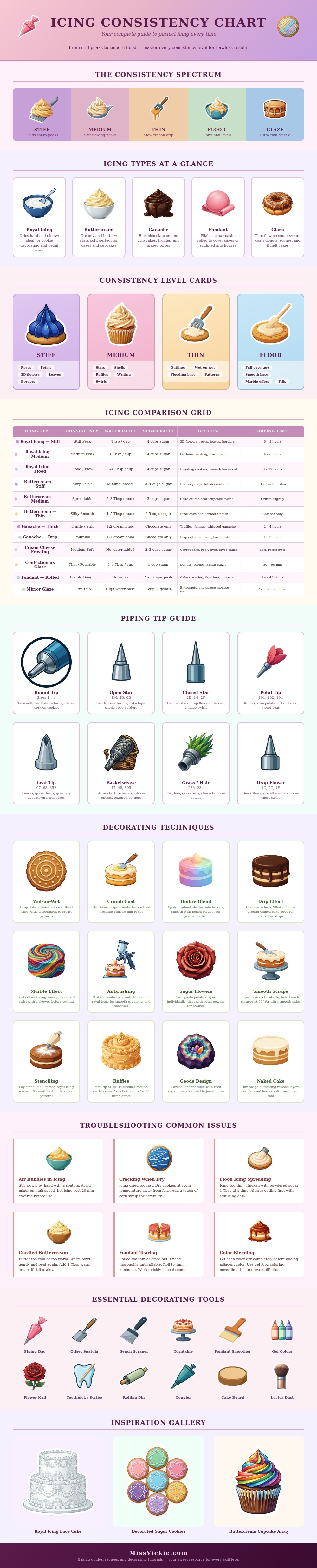
If you want to bake consistent instead of guessing, learn about relationship between water and sugar. You don’t need a PhD in chemistry to do it. All you need to know is that honey flows over a surface but ice cream holds stiff peaks. There are three types of royal icing. You can see below how slight changes in liquids will totally change your icing’s character.
Understanding Icing Consistency
Stiff is what you want if you’re attempting fine lettering and/or intricate 3D flower. The sugar molecules has tightly wrapped themselves around the proteins in egg white, making it hold its shape. It is glossy and hard when dried, making it perfect for any cookie detail that needs to withstand shipping.
On the opposite side of the scale sits flood consistency. It should be thick enough not to flow past edge of an outline, but runny enough to level itself out onto a flat surface. This is where most novice decorator get hung up. They pour in too much water and end up with puddle instead of a decorative border.
Royal Icing is protein based. Buttercream is not. It is fat based. Royal icing will harden solid. It crusts instead of hardening like royal icing. What happens? It crusts.
When building some taller decorations you need a stiff BC so they can supports their own weight against gravity. Soft buttercream will not hold weight of a rose piped out high off the cake- it will fall over as it starts to get heavy on itself. On the other hand, when you just want a nice smooth finish on your cake, you don’t want such a stiff mixture as it won’t spread well at all. It will pull up crumbs of lower layer as it goes.
The trick again is temperature. If you have cold butter it will resist spreading or shaping. But if you have warm butter it will melt right into a gooey mess in summertime. Take time to get used to how the temperature feels in your kitchen, then go from there.
That’s not the only variable Ganache brings. Depending on ratio of chocolate and cream, you have a dripping cake topping or a batch of truffles in your hands. If you go one-to-two (one part chocolate, two parts cream), you’ll end up with a paste that is thick like a truffle. Invert those numbers and you’ve got a pourable glaze that will flow over the side of your chilled cake.
With a few tablespoons difference of liquid, the viscosity can be completely different. That’s why recipes frequently instruct you to cool the ganache first before pouring: you’re looking for something viscous enough to cling to the surface but still fluid enough to drip. But these problems could of been solved with time.
To fix air bubbles, simply use a spoon or rubber spatula and stir by hand. This will remove any air bubbles instantly and get rid of that smooth consistency you spent all that effort achieving! When your fondant starts tearing as you roll it out, instead of continuing to pull at the fondant, set it aside, let it sit for a moment and then try to knead it back together.
With sugar, as long as you don’t fight it, it’s forgiving. Often times you’ll feel like you’re fighting against the ingredients, but it’s more like you’re negotiating with physics. Once you accept the behavior of these mixtures, the worry melts away. What you see with your eyes will eventually become known to your hands. You won’t stare at the clock anymore, you’ll feel the texture.
That mental shift is difference between a nervous baker and a confident decorator. It’s less about exact measurements and more about the flow.