Ice Cream Overrun Calculator
Estimate overrun, air percent, churned volume, density, serving yield, and batch expansion from the mix volume, mix weight, and finished draw volume.
Choose a common frozen dessert target, then adjust your actual mix volume, weight, churned draw, serving size, and pack loss.
Formula: overrun percent = (churned volume - mix volume) / mix volume x 100. Air percent is the air volume divided by the churned volume.
Overrun Results
Measured expansion and serving yield will appear here.
Batch Breakdown
Yield Breakdown
Lower air, warmer serving temperature, smaller scoops feel rich and heavy.
Balanced home and scoop-shop range with creamy body and clean volume gain.
Lighter scoop, higher expansion, and more containers from the same mix volume.
Draw temperature and machine pressure can make air percent change quickly.
| Frozen Dessert | Typical Overrun | Air Percent of Finished Volume | Expected Density Feel |
|---|---|---|---|
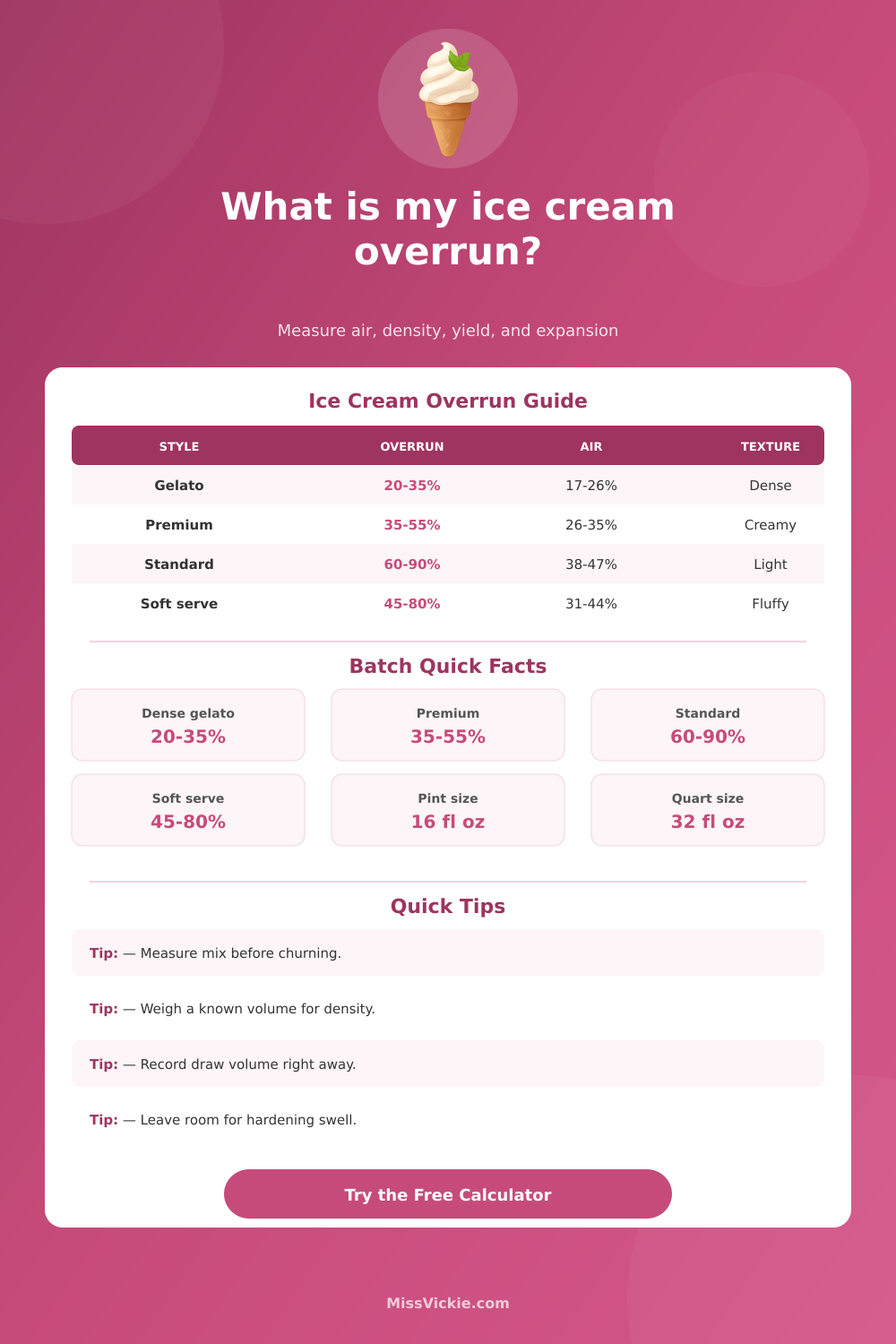
| Italian-style gelato | 20 to 35 percent | 17 to 26 percent | Dense, elastic, slow melting |
| Premium home ice cream | 35 to 55 percent | 26 to 35 percent | Creamy, scoopable, rich |
| Custard ice cream | 30 to 50 percent | 23 to 33 percent | Silky, heavy, egg-rich |
| Standard hard ice cream | 60 to 90 percent | 38 to 47 percent | Light, fluffy, higher yield |
| Soft serve draw | 45 to 80 percent | 31 to 44 percent | Soft, airy, machine dependent |
| Fruit sorbet | 15 to 35 percent | 13 to 26 percent | Bright, icy, lower fat support |
| Starting Mix | At 30% Overrun | At 50% Overrun | At 80% Overrun |
|---|---|---|---|
| 1 quart mix | 1.30 qt / about 10 scoops | 1.50 qt / about 12 scoops | 1.80 qt / about 14 scoops |
| 2 quarts mix | 2.60 qt / about 20 scoops | 3.00 qt / about 24 scoops | 3.60 qt / about 29 scoops |
| 1 liter mix | 1.30 L / about 9 servings | 1.50 L / about 10 servings | 1.80 L / about 12 servings |
| 5 liters mix | 6.50 L / about 43 servings | 7.50 L / about 50 servings | 9.00 L / about 60 servings |
Serving counts use a 4 fluid ounce or 150 milliliter serving and do not include dasher loss or hardening shrink.
Overrun is the amount of air that gets added to the ice cream mix during the churning process. The amount of air, or overrun, will mathematically determine the final volume of the ice cream. When you make ice cream, the volume of the liquid mix wont be the same as the volume of the ice cream that is sold in the container.
This difference in volume is due to the overrun of air that got added to the mix during churning. The overrun affects the texture of the ice cream, as well as the number of container that can be filled with that batch of ice cream mix. It is important to understand how overrun works to create an ice cream that is produced in a repeatable process, instead of a guessing game.
What Overrun Is and How to Measure It
To calculate the overrun of your batch of ice cream, you will need to measure several component of the ice cream production process. The components that you will need to measure include the starting volume of the mix, the weight of the starting mix, the finished volume of the ice cream, and the amount of product that was lost during the process. The weight of the starting mix will allow you to calculate the density of the mix prior to adding air to the mix.
The finished volume will help you to calculate how much the mix expanded after air was added to the mix. The amount of product that was lost during the process will factor into your overrun calculation because some of the product will stick to the dasher and transfer tools. By calculating overrun with these four different measurement, you can calculate the percentage of air in your finished batch of ice cream.
Different types of ice cream require different amount of overrun to achieve the desired texture of the ice cream. Gelato requires a lower amount of overrun than other types of ice creams to achieve the dense texture of the product. Premium ice creams require a moderate amount of overrun in the churning process so that the ice cream will feel light when consumed but will still contain the fat and sugar that coats the mouth.
Standard ice creams that are sold in supermarkets require the most overrun so that as many containers of ice cream as possible can be created from each batch of mix. The last type of ice cream described is soft-serve ice cream, which is different than the other types described because a soft serve machine adds air to the mix during the serving process. By utilizing an overrun calculator, you can prepare these different types of ice creams in a recipe and the actual overrun can be determined to ensure that it falls within the range of the required overrun for that type of ice cream.
To calculate the overrun of your batch of ice cream, it is important that you measure each of the ingredients and the finished product correctly. Each measurement must be taken with accuracy. To weigh the amount of the starting mix, it is important to weigh the mix prior to adding the mix to the ice cream machine.
Measuring the volume of the starting mix may indicate the proper amount of the ingredient, but the weight will be more accurate. It is also essential to measure the finished product of the ice cream. The volume of the product that is produced can change after the product has been poured from the dasher, as air begins to escape from the product after it is poured.
Allowance must also be made for product loss and hardening shrink. The finished product must be measured after product loss and shrink to present an honest number of the amount of product that can be produced by the machine. These measurements will help you to determine the number of containers of ice cream of a specific size that you can produce.
It will also allow you know the average weight of each serving of ice cream that your machine will produce. Although many people believe that higher amounts of overrun are better for the profit of the business, there are both positive and negative effects of high amounts of overrun as compared to low amounts of overrun. High amounts of overrun will allow the batches of ice cream to be stretched to create more servings.
However, high amounts of overrun can also create an icy texture to the ice cream if the amount of air is too much for the stabilizers to hold. Low amounts of overrun will produce a texture to the ice cream that is considered to be luxurius. However, using low amounts of overrun will require more liquid ice cream mix to reach the same amount of servings as ice creams that contain higher amounts of overrun.
The amount of overrun that you use will depend upon the ingredients that you use to prepare your ice cream as well as your customers and their preferences for the texture of the ice cream. Additionally, the amount of overrun will also depend upon whether you are selling your ice cream by weight or by volume. Another measurement that can be used in the production of ice cream is the density measurement of the finished product.
If the overrun of the batch of ice cream was high, yet the product feels heavy, it is possible that the measured volume of the product is incorrect. If the density of the product is very light yet the measured amount of overrun is modest, it is possible that the base ingredients for the ice cream were too thin. By measuring the density of the product, the chef can determine if the issue is with the churning process of the machine or if the error is in the ingredients of the recipe.
The usable volume of the batch of ice cream can also be measured with the help of a calculator. The calculator can factor in the amount of containers of a specific size that the batch of ice cream will create after the product loss. The calculator can also indicate the average weight of each serving of ice cream that can be created by the machine.
The average weight of each serving of ice cream is important for determining the price of scoops of ice cream. It is important to note, however, that small changes in the product loss can create changes in the amount of product that can be created. It is, therefore, better to measure the product that can be created by the batch of ice cream by the machine.
The most value will be found in these different measurements when you are using the same recipe and preparing the same types of ice cream. It is likely that the overrun will be correct for one batch of ice cream, yet not for another batch. For instance, one batch of ice cream may include berries that contain more juice than the other batches, or the amount of hydration level of the stabilizers may differ between batches.
By tracking each batch and the amount of overrun that each batch created, valuable data can be collected. This data can be used to gain a better understanding of the process of making ice cream, as well as to plan for variables in the process that cannot be controlled. By tracking the overrun of each batch of ice cream, the chef can ensure that the product that is prepared is close to what was intended for the batch.