Volume of Ice Cream Cone Calculator
Estimate how much ice cream fits inside a cone and above the rim using conical fill geometry, spherical-cap scoop math, serving count, and realistic allowance.
Choose a real serving style, then adjust the inside rim, cone height, scoop size, fill level, and batch count to match your cones.
Full Volume Breakdown
Small 1.45 inch rim and 3.4 inch height for light servings.
Classic flat-bottom cone, modest cavity, usually needs one scoop.
Narrower crisp cone with enough room for filled tip and dome.
Wide rim and taller body make it the best double-scoop choice.
| Cone style | Inside rim | Inside height | Full cone volume | Best scoop match |
|---|---|---|---|---|
| Kids wafer cone | 1.45 in / 3.7 cm | 3.4 in / 8.6 cm | 0.9 fl oz / 27 ml | 1.5 to 1.75 in scoop |
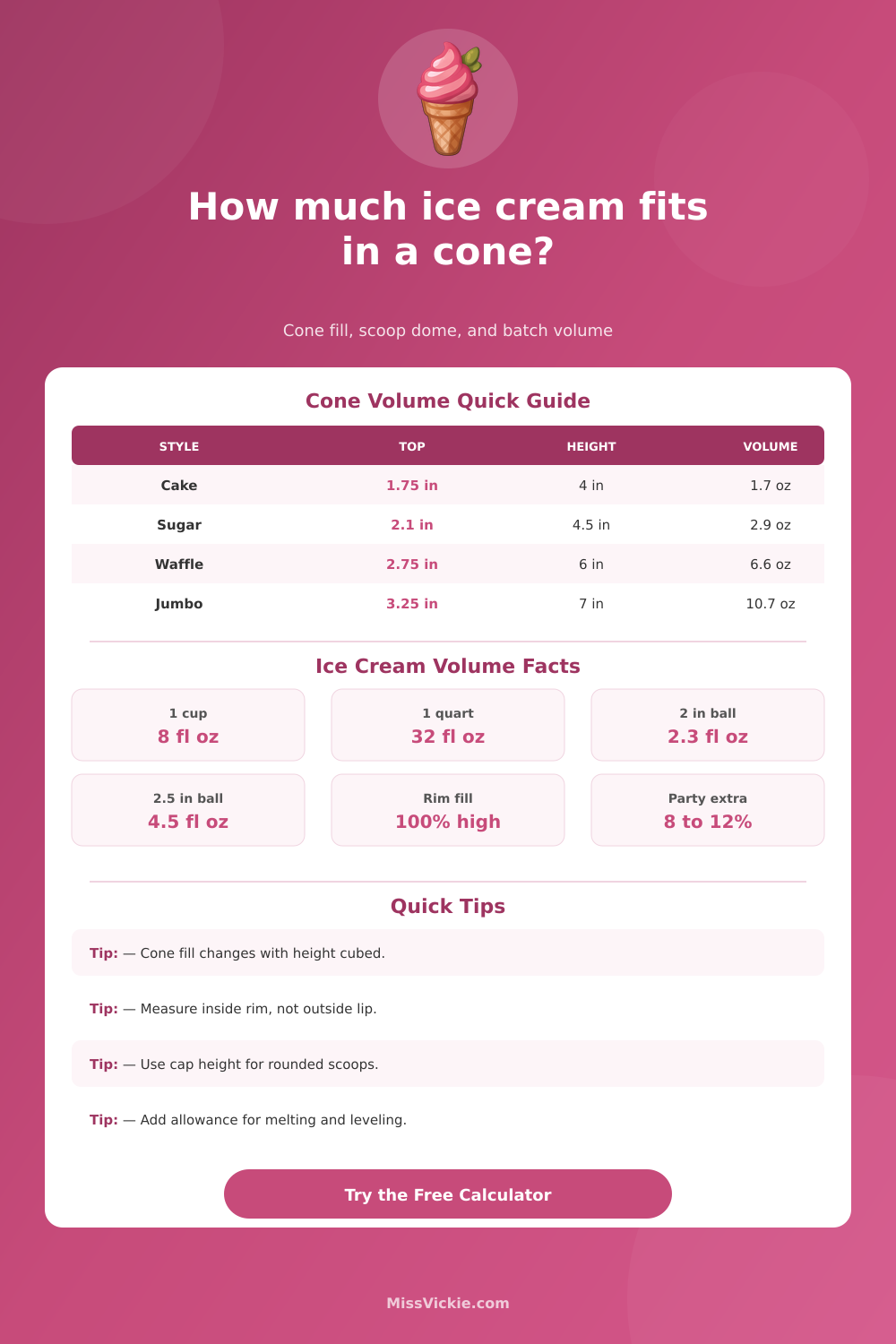
| Classic cake cone | 1.75 in / 4.4 cm | 4.0 in / 10.2 cm | 1.8 fl oz / 52 ml | 2.0 to 2.25 in scoop |
| Standard sugar cone | 2.10 in / 5.3 cm | 4.5 in / 11.4 cm | 2.9 fl oz / 86 ml | 2.25 to 2.5 in scoop |
| Regular waffle cone | 2.75 in / 7.0 cm | 6.0 in / 15.2 cm | 6.6 fl oz / 194 ml | Two 2.25 in scoops |
| Tall gelato cone | 2.35 in / 6.0 cm | 5.4 in / 13.7 cm | 4.3 fl oz / 126 ml | Spoon-packed dome |
| Jumbo waffle cone | 3.25 in / 8.3 cm | 7.0 in / 17.8 cm | 10.7 fl oz / 316 ml | Two large scoops |
| Scoop diameter | Full sphere volume | Hemisphere dome | Common serving use | Cones per quart |
|---|---|---|---|---|
| 1.50 in / 3.8 cm | 0.98 fl oz / 29 ml | 0.49 fl oz / 14 ml | Tasting cone or kids cone | About 32 full balls |
| 1.75 in / 4.4 cm | 1.55 fl oz / 46 ml | 0.78 fl oz / 23 ml | Small single scoop | About 20 full balls |
| 2.00 in / 5.1 cm | 2.32 fl oz / 69 ml | 1.16 fl oz / 34 ml | Standard small scoop | About 14 full balls |
| 2.25 in / 5.7 cm | 3.30 fl oz / 98 ml | 1.65 fl oz / 49 ml | Classic scoop shop dome | About 10 full balls |
| 2.50 in / 6.4 cm | 4.54 fl oz / 134 ml | 2.27 fl oz / 67 ml | Generous sugar cone scoop | About 7 full balls |
| 3.00 in / 7.6 cm | 7.83 fl oz / 232 ml | 3.92 fl oz / 116 ml | Oversized waffle cone scoop | About 4 full balls |
| Fill height | Volume fraction | What it means | Example on 6 fl oz cone |
|---|---|---|---|
| 70% of height | 34.3% of full volume | A cone that looks mostly filled still holds much less below the rim. | 2.1 fl oz |
| 80% of height | 51.2% of full volume | Good for a light center before adding a large scoop. | 3.1 fl oz |
| 90% of height | 72.9% of full volume | Common shop fill when the top scoop is the main portion. | 4.4 fl oz |
| 100% of height | 100% of full volume | Level to rim, before any dome, cap, or swirl above the cone. | 6.0 fl oz |
| Kitchen measure | Fluid ounces | Milliliters | Cups | Use in cone planning |
|---|---|---|---|---|
| 1 tablespoon | 0.5 fl oz | 14.8 ml | 0.0625 cup | Fine-tuning mini cones or tip plugs |
| 1/4 cup | 2 fl oz | 59 ml | 0.25 cup | Small scoop or cake cone serving |
| 1/2 cup | 4 fl oz | 118 ml | 0.5 cup | Common single-scoop serving |
| 1 pint | 16 fl oz | 473 ml | 2 cups | About 3 to 6 cones, depending on style |
| 1 quart | 32 fl oz | 946 ml | 4 cups | Good planning size for parties |
Calculating the portion of ice cream that will be needed for an event are a necessary task for the host of the event. The calculation of portions require an understanding of a few different factors related to the volume of ice cream that will go into each cone. Factors to consider include the dimension of the cone, the size of the scoop of ice cream that will be used to fill each cone, and the rate at which the ice cream will melt.
If the portions isnt calculate correctly, it is possible that there will not be enough ice cream to provide each guest with a serving. The volume of the cone can be calculated from the internal dimensions of the cone. The height of the cone alone, however, is not a measurement of the volume of the cone.
How to Calculate Ice Cream Portions for an Event
The volume of a cone is related to the height of the cone as an element that is raised to the third power; therefore, if the cone is only filled to eighty percent of the height of the cone, the cone will not contain eighty percent of the volume of the cone. In fact, the cone will contain only about half of the volume of the cone when it is filled to eighty percent of it’s height. The volume of the cone also must account for the empty space within the tip of the cone, as well as the portion of ice cream that form a dome above the open rim of the cone.
Each of these dimension can be accounted for in the calculator for ice cream portions; the calculator allows the user to enter the inside rim diameter of the cone, the usable height of the cone, and the tip space of the cone. The scoop that is used to deliver the ice cream can also impact the portion calculation. The scoop may be a perfect sphere, for instance, but it may be flattened when it is use to fill the cones.
An adjustment for scoop shape can be made in the portion calculator. Additionally, the height of the dome of ice cream can also impact the portion size calculation; the taller the dome, the more ice cream will be delivered to each cone. These difference in scoop size and volume can be underestimated, but the difference in volume becomes significant when that volume is calculated in relation to the total number of guest that will attend the event.
Other factors that can impact the volume of ice cream that is served to each guest include the rate at which the ice cream melt. Ice cream melts based on the temperature of the environment in which it is served, as well as the fat content of the type of ice cream that is served. The percentage of ice cream that is lost due to melting can be accounted for in the portion calculation; a percentage can be allotted for the expected loss of volume due to melting of the ice cream.
Percentages of ice cream loss can range from approximately ten percent for indoor event to fourteen percent or more for outdoor event. The type of cone that will be used will also impact the amount of ice cream that must be prepared. Cake cone have small cavities and, thus, hold less ice cream than cones with larger cavities, such as waffle cones.
Sugar cone contain a medium amount of ice cream. Each of these cone types can be referenced in the portion calculator to ensure that the host correctly selects the type of ice cone that will be used at the event. If ice cream is to be batched into one container, the volume of the container can be determined from the portion calculations.
The volume of ice cream that will be contained in each cone can be converted to the total volume that can be held by a container of a specified size. For instance, the calculator can determine how many cone of ice cream can be filled from a single quart or single tub of ice cream. Such calculations allow for the quantity of each container of ice cream to be determined in relation to the number of guest.
When entering data into the portion calculator, some common mistake should be avoided. For instance, the inside diameter of the cone should be measured, rather than the outside diameter of the lip of the cone. Additionally, the height of the cone should be measured from the tip of the cone to the fill height, rather than from the top of the cone down.
Finally, the tip gap of the cone should be measured and enter into the calculator to ensure that the empty space at the bottom of the cone is not counted as usable volume for the cone. By using the portion calculations, it is possible to ensure that each cone contains the same amount of ice cream, and that each guest receives an identical portion. By ensuring that each cone has the same amount of ice cream, the host will not run out of ice cream prior to providing each guest with a serving, and each guest will receive the same portion of ice cream as each of the other guest.