Honey to Sugar Substitute in Baking Calculator
Convert the sugar in a baked recipe to honey, then adjust liquid, baking soda, oven temperature, sweetness target, and browning risk for the batch size.
🍯Quick baking presets
Choose a starting point, then fine tune the sugar amount, honey moisture, oven temperature, and recipe liquid.
⚖Measurement mode
🧁Original recipe sugar
🫙Honey behavior and sweetness
Honey substitution plan
Conversion breakdown
Honey bakes darker than sugar. Watch small or thin bakes early.
📌Core honey substitute rules
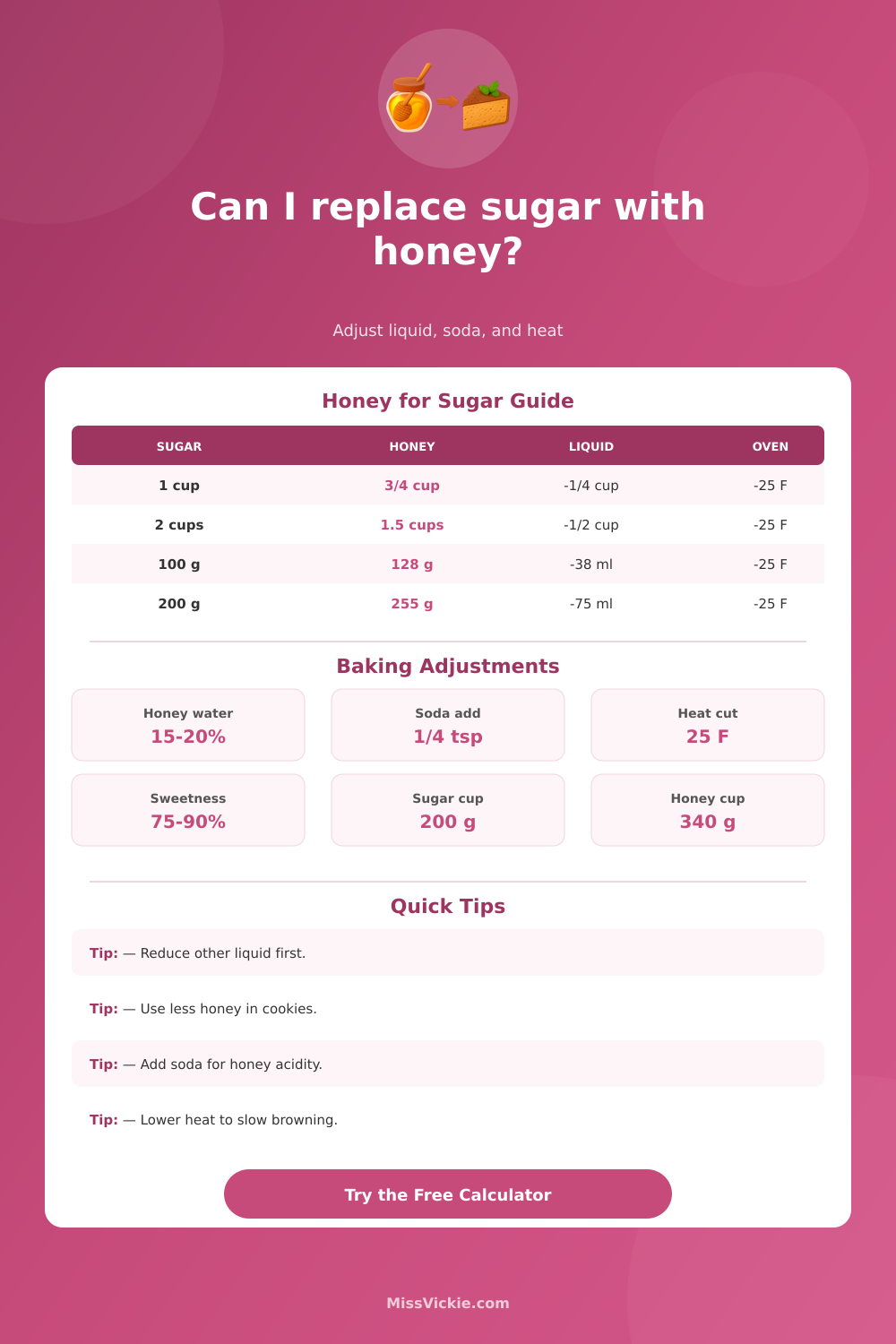
Base swap for 1 cup granulated sugar.
Common reduction per cup of honey.
Usual addition per cup of honey.
Typical oven reduction for honey.
📐Recipe type guardrails
| Recipe type | Best honey share | Main adjustment | Watch for |
|---|---|---|---|
| Layer cake | 50% to 100% of sugar | Reduce liquid and add soda | Darker edges, softer crumb |
| Muffins or cupcakes | 75% to 100% of sugar | Keep batter thick enough to mound | Sticky tops if underbaked |
| Quick bread | 75% to 100% of sugar | Reduce liquid, bake a little longer if needed | Center may brown before set |
| Drop cookies | 25% to 50% of sugar | Chill dough and keep some dry sugar | Extra spread and chewy edges |
| Bars and oat slices | 50% to 100% of sugar | Press mixture firmly and lower heat | Fast browning at pan edges |
| Yeast bread | 50% to 100% of sugar | Count honey as both sweetener and liquid | Crust darkens before loaf finishes |
🧪Honey moisture and acidity reference
| Honey style | Moisture range | Flavor impact | Baking note |
|---|---|---|---|
| Clover honey | 16% to 18% | Mild and familiar | Good all-purpose default |
| Wildflower honey | 17% to 19% | Floral and variable | Use the calculator moisture field if known |
| Orange blossom honey | 16% to 18% | Bright floral citrus | Nice in cakes, muffins, and loaf bakes |
| Buckwheat honey | 17% to 20% | Dark, malty, strong | Lower heat and expect darker crumb |
| Raw high-moisture honey | 18% to 20% | Bold and aromatic | Needs firmer liquid reduction |
| Thick low-moisture honey | 14% to 16% | Dense and concentrated | May need less liquid reduction |
📋Common batch examples
| Original sugar | Approx honey | Liquid cut | Soda add |
|---|---|---|---|
| 1/2 cup sugar | 3/8 cup honey | 1 1/2 tbsp | Scant 1/8 tsp |
| 1 cup sugar | 3/4 cup honey | 1/4 cup | 1/4 tsp |
| 1 1/2 cups sugar | 1 1/8 cups honey | 4 1/2 tbsp | Rounded 1/4 tsp |
| 2 cups sugar | 1 1/2 cups honey | 1/2 cup | 1/2 tsp |
| 300 g sugar | 380 g honey | 110 ml | 3/8 tsp |
| 500 g sugar | 640 g honey | 185 ml | 5/8 tsp |
💡Baking notes for honey swaps
Measure the honey by weight when possible. Cups are practical, but sticky ingredients vary with temperature and how completely they leave the measuring cup.
Do not remove all liquid from a recipe. If the calculator asks for more reduction than the recipe contains, reduce what you can and expect a softer, moister bake.
Keep some dry sugar in crisp cookies. Honey attracts moisture, so all-honey cookie doughs spread more and finish chewy rather than crisp.
Check early near the edges. Honey browns quickly, especially in dark pans, convection ovens, small muffin cups, and thin bar cookies.
Using honey different than sugar in your baking isn’t just about swapping one ingredient for another. Batters don’t spread the same way; they contain less liquid; the leavening (baking soda) is different; and edges brown quicker. Beginners who follow rule to use three-quarters as much honey as sugar are often baffled when their cake’s edges get dark before inside sets, or when cookies spread out too far.
This calculator does math for you. You tell it what kind of recipe you want to make, how big batch is, and how sweet or not sweet you want it. Many jars of honey contain about one-seventh water by weight, which is different from the water you measure in a cup. Honey has some acidity, and that acid interact with baking soda. Even if the recipe already includes leaveners, it might take another pinch of soda.
How to Swap Sugar for Honey
Honey browns more quickly than sucrose does (because it’s mostly fructose), so typically you reduce oven temperature by maybe twenty-five degrees. That varies depending on how thick cookie is or how dense loaf is; the tool lets you change those values right here. It doesn’t give generalized advice, but reflect reality of your pans and oven.
Most bakers underestimate how important recipe type are. For cakes, trimming back the liquid lets you generally make a straight sugar-for-honey swap. With drop cookies, however, there’s typically no room for more than half honey before dough goes slack. The cookies will be chewy rather then crisp. Somewhere in between are yeast breads, which see honey used not just as a sweetener but also to contribute to the overall hydration. The calculator has separate limits for each type of baked good.
The calculator helps you avoid accidental pushing your cookie dough past point where structure holds. Then there’s change in math due to moisture content within the honey itself. Runny wildflower variety have more free water than thick, cool-climate honey with lower moisture content. Perhaps there is no need to remove as much liquid from remaining ingredients. Enter moisture percentage into the input field and it matches actual honey in the jar on your counter. No need to rely on average, which might not apply.
The sweetness target operates similarley. For some, they want final baked good to taste just as sweet as what went into it. For others, they like it milder in the background, letting other flavors come through. Change that one setting and it scales how much honey is needed. No need to re-calculate all the rest manualy.
Everyone misses this until their first batch turns out darker than they like: this machine has a browner-risk rating. What it’s telling you is that your combination of recipe style (like cake vs. Cookie), amount of honey, oven temp, and sensitivity of edge to color all results in this meter readout. A higher number doesn’t mean you’re going to screw up this time. It’s saying: Check 5 min earlier. Maybe rotate your pan? Cover it with some foil? That one data point alone helps prevent common error of thinking, “I’ve baked these cookies without honey before. Why would adding honey change the time?”
Because a little bit of honey goes a long way (we’ve got a feel for that), we reward tiny tweaks and precise swaps, not “instead-of” substitutions. We know exactly what level of liquid you’ll be adding. We know exactly how much more acidic it will make soda. We know when the surface is likely to darkens. Everything else follows.
That’s what rest of recipe does, usually. The calculator just shows these relationships before opening the oven door.