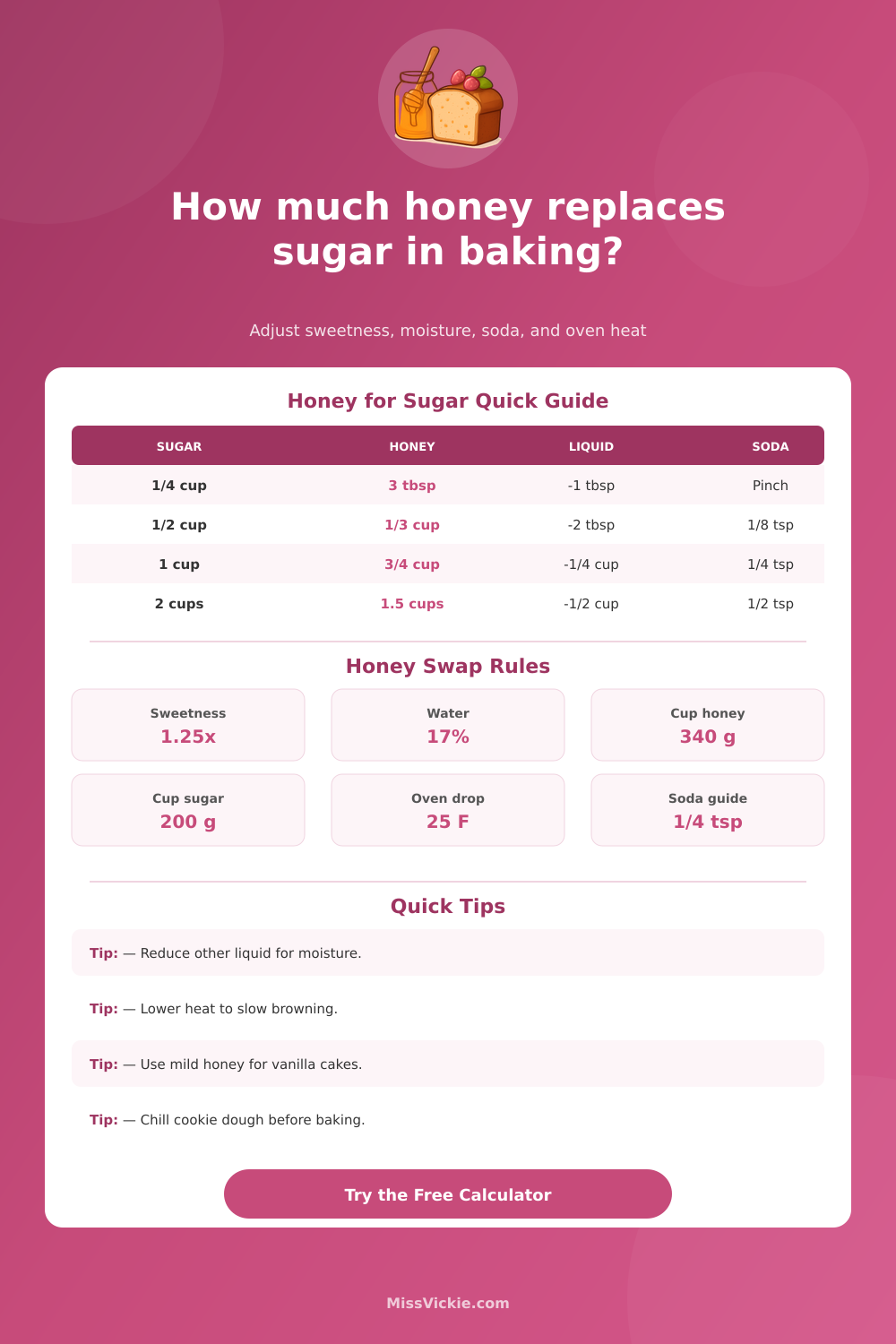
How Much Honey to Replace Sugar in Baking?
Convert granulated sugar to honey for cakes, cookies, muffins, quick breads, yeast doughs, and bars while balancing sweetness, water, acidity, browning, and pan behavior.
Start with a baked-good style, then fine tune sugar amount, honey type, liquid, flour, leavener, and browning tolerance.
Replacement Breakdown
| Original sugar | Balanced honey | Match-sweet honey | Liquid reduction | Soda note |
|---|---|---|---|---|
| 1/4 cup sugar | 3 tablespoons honey | 3 tablespoons plus 1 teaspoon | 1 tablespoon | Pinch if no acidic dairy |
| 1/2 cup sugar | 1/3 cup honey | 6 tablespoons honey | 2 tablespoons | 1/8 teaspoon soda |
| 1 cup sugar | 3/4 cup honey | 3/4 to 4/5 cup honey | 1/4 cup | 1/4 teaspoon soda |
| 1 1/2 cups sugar | 1 cup plus 2 tablespoons honey | 1 1/4 cups honey | 6 tablespoons | 1/4 to 3/8 teaspoon soda |
| 2 cups sugar | 1 1/2 cups honey | 1 2/3 cups honey | 1/2 cup | 1/2 teaspoon soda |
| Baked good | Honey target | Liquid strategy | Texture watch | Best honey |
|---|---|---|---|---|
| Cakes and cupcakes | 70% to 78% of sugar volume | Reduce milk or water first | May brown early at edges | Light clover or orange blossom |
| Quick breads | 75% to 85% of sugar volume | Reduce liquid, then add flour only if loose | Very moist center needs full bake | Clover, wildflower, or raw |
| Cookies | 65% to 75% of sugar volume | Chill dough; reduce liquid lightly | More spread and chew | Mild honey or creamed honey |
| Brownies and bars | 70% to 80% of sugar volume | Cut water-based liquid | Fudgier, stickier crumb | Dark or buckwheat for cocoa |
| Yeast dough | 80% to 90% of sugar volume | Keep dough tacky, not wet | Faster browning crust | Light honey for rolls |
| Factor | Formula used | Typical value | Why it matters | When to override |
|---|---|---|---|---|
| Sweetness | Sugar grams divided by honey sweetness | Honey is about 1.2 to 1.35 times sweeter | Prevents oversweet batter | Strong honey or dessert-style bakes |
| Honey water | Honey grams multiplied by water percent | Usually 15% to 18% water | Explains liquid reduction | Raw honey or dry cookie dough |
| Liquid reduction | Added honey water minus retained moisture | About 1/4 cup per cup sugar | Keeps batter thickness close | Already dense batters |
| Baking soda | Up to 1/4 teaspoon per cup sugar replaced | Less when acidic ingredients exist | Balances honey acidity and browning | Yeast doughs, egg foam cakes, or soda recipes |
| Oven heat | Lower 10 to 30 F depending on browning | 25 F for most cakes and loaves | Honey browns faster than sugar | Crisp cookies or pale cakes |
Builds structure, helps creaming, and gives crisp edges without adding water.
Adds water, acid, aroma, stronger sweetness, and faster browning.
Remove milk, water, juice, or coffee before changing eggs or fat.
Lower oven heat for cakes and loaves; chill cookies when spread matters.
Honey can be substitute for granulated sugars in baking recipe. However, honey will change the texture and flavors of the baked goods. Honey contain more moisture than granulated sugar.
Additionally, honey is a slightly acidic, which can change how the baked goods brown. Since honey is more concentrate than granulated sugar, you will need to use less honey than the amounts of granulated sugar in the original recipe. If you dont adjust the amount of liquid in the recipe for the honey, the baked goods will tend to be gummy due to an extra moisture from the honey.
Tips for Baking with Honey Instead of Sugar
Honey is approximately one and a quarter times sweeter than granulated sugar by weight. Therefore, you will need to use less honey than granulated sugar to replace to the sweetness in the recipe. Additionally, honey contains about seventeen percent water by weight.
This water content will add moisture to the baked goods. Therefore, you must also reduce the amount of liquid in the recipe. For example, if you are baking a cake you may need to reduce the amount of liquids more more than if you were baking a brownie because cakes contain more flour than liquids while brownies contain more liquids than flour.
The acidity in honey can also change the chemical reaction in the baking process. Honey is acidic which will react with the baking soda in the recipe. If the recipe also contains acidic ingredient you do not need as much baking soda as you would for nonacidic ingredients.
Additionally, the sugars in honey will begin to caramelize at a lower temperature than granulated sugar. This means that the baked goods may burn on the edge so you will need to lower the oven temperature by twenty-five degrees. The type of honey you use will change the flavor and texture of the baked good.
For example, if you use clover honey or orange blossom honey you will not change the flavor of vanilla cake or citrus flavored cake. However, if you use buckwheat honey or dark honey you could change the flavor of a plain cake. Honey that is raw contain water and crystals while creamed honey will behave like a paste when mixing with baking ingredients.
Therefore, you should decide what type of flavor and texture you would like in your baked good when you purchases honey. The texture of the baked good will also change if you use honey in your recipe. Since honey interfere with the formation of gluten the crumb of the baked good will be more tenderly.
This is helpful for items like muffins but can be a problem for delicate cookies. Additionally, baked goods with honey will tend to have dough or batter that benefit from resting. For example, you can refrigerate cookie dough to avoid cookies spreading to much on the baking sheet.
Additionally, quick bread batter can sit for ten minutes to allow the flour to absorb the moisture from the honey. Some common mistake when using honey in place of granulated sugar is to treat the honey as if it were the granulated sugar. Using the same amount of honey as the granulated sugar in the recipe will lead to baked goods that are wet in the center.
Using the same oven temperature as the recipe when baking items with honey will make the edges of the baked goods burn while the center is still raw. The solution to both of these problem is to adjust the amount of liquid in the recipe, the oven temperature, and the amount of baking soda. With these adjustment the honey will function correctly in your recipe.