💧 Homebrew Water Chemistry Calculator
Calculate salt additions to hit target ion levels for any beer style — enter your water volume and salt amounts
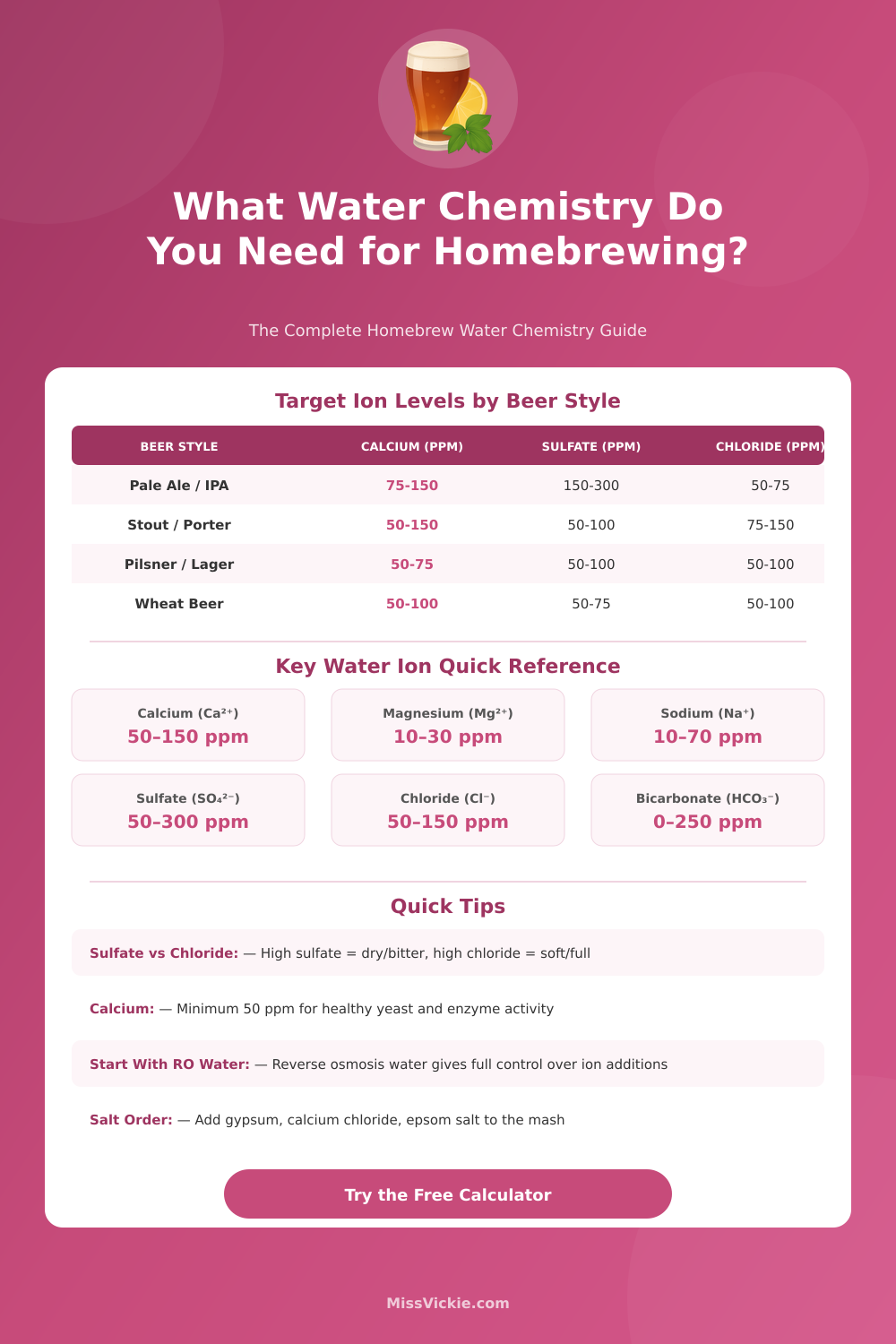
| Beer Style | Ca (ppm) | Mg (ppm) | Na (ppm) | SO₄ (ppm) | Cl (ppm) | HCO₃ (ppm) |
|---|---|---|---|---|---|---|
| West Coast IPA | 100–150 | 5–15 | 10–30 | 150–300 | 50–75 | 0–50 |
| NEIPA / Hazy IPA | 75–125 | 5–15 | 10–40 | 50–100 | 100–200 | 0–75 |
| Stout / Porter | 50–150 | 10–20 | 20–70 | 50–100 | 75–150 | 100–250 |
| Czech Pilsner | 30–60 | 5–15 | 5–15 | 20–50 | 30–60 | 30–80 |
| English Pale Ale | 75–150 | 5–20 | 10–40 | 75–175 | 75–125 | 50–150 |
| Wheat / Hefeweizen | 50–100 | 5–15 | 10–30 | 50–75 | 50–100 | 50–150 |
| Amber / Red Ale | 50–100 | 10–20 | 10–40 | 50–125 | 50–100 | 50–150 |
| American Lager | 50–100 | 5–15 | 5–20 | 50–100 | 50–100 | 0–75 |
| Salt | Ca (ppm/g/gal) | Mg (ppm/g/gal) | Na (ppm/g/gal) | SO₄ (ppm/g/gal) | Cl (ppm/g/gal) | HCO₃ (ppm/g/gal) |
|---|---|---|---|---|---|---|
| Gypsum (CaSO₄·2H₂O) | 61.5 | 0 | 0 | 147.4 | 0 | 0 |
| Calcium Chloride (CaCl₂) | 72.0 | 0 | 0 | 0 | 127.5 | 0 |
| Epsom Salt (MgSO₄·7H₂O) | 0 | 26.1 | 0 | 103.0 | 0 | 0 |
| Table Salt (NaCl) | 0 | 0 | 104.0 | 0 | 160.3 | 0 |
| Baking Soda (NaHCO₃) | 0 | 0 | 72.3 | 0 | 0 | 191.0 |
| Chalk (CaCO₃) | 105.9 | 0 | 0 | 0 | 0 | 158.8 |
| SO₄:Cl Ratio | Character | Best For |
|---|---|---|
| 4:1 or higher | Very bitter / dry / crisp | West Coast IPA, Dry Stout |
| 2:1 to 4:1 | Moderately bitter, accentuates hops | Pale Ale, American IPA |
| 1:1 | Balanced / neutral | Amber Ale, Kolsch, Lager |
| 1:2 to 1:4 | Soft, full, rounds malt | NEIPA, English Bitter, Porter |
| 1:4 or lower | Very soft / round / sweet | Milk Stout, Oatmeal Stout |
Brewing water forms a key part of the whole beer process. It affects the taste, color, aroma and feel of the beer. Water chemistry is truly complex, but knowing the basics already helps a lot for better results.
Tap water comes chiefly from two main sources: surface water from lakes, rivers and streams, or groundwater from underground. Groundwater has usually more minerals, but fewer organics like algae and bacteria. Hard water is something that many heard, especially here, where tap water is genuinely hard.
Why Water Is Important for Brewing Beer
Hardness was measured originally, as far as hardly you do foam with soap, what is not like this useful for home brewing of beer.
When tap water taste well from the tap, it probably works for brewing. Campden tablets help against chlorine and chloramines. Carbon filtration removes chlorine, chloramine and other impurities, so water becomes pure and ready for use.
A brewer observed, that each his beer had same weird smell and taste regardless of the style, that happens, when you do not address chlorine amounts.
Proper water changes help of more bitter salt taste until balance of malt tenderness, and do everything the difference. Simpler way for brewers alter water are add salts. Calcium chloride and plaster is common salts for reach wanted mineral levels.
Settle one campden tablet for twenty gallons of tap water are easy first step. Reverse osmosis water is other option, because it starts almost without salts and allow precise addition of involved minerals.
Most many home brewing programs as ProMash or BeerSmith have tools, that counts, as various salt additions alter the water profile. Simple dropper helps to dose tap water or add acids for control pH. Buy pH meter are important, because control can not stop even for a moment.
Use baking powder instead of bicarbonate of soda because of mistake can cause, that water clots, so mind detail.
Mashing is process, in that enzymes crush malt and alter starches in sugar for fermentation. Typical home brewer take one until one and half quarts of water for pound of grain. Sugar feeds the fermentation, that ultimately does alcohol from it for beer, no only sweet water.
In more nourishment for fermentation, des more well it succeeds. Salty mineral levels in water and grain all help to bitterness, so well set them originally matter for smooth beer.