🍺 Homebrew Priming Calculator
Calculate exact priming sugar amounts for perfect bottle carbonation every batch
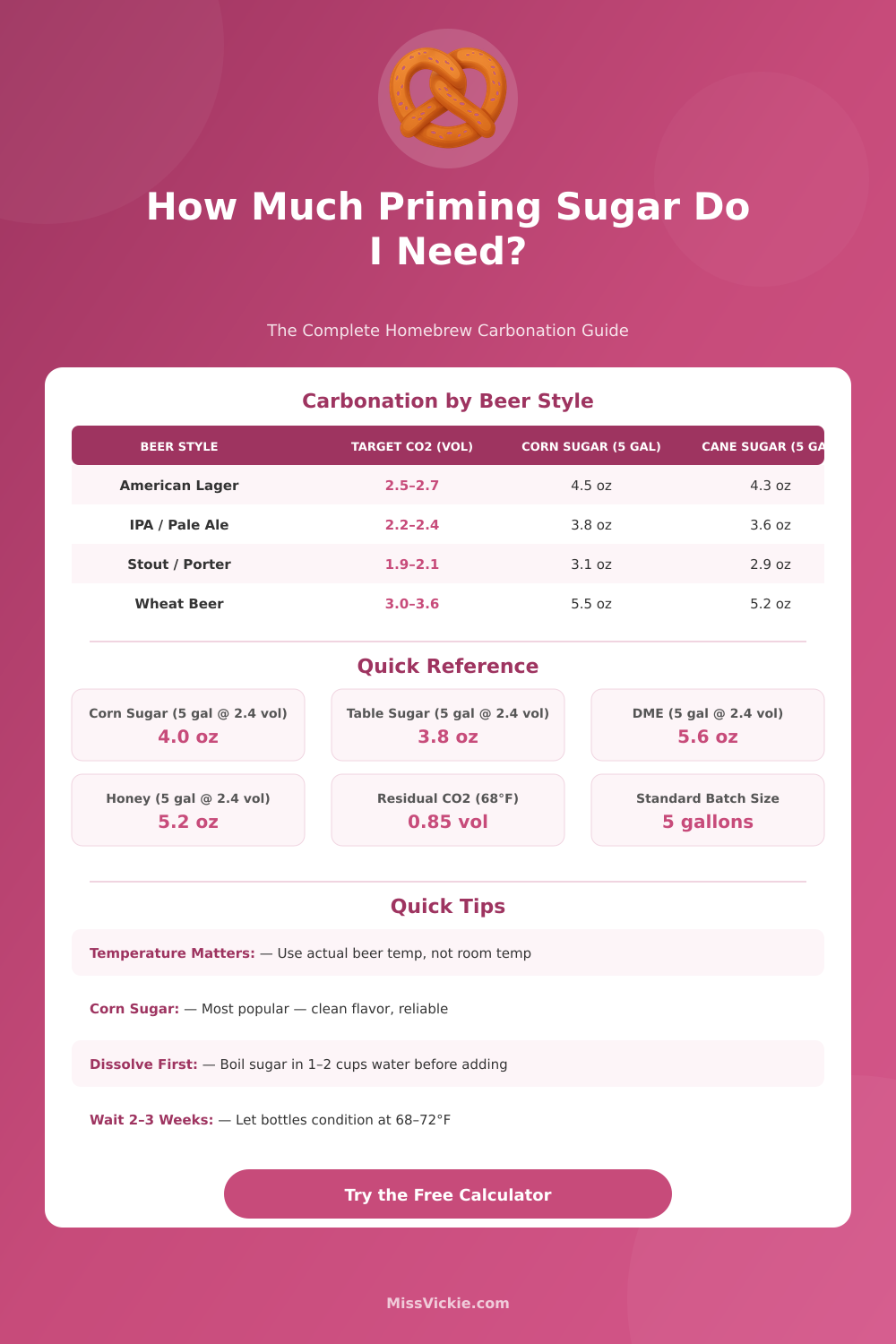
| Sugar Type | 1 Gallon | 3 Gallons | 5 Gallons | 10 Gallons |
|---|---|---|---|---|
| Corn Sugar (Dextrose) | 0.8 oz | 2.4 oz | 4.0 oz | 8.0 oz |
| Table Sugar (Sucrose) | 0.76 oz | 2.3 oz | 3.8 oz | 7.6 oz |
| Dry Malt Extract (DME) | 1.12 oz | 3.4 oz | 5.6 oz | 11.2 oz |
| Honey | 1.04 oz | 3.1 oz | 5.2 oz | 10.4 oz |
| Brown Sugar | 0.8 oz | 2.4 oz | 4.0 oz | 8.0 oz |
| Maple Syrup | 1.3 oz | 3.9 oz | 6.5 oz | 13.0 oz |
| Beer Temp (°F) | Beer Temp (°C) | Residual CO2 (vol) | Notes |
|---|---|---|---|
| 35°F | 2°C | 1.26 vol | Cold-crashed lager |
| 40°F | 4°C | 1.17 vol | Refrigerator temp |
| 50°F | 10°C | 1.00 vol | Cellar / cold fermented |
| 60°F | 16°C | 0.92 vol | Cool basement |
| 68°F | 20°C | 0.85 vol | Standard room temp |
| 72°F | 22°C | 0.82 vol | Warm room |
| 78°F | 26°C | 0.78 vol | Summer / warm climate |
| Sugar Type | Relative Amount | Flavor Impact | Notes |
|---|---|---|---|
| Corn Sugar (Dextrose) | 1.00x (baseline) | Neutral / clean | Most popular choice |
| Table Sugar (Sucrose) | 0.95x | Very clean | Works equally well |
| DME | 1.40x | Malty | Stays true to style |
| Honey | 1.30x | Subtle honey | Varies by honey type |
| Brown Sugar | 1.00x | Slight molasses | Use in darker beers |
| Maple Syrup | 1.60x | Maple note | Only ~66% fermentable |
Homebrewing is simply the art of making beer, wine, cider and mead right in your home. It ties together a whole world of brewers, mead makers, vintners and cider makers, all united by love for fermented drinks from the ground. The homebrewing community has a clear target: a homebrewer in every neighbourhood and a club in every city.
What moves all of them is the celebration and promotion of fermentation as art together with science, while you build a strong community of brewers for today and tomorrow
Homebrewing for Beginners
Home brewing was not actually legal at the federal level until 1978. Before the Ban, folks did beer at home without problems (even George Washington himself did that). It is surprising how much everything changed since those early times.
Most homebrewers work with batches of around 19 liters, or 5 US gallons. Here is the reason: Cornelius kegs, that many use for storage, have exactly that capacity. If you simply start with all-grain homebrewing, though, smaller batches; say 2.5 gallons, can serve well as a first step.
Some reckon that that is the ideal for any skill levle.
Recipe design tools are found for homebrewers that want to use them. For instance, Brewer’s Friend is a full-featured recipe designer full of brewing software, calculators, a brew day planner and a place to note your sessions. It intends to help you perfect your beer every time.
A good tactic is to spend time reading in HomeBrewTalk, the Homebrewers Association and alike groups, then create own recipes from that which attracts you.
Online forums deal with everything, from general chat about homebrewing until deep analysis of all-grain methods, recipe swaps and discussions about wine and mead. Here you find talks about yeast, grains, kits, almost everything regarding fermentation. Real advantage of those big community spaces is that you can ask any question about homebrewing without doubt whether it belongs in a yeast thread, an all-grain section or beginner corner.
Cooking with homebrew is genuinely a fun thing. Sean Paxton, known as The Homebrew Chef, shows how to put beer in everyday meals and nice dinners. He teams up with pub owners and craft brewers to create exclusive multi-course beer dinners.
His website offers recipes that go from simple until complex, all centered around beer as an ingredient. Homemade beer mustard is a good example (you only require beer), mustard seeds and either a food processor or mortar so that it works.
A good homebrew shop nearby can have a big selection of barley malts, together with tricky kinds like wheat, rye and spelt. Some bakers made bread from leftover homebrew mash, although controling the humidity can be difficult. Many possibilities are for adapt and perfect the taste asyou go.