🍺 Homebrew Alcohol Calculator
Calculate ABV, attenuation, calories, and batch yield for beer, wine, mead, and cider
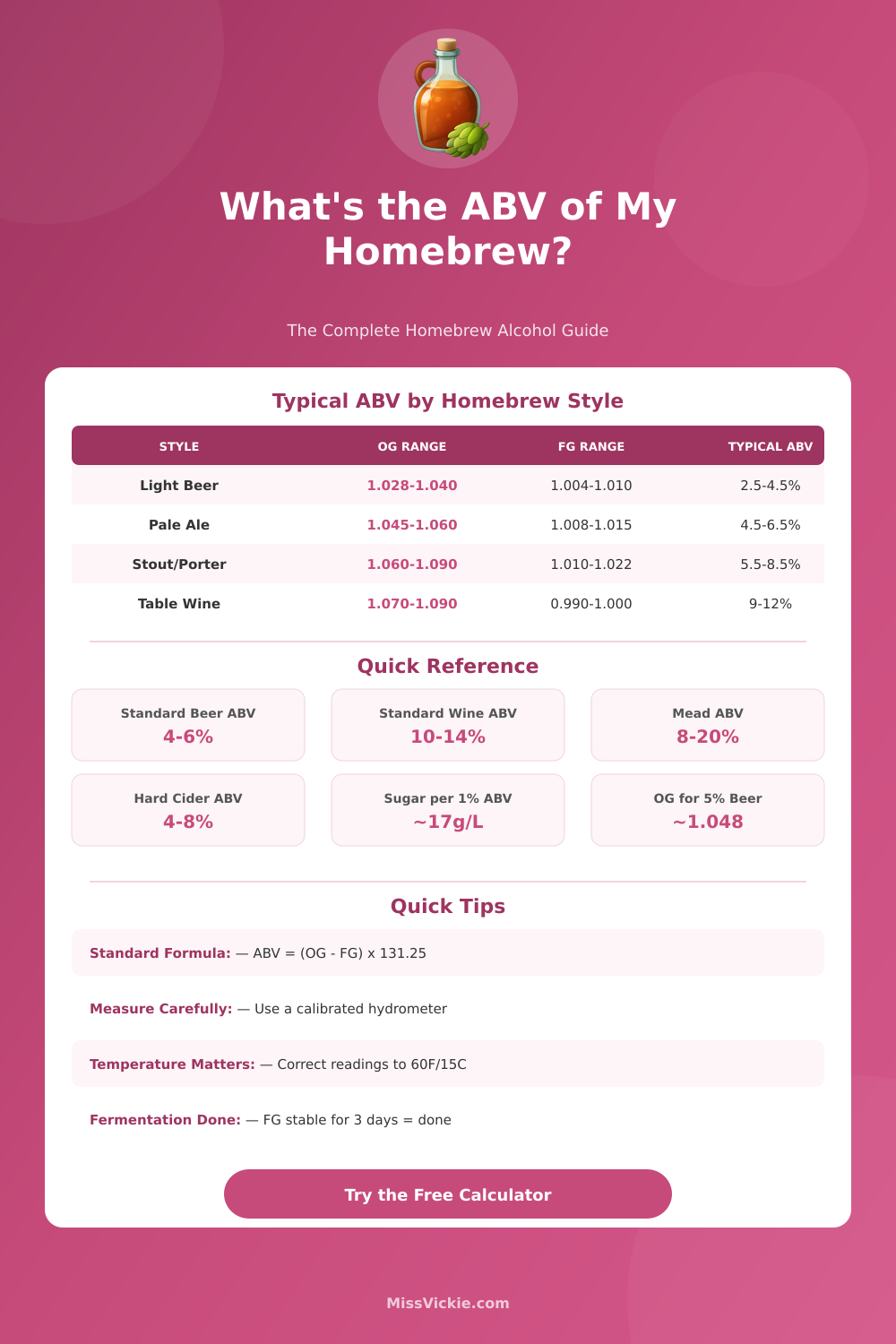
| Style | OG Range | FG Range | Typical ABV | Attenuation |
|---|---|---|---|---|
| Light Lager | 1.028–1.040 | 1.004–1.010 | 2.5–4.5% | 75–85% |
| American Wheat | 1.040–1.055 | 1.008–1.013 | 4–5.5% | 73–80% |
| Pale Ale | 1.045–1.060 | 1.008–1.015 | 4.5–6.5% | 75–82% |
| IPA | 1.056–1.075 | 1.008–1.018 | 6–7.5% | 78–85% |
| Stout / Porter | 1.060–1.090 | 1.010–1.022 | 5.5–8.5% | 72–80% |
| Imperial IPA / Stout | 1.075–1.120 | 1.012–1.024 | 8–12% | 76–84% |
| Table Wine (Dry) | 1.070–1.085 | 0.990–1.000 | 9.5–11.5% | 98–100% |
| Table Wine (Sweet) | 1.085–1.110 | 1.005–1.020 | 8.5–13% | 82–94% |
| Mead (Session) | 1.060–1.080 | 0.998–1.010 | 7–10% | 88–99% |
| Mead (Traditional) | 1.080–1.120 | 0.990–1.010 | 10–15% | 92–99% |
| Hard Cider | 1.045–1.065 | 0.998–1.010 | 5–8% | 85–99% |
| Bochet / Fruit Mead | 1.100–1.150 | 0.995–1.015 | 12–18% | 90–99% |
| OG | Potential ABV (max) | Sugar Content (approx) | Common Use |
|---|---|---|---|
| 1.020 | 2.6% | 51 g/L | Kvass, very light beer |
| 1.030 | 3.9% | 77 g/L | Light table beer |
| 1.040 | 5.2% | 102 g/L | Session ale, light lager |
| 1.050 | 6.6% | 128 g/L | Standard ale, pale ale |
| 1.060 | 7.9% | 154 g/L | IPA, stout |
| 1.070 | 9.2% | 179 g/L | Strong ale, table wine |
| 1.080 | 10.5% | 205 g/L | Barleywine, session mead |
| 1.090 | 11.8% | 231 g/L | Strong wine, dry mead |
| 1.100 | 13.1% | 257 g/L | Traditional mead |
| 1.120 | 15.7% | 309 g/L | Big mead, dessert wine |
| 1.150 | 19.7% | 385 g/L | High-gravity mead |
| Sugar Type | Gravity Points/lb/gal | Fermentability | Notes |
|---|---|---|---|
| Table Sugar (Sucrose) | 46 | 100% | Fully fermentable, clean |
| Corn Sugar (Dextrose) | 46 | 100% | Common priming sugar |
| Light DME (Dry Malt) | 44 | 75% | Beer flavor, moderate body |
| Light LME (Liquid Malt) | 36 | 75% | Beer flavor, moderate body |
| Honey | 35 | 95% | Adds honey character |
| Maple Syrup | 30 | 90% | Subtle maple flavor |
| Brown Sugar | 46 | 100% | Slight molasses flavor |
| Lactose (Milk Sugar) | 42 | 0% | Non-fermentable, adds body |
| Apple Juice (per gal) | 14–16 | 95% | Base for hard cider |
| Grape Juice (per gal) | 22–28 | 98% | Base for wine |
| Measured Temp (°F) | Correction Factor | Measured Temp (°C) | Add to Reading |
|---|---|---|---|
| 50°F | −0.0007 | 10°C | −0.0007 |
| 55°F | −0.0003 | 13°C | −0.0003 |
| 60°F | 0.0000 | 15.5°C | 0.0000 (calibrated) |
| 65°F | +0.0006 | 18°C | +0.0006 |
| 70°F | +0.0012 | 21°C | +0.0012 |
| 75°F | +0.0018 | 24°C | +0.0018 |
| 80°F | +0.0027 | 27°C | +0.0027 |
| 85°F | +0.0036 | 29°C | +0.0036 |
| 90°F | +0.0048 | 32°C | +0.0048 |
homebrew of alcohol is made up of the preparation of beer or other alcoholic drinks at home, for personal use without commercial intent. For thousands of years one did beer home, before it became product of businesses. One can buy gear as tools and fermenting tins in local specialist stores or online.
All new brewers should first receive basic homebrew gear.
How to Make Alcohol at Home
The easiest way to produce alcohol home is to mix sugar, water and yeast in a bottle. Lay it in a cabinet for a week, and it will become an alcoholic drink. Making alcohol from beer is simple work, even so reaching drinkable results requires an entirely otehr challenge.
Trying is a key part, and little changes in ingredients can lead to unusual but pleasing flavors.
An excellent starting point for newcomers is the fermentation of mead, cider or wine. They skip the whole brewing procedure and work as a gateway too the fermenting world. In wine, juice from grapes without preservatives works well.
Fermented filtered juice until clear state commonly reaches between 5% and 7% of alcohol by volume. Use store-bought fruit juice for wine is an excellent method for making cheap drink with high alcoholic content.
In beer the procedure includes a stage called mashing, that helps warm water convert starch in sugar. Then one boils that sugar water in a jar with hops, that adds the typical bitterness and fragrances. This hopped sugar water, called wort, later passes in a fermenter, where yeast alters sugar in alcohol and carbon gases.
Yeast is a living creature, that alters sugar in alcohol. Ale tins use top fermenting yeast and usually stay in temperatures between 60 and 78 degrees Fahrenheit. They ferment only during a week, what makes them better for homebrew fans.
Lager yeast requires more time, stretching the whole process to weeks or even months. After fermentation one requires at least two weeks for bottling, because that forces carbonation to happen. A full month of waiting can ensure morequality results.
The best way to expand the alcoholic grade is to add more sugar, that yeast can consume. One can strengthen a recipe to double or imperial variant by means of that method. For instance, add more fermentable sugar to a recipe for stout to make it imperial stout.
For cheap beer with high alcohol and good flavor, west coast pale ale or IPA with medium hops and strongly fermenting yeast works well.
Counting the alcoholic proportion is easy using a hydrometer. One measures the density of the liquid before and after fermentation to receive the needed values. The basic formula is original density minus final density, multiplied by 131, what gives the ABV.
Mead can cost a lot, because honey is expensive. A recipe based only on corn and yeast is a more economic option for alcohol production.