
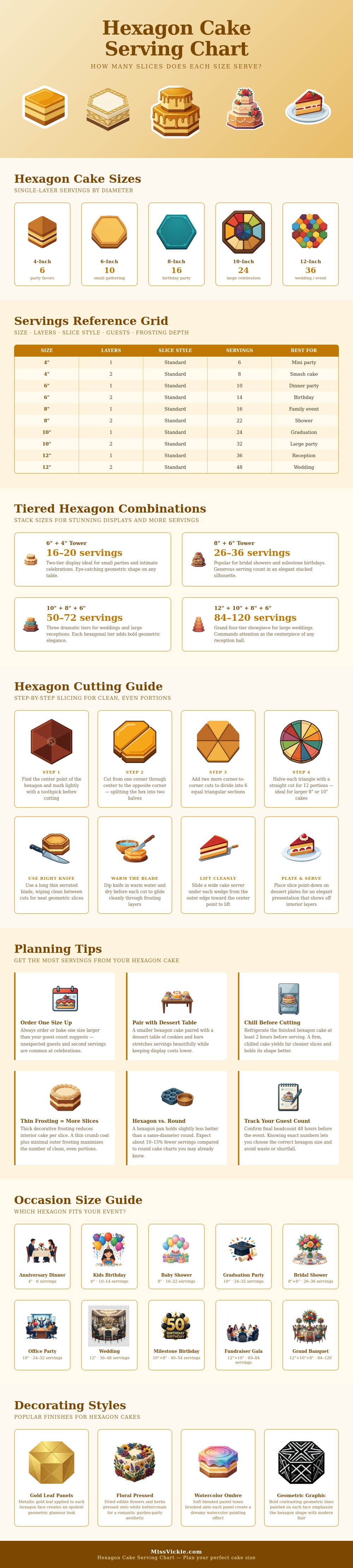
Since the angles of a hexagon are different than a round cake, making this type of cake will take some thought regarding angles and what kind of yield to expect from each pan. For example, do you want a cake that looks impressive with it’s pointy ends? Or do you need enough slice so everyone can get their own piece?
If only there were a way of knowing! How many people can one pan feed? Well, there’s a chart for that: It’s called a serving chart. What’s the problem with these cake? (Other than I made too many.) Because of their angles, standard round cake pans holds slightly more batter then hexagon pans of same diameter.
Tips for Hexagon Cakes
If you use an online calculator to determine your batter, be aware that a hexagon pan will yield about 10, 15 fewer servings than standard charts indicate. For example, a six inch hex will yield ~10 slices, good for a small dinner but not quite enough if you’re trying to feed a crowd. Doubling the height bring it back up to 14 slices, with some spare for those guests looking for another helping or two. As the chart illustrates, adding a second layer doesn’t require any additional table space but increases cake capacity to 14 slices.
The math shifts when you stack tier, too. A two-tier cake in an eight- and a six-inch size is visually appealing with about twenty-six to thirty-six servings, perfect for a bridal shower. For bigger parties, consider several cakes or three or four tiers to get up into the hundreds of servings; though remember, you want your cake to be able to feed everyone, or not?
If it’s just an ice cream bar and cupcakes, that might make sense. It also saves money; you could have one larger decorated hexagon paired with some brownies and cookies. This makes for a more styled looking display that will cost less then a big tiered cake. It takes away the pressure and keeps the purse strings tight.
To slice a hexagon cake is trickier; the angles are hard to gauge, so accuracy is key. Start by locating your cake’s center (marking it with a toothpick will help you visualize where that is). From there, slice down through one corner to the opposite, creating six identical triangles. For bigger cakes, cut them in half again to make twelve equal-sized wedges. Clean lines happens when you use a long serrated knife, and dipping the blade in warm water between each slice ensures no frosting drags. It requires both patience and technique to keep the edges razor-sharp; I simply wipe the blade between cuts.
When it comes time to serve the cake, timing matter just as much as how you cut it. Giving the cake at least two hours in the fridge makes the structure more stable and the frosting firmer, leading to cleaner cuts with less crumbling. This can be especially helpful for multi-layered cakes, because they needs more stability. Because a thick layer of frosting means less cake per slice, having a thinner layer helps get most cake-to-guest ratio (also called a “crumb coat”).
To select the right-sized cake, always double-check your headcount forty-eight hours before the event instead of trying to guess. Too many servings will go to waste, while not having enough means no one gets a piece. The hexagon cake is a statement piece for which some planning would of pay off. It’s all about getting it onto the table and slicing it out into tasty goodness with confidence.
Whether you go for simple buttercream or something like gold leaf, knowing how to plan your cuts based off the shape means you can handle the details as a seamless element of the celebration. Once you know how to work with the shape, its geometry will be working for you.