Hard Boiled Quail Egg Time Calculator
Estimate a quail-specific hard-boil window from egg count, size, fridge temperature, hot or cold water start, altitude, yolk firmness, simmer strength, ice bath time, peeling needs, serving use, and overcook margin.
🥚Quail egg presets
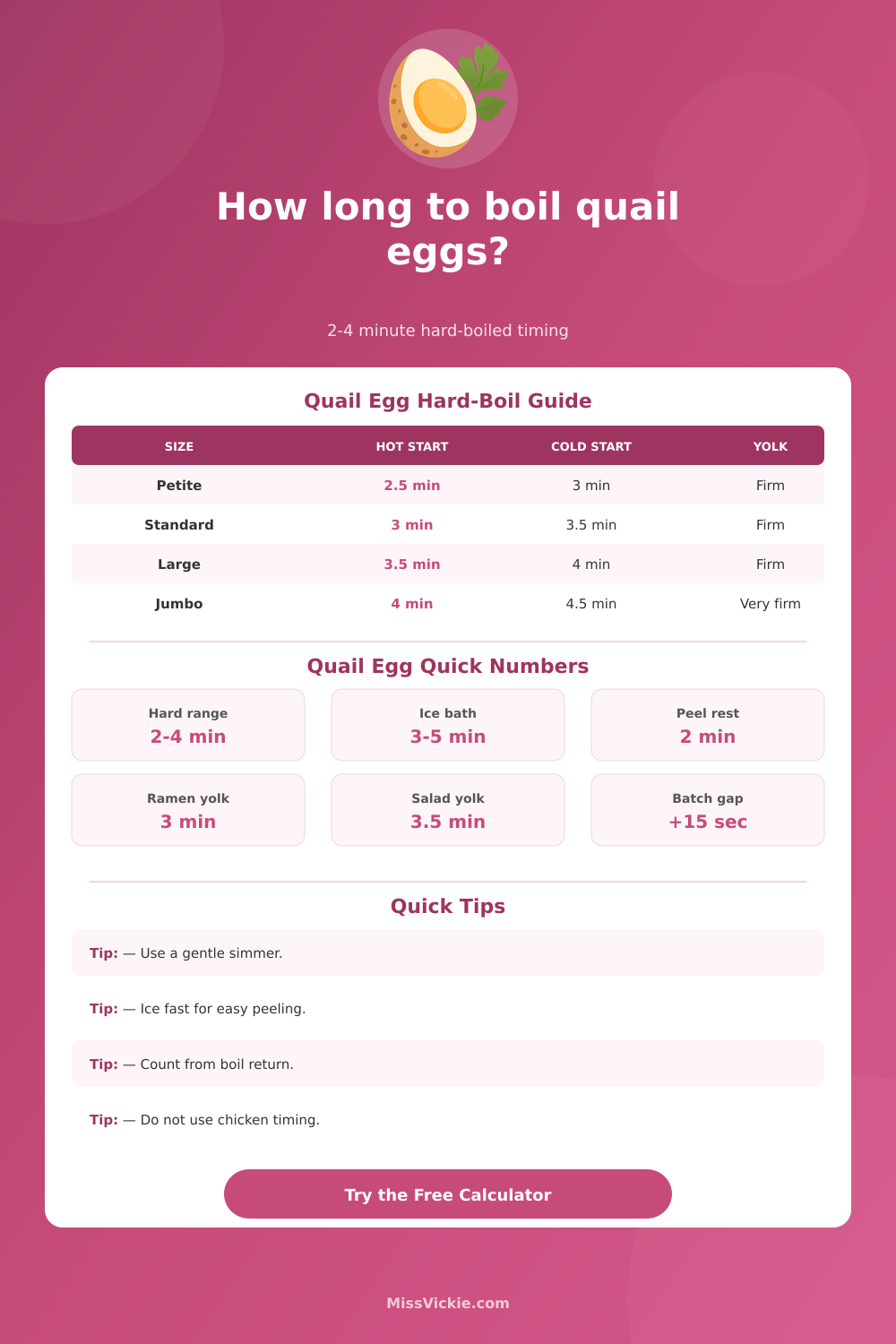
These presets use the small 2 to 4 minute hard-boiled quail egg range. They are not chicken egg defaults.
⚙Calculator inputs
Quail egg timing plan
Use the calculator to estimate the simmer and cooling plan.
Timing breakdown
⏱Hard-boiled quail timing grid
📋Reference tables
| Quail egg size | Typical weight | Hot-start hard time | Best use |
|---|---|---|---|
| Petite | 8 to 9 g each | 2:25 to 2:50 | Snacks, bento, tiny garnishes |
| Standard | 10 to 11 g each | 2:55 to 3:20 | Ramen, salads, lunch boxes |
| Large | 12 to 13 g each | 3:20 to 3:45 | Slicing, deviled quail eggs |
| Jumbo | 14 g plus each | 3:40 to 4:10 | Pickling, platters, firmer yolks |
🌡Adjustment guide
| Factor | Add or subtract | Why it matters | Quail-specific note |
|---|---|---|---|
| Refrigerated eggs | Add 10 to 25 sec | Cold centers heat more slowly. | Small eggs still finish in minutes, not 10 minutes. |
| Cold water start | Start timer at boil, shorter simmer | Eggs preheat as water warms. | Total clock time is longer, simmer time is not. |
| High altitude | Add 5 to 25 sec | Boiling water is cooler. | Extra seconds matter because the baseline is short. |
| Pickling batch | Add 10 to 25 sec | Firm yolks peel and cure neatly. | Stop at the top of the quail range. |
🍽Serving and batch guide
| Use | Eggs per person | Texture target | Cooling target |
|---|---|---|---|
| Ramen or noodle bowl | 2 to 3 eggs | Moist hard-set yolk | 3 to 4 minute ice bath |
| Salad or garnish | 3 to 4 eggs | Firm sliceable yolk | 4 to 5 minute ice bath |
| Snack box or bento | 4 to 6 eggs | Balanced hard-boiled | 3 to 5 minute ice bath |
| Deviled or pickled | 6 to 8 halves | Firm to very firm | 5 minute ice bath plus rest |
💪Quail egg nutrition estimate
🔬Peeling and doneness notes
Peeling batch logic
For party trays or pickling, the calculator adds a firmer chill and rest because quail shells and membranes can cling when eggs are still warm.
Overcook margin
Quail yolks can turn dry fast. Minimal margin favors ramen and snacks; maximum margin is reserved for pickles or very firm slicing.
💡Cooking tips
For hot start, start timing after the boil or simmer returns. For cold start, the calculator treats warm-up separately.
Use a spoon or spider to lower quail eggs and hold a gentle simmer so the shells do not crack.
Three to five minutes in ice water stops carryover and tightens the white for cleaner peeling.
More than two dozen quail eggs in a small pot can slow boil recovery. Split the batch for even yolks.
Quail eggs are tricky to boil, there isn’t much room for error here. Chicken eggs, on the other hand, are forgiving; they will survive a five minute window without turning rubbery. Quail egg are not like that. These guys cook quick, and they overcook more quickly. Thirty seconds of neglect is all that separates a chalky gray ring from a creamy yolk.
Because we’re dealing with a much tinier egg, there’s no room for guessing: You can’t just eyeball it, taking into account the rate at which heat transfer through such a tiny vessel. That’s where the calculator does its work, it adjusts for variables that throw off your texture, and then sets a timer based off those specifics.
Why You Need a Quail Egg Calculator
Now for the second variable: altitude. Most people live at sea level and probably haven’t thought about how lower air pressure lowers boiling temperature of water. Anyone who has lived in Denver or the Rockies know this well. Though the egg may appear to be happily bubbling along, that cooler cooking water result in a longer-cooking egg, even if by only ten or fifteen seconds; which could mean no more moist yolk, just fully hard ones. You don’t want to have to remember boiling point depression chart as you stand hovering above the pot; this tool handles that for you. A little thing, yes, but when you’re dealing with such narrow windows of doneness, it makes a difference.
There’s also the matter of starting temperature. Shocking cool water will take longer to get back to a simmer then warmer water that’s already on the kitchen counter. Drop a dozen ice-cold quail eggs in your pot and what do you get? It become a whole lot colder. To be clear, timer shouldn’t start until the water actualy reaches a boil. The calculator accounts for both types of starts: cold (straight-from-the-fridge) and hot (room-temperature).
Most folks’ mistake is starting the timer too soon. When they plunk their eggs in the pot, they pull out their watch and set it to count down three minutes. Meanwhile the water take twice as long to reboil… and then the whites turn out to be underdone. But the timing depend on what kind of texture you’re going for, too: You’d need a set-yet-moist ramen egg yolk (so it runs a bit when sliced), whereas a pickled egg would require an ultra-firm yolk (which won’t fall apart in the vinegar). With the calculator, you can adjust to your preferred yolk doneness within small window of 2 to 4 minutes, moving the time higher or lower as needed.
Not all cooking…It’s all about building structure for whatever dish you’re using it for. Want a nice-looking deviled egg? Firmer yolk pipes better and keeps its shape. Looking to garnish a salad? A softer yolk stands out more against the crisp greens.
Then comes the last part: peeling. If the quail eggs aren’t cooled correctly, they’re not coming out of their shells nicely. Because their membranes stick tightly, and because their shells are so thin, it’s crucial to use an ice bath. You want to stop whatever’s cooking when the timer beeps… Otherwise the carryover heat keep the yolk getting firmer and firmer as you fiddle with removing the shells. Depending on whether you’re planning to do one big batch of peeling, or multiple smaller batches, there’s an ice bath time suggestion on the tool. If you’re doing a party platter of thirty eggs, then you’ll want those chilled longer and deeper to shrink the whites uniformely from the shell.
In the end, then, the key to cooking quail eggs is more science than art: there’s simply no margin for error with an entire cooking window smaller than the duration of a commercial break. Stop guessing. Figure out how long it takes to cook your egg at whatever temperature you like, taking into account altitude and other factors. Suddenly, you will know when it is just right instead of asking if it is too soon or too late.
Whether you’re cooking two eggs for dinner, or thirty for a party, consistency should be what you’re aiming for. And once you nail down all the factors, you’ll find that the anxiety melts away. Instead of sweating over the gray ring of doom, you can savor that shiny orb of perfection that is the quail’s egg… Now a dependable friend, instead of a finicky ingredient. You should of known it would be easier.