Hard Boiled Egg Cooking Time Calculator
Estimate hard-boiled egg timing from egg size, starting temperature, count, pot crowding, water depth, boil or steam method, altitude, yolk firmness, carryover, ice bath time, and peel-ease goals.
🥚Egg timing presets
Choose a common egg batch, then adjust size, starting temperature, water depth, altitude, and ice bath time before starting the clock.
⚖Units
🍳Egg size and batch setup
💧Cooking method and water depth
❄Carryover, ice bath, and peeling
Your egg timing plan
Timing breakdown
Run the calculator to see crowding, boil vigor, altitude, and carryover warnings.
📌Hard-boiled egg timing references
Large cold eggs are usually firm in this range with a hot start.
A full chill reduces carryover and improves peeling.
Boiled eggs should be covered by water; steamers need steady steam below.
Week-old eggs commonly peel cleaner than very fresh eggs.
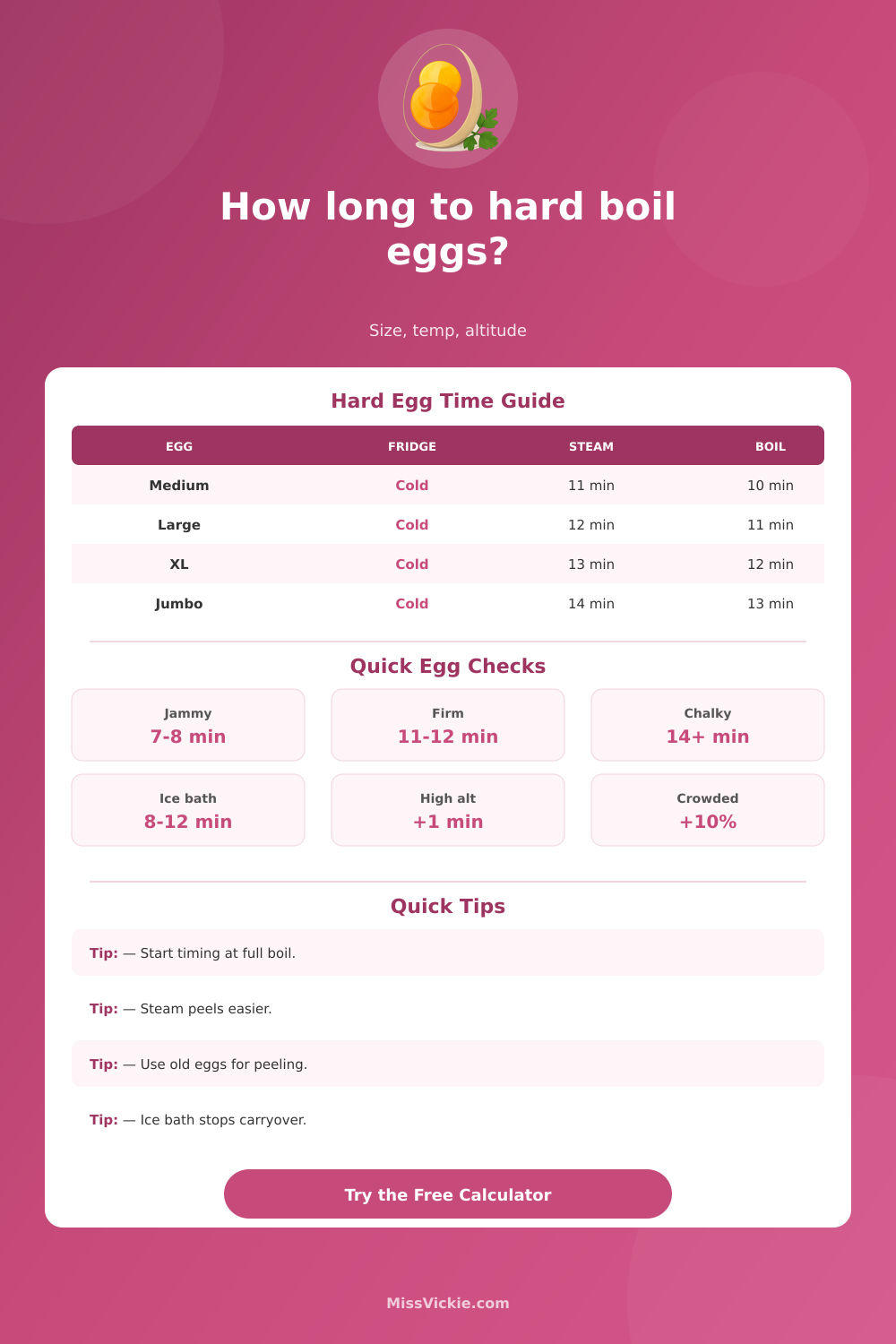
🕒Size and yolk firmness table
| Egg size | Typical shell weight | Firm hard yolk, fridge-cold | Adjustment note |
|---|---|---|---|
| Small | About 1.5 oz / 43 g | 9.5-10.5 minutes | Check early; the yolk center sets fast. |
| Medium | About 1.75 oz / 50 g | 10-11 minutes | Good for snacks and lunch boxes. |
| Large | About 2 oz / 57 g | 11-12 minutes | Most grocery-store recipes assume this size. |
| Extra-large | About 2.25 oz / 64 g | 12-13 minutes | Add time for a fully firm center. |
| Jumbo | About 2.5 oz / 71 g | 13-14 minutes | Benefits from a longer ice bath. |
🌡Method, altitude, and cooling table
| Condition | Time effect | Peel effect | Kitchen cue |
|---|---|---|---|
| Steam basket | Similar or +0.5 minute | Often easier | Begin timing when strong steam surrounds the eggs. |
| Cold-start pot | Includes heat-up time | Gentler shells | Use a covered pot and move to ice when the timer ends. |
| High altitude | About +0.5 to +2 minutes | No direct change | Water boils cooler, so the yolk sets slower. |
| Crowded pot | About +5% to +15% | More cracks | Use a wider pot or cook in two batches. |
| No ice bath | Carryover adds cooking | Harder peel | Expect a firmer, sometimes gray-edged yolk. |
💡Egg boiling tips
Prevent cracks: Lower cold eggs gently with a spoon, avoid a violent rolling boil, and keep water about 1 inch above the shells for boiling.
Peel cleanly: Steam or hot-start older eggs, chill hard in ice water, crack all around, then peel from the wider air-cell end under water.
Avoid gray rings: Gray-green edges come from overcooking and slow cooling. Use the check window and move eggs directly into an ice bath.
Cook batches evenly: If eggs sit in two layers or crowd the pot wall, split the batch or rotate once after the water recovers.
Making the ideal hard-boiled egg isn’t about blind luck; it is about knowing how to do it. Timing varies based off egg size, how many eggs fits in your pot, whether you start with room-temperature or cold eggs, and even your kitchen’s altitude. Until then, the shells won’t want to part ways with their yolks, or the yolks themselves may be underdone.
Enter the timing calculator: Feed it the variables that you know for your given batch, and voilà: you get a working time frame rather than a shot in the dark. The size of your egg also makes a difference because a larger volume of liquid mean it takes longer for heat to reach a bigger yolk. It will take noticeably longer, for instance, to get a jumbo egg cooked through to the center different than a medium-size one. The calculator accounts for differences in size and time before adding any other variables.
How Egg Timing Calculators Work
The starting temperature also matters. Chilled eggs from refrigerator don’t just make the time longer. They also increase the chance of cracking if you drop them into boiling water, and they delay when the center of the egg start cooking. Twenty minutes spent sitting on the counter before cooking eliminates that delay. So there’s a starting-temperature variable as well.
Another factor is crowding and batch size. Shoulder-to-shoulder eggs in a skinny pot mean less even recovery from temperature changes. You cook longer, you get more cracked egg. The pot-diameter plus number-of-eggs combo tell the calculator how crowded things are. It then adjusts by a modest amount. It’s not much but avoiding the common mistake of thinking an eighteen-egg batch cooks just like a six-egg one can realy matter.
The physics change in slight ways by altitude and method choices. The higher you go, water boils at a lower temperature, meaning that it take longer for the yolk to set. Steaming makes peeling easier than boiling because the shell comes off more easily, but the timing still need a small adjustment. Instead of leaving you to remember different rules depending on the situation, it folds all those effects into its final recommendation.
The cooking phase is important but so are carryover and chilling. When eggs come out of the water, they continues to cook, particularly when sitting in colander while you set up an ice bath. That’s why a brief carryover period followed by thorough chilling halts further progress. (It also loosens the membrane for easier removal.)
The calculator accounts for both phases so the overall plan factors in the whole sequence, not just time in the pot. That’s what all good timing tools are about: taking the math out of the equation. You’ll decide if you prefer a runny or more cooked yolk. You’ll also decide whether you care about clean-peeling eggs, since some meals is served shelled and others are not. But someone else did the math about how many eggs can fits in a pan, how long each one will take to cook, and how much cooling time it need, depending on altitude and other factors. And you get to spend your time on the stuff that counts.
Getting the eggs to exactly the right stage of doneness, and providing enough chill, is easier then ever. You should of used a calculator for this.