Hard Boiled Egg Time for Deviled Eggs Calculator
Estimate the cook, chill, peel, filling, and serving timeline for deviled eggs with fully set yolks, tender whites, minimal green ring risk, and realistic picnic or potluck holding time.
🥚Deviled Egg Timing Presets
Choose a common deviled egg situation, then adjust the egg size, method, altitude, chilling, and serving plan.
⚙Eggs, Method, And Party Conditions
Your Deviled Egg Timing Plan
Enter your batch details to estimate timing and serving yield.
Timing Breakdown
Yield And Serving Breakdown
📌Deviled Egg Quick Reference
🍳Method Comparison For Deviled Eggs
Best when you want a narrow timer and classic firm yolks.
Hot steam sets the outside quickly and often releases shells cleanly.
Good for crack-prone eggs, but timing depends on pot size and heat.
Fully set yolks with fast chilling beat extra-long cooking.
📊Hard-Boil Timing Table
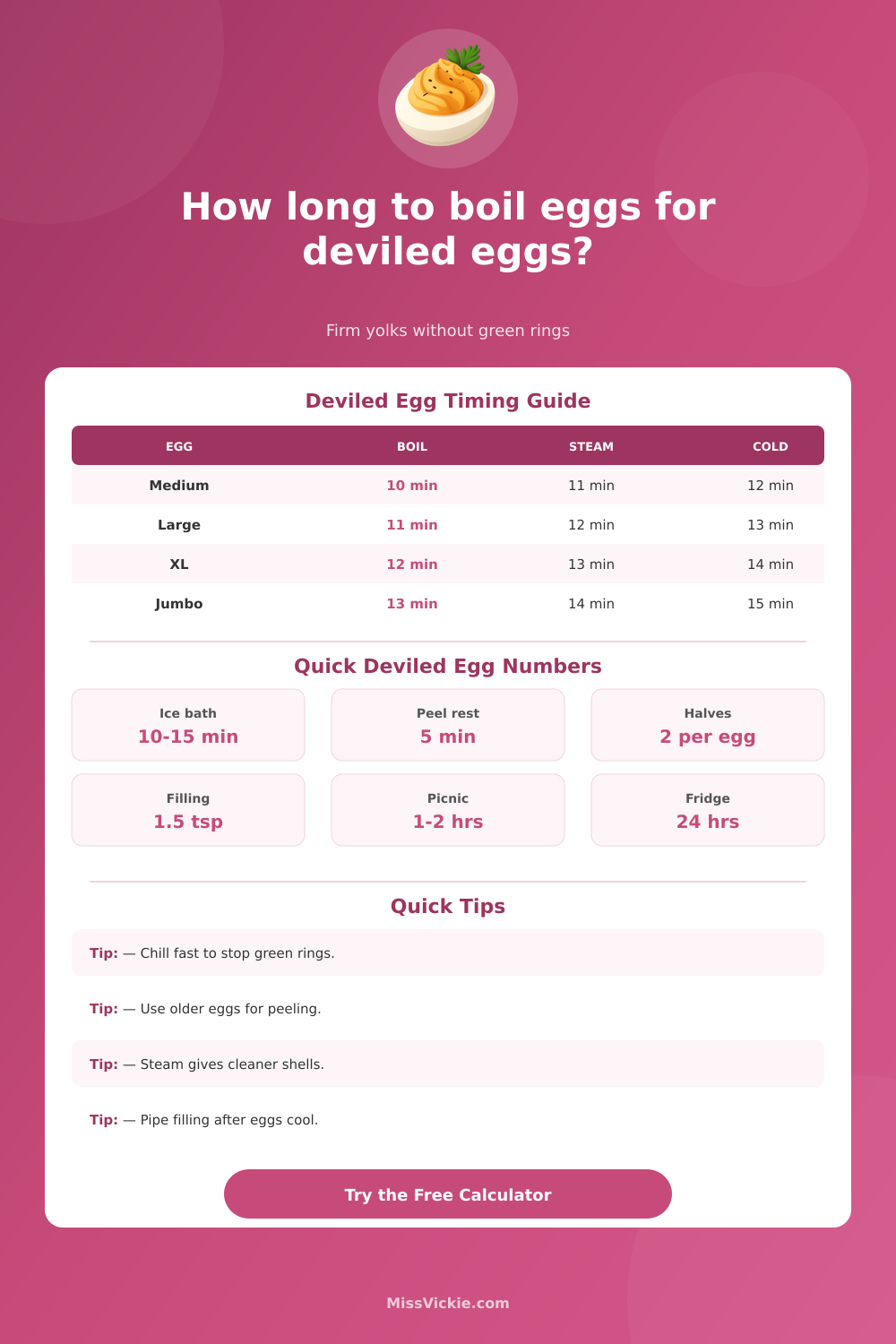
| Egg Size | Boiling-Water Start | Steam Basket | Cold-Water Start | Best Deviled Egg Use |
|---|---|---|---|---|
| Small | 9 to 10 minutes | 10 to 11 minutes | 11 to 12 minutes after boil | Appetizer trays with light filling |
| Medium | 10 to 11 minutes | 11 to 12 minutes | 12 to 13 minutes after boil | Small platters and lunch prep |
| Large | 11 to 12 minutes | 12 to 13 minutes | 13 to 14 minutes after boil | Standard deviled eggs |
| Extra large | 12 to 13 minutes | 13 to 14 minutes | 14 to 15 minutes after boil | Generous piped filling |
| Jumbo | 13 to 14 minutes | 14 to 15 minutes | 15 to 16 minutes after boil | Large party portions |
Timing assumes chicken eggs, a prompt ice bath, and yolks that are fully set for mashing rather than jammy or soft.
⛰Adjustment Reference Table
| Condition | Typical Adjustment | Why It Matters | Deviled Egg Cue |
|---|---|---|---|
| Fridge-cold eggs | Add 30 to 60 seconds | Cold yolk centers lag behind the whites | Use ice after cooking, not extra boiling |
| Room-temperature eggs | Subtract 20 to 40 seconds | Centers heat sooner | Watch overcook risk near the yolk rim |
| Altitude above 3,000 ft | Add 30 to 120 seconds | Water boils cooler at altitude | Steam or test one egg for large batches |
| Crowded pot | Add 30 to 90 seconds | Water recovery slows after eggs go in | Stir once gently to center yolks |
| Very fresh eggs | No cook-time fix | Membranes cling more tightly | Steam, chill, crack, and peel under water |
🥄Deviled Egg Yield Table
| Whole Eggs | Possible Halves | Usable Halves At 8% Loss | Classic Filling Estimate | Good For |
|---|---|---|---|---|
| 6 eggs | 12 halves | 11 halves | About 1/3 cup | Family snack or small dinner |
| 12 eggs | 24 halves | 22 halves | About 3/4 cup | Standard appetizer plate |
| 18 eggs | 36 halves | 33 halves | About 1 1/8 cups | Potluck side tray |
| 24 eggs | 48 halves | 44 halves | About 1 1/2 cups | Large party platter |
| 36 eggs | 72 halves | 66 halves | About 2 1/4 cups | Buffet or holiday event |
🧊Chilling And Potluck Holding Table
| Stage | Recommended Time | Temperature Goal | Practical Note |
|---|---|---|---|
| Ice bath after cooking | 10 to 15 minutes | Cool whites quickly | Refresh ice if it melts fast |
| Peel rest | 5 minutes | Cold but workable | Tap all over, then peel from the wide end |
| Refrigerated make-ahead | Up to 24 hours | Keep chilled | Store whites and filling separately for best look |
| Room-temperature serving | Up to 2 hours | Below hot-day danger | Return extras to the fridge promptly |
| Hot picnic table | Up to 1 hour | Above 90°F is risky | Serve over ice or bring smaller trays out in waves |
💡Deviled Egg Tips
🥚Egg And Filling Nutrition Reference
Making deviled eggs for company sends every home cook into a frenzy. Stand there at the stovetop, staring at the water, waiting, waiting: Is 11 minutes long enough to set the yolk? Too long and you’ve got a chalky, gray blob on your hands. Even though these are such simple ingredient, it seems like high-stakes cooking.
Why? Whether your egg has a cream-colored center or a dry, off-putting rim is less about guessing and more about physics. You want just enough time to get all the protein set so you can mash it up, yet not too much time or you’ll experience that ugly, chemical-reaction-caused green ring around the yolk’s perimeter. The trick is to not let iron in the white react with sulfur in the yolk for too long. The longer you leave them together, the bigger the ring.
The Science of Perfect Deviled Eggs
This calculator will help you hit that sweet spot. Adjust it based off factors like egg size and their temperature as they come out of the fridge.
The second thing about egg peeling I’ve found that’s counterintuitive: Egg age does matter. Eggs that were just laid yesterday will be more difficult to peel than older eggs because they still has some higher pH white (the inside of the egg), which means there’s a tighter bond between the inner membrane and the shell. Over time, some carbon dioxide seeps out of the porous shell, increasing the pH and loosening the adhesion. So if you buy very fresh eggs at a farmstand, know that you’ll lose more whites to tearing as you peel. To account for this, the tool lets you choose how old your eggs are, which goes into estimate of how many usable halves to expect. That’s one reason many chefs suggest using large grocery-store eggs for deviled eggs instead of ultra-fresh farm ones; they’re less likely to tear away cleanly.
Timing varies quite a bit depending on your method of choice. With a boiling water start, you have an accurate timer: two hundred twelve degrees Fahrenheit instantaneously. Steam is more gentle, eggs don’t bang around in turbulent water, giving cleaner shells too. But steam takes just a little longer to get up to temp deep inside a big ol’ jumbo-sized egg. The page’s reference tables makes this difference clear, so that you can adjust methods without having to adjust your whole plan.
You’ll also want to take into consideration the different boiling point of water if you’re at high altitude. In Denver, water doesn’t boil as hot as it does in New York City, so even though it may look like some vigorous bubbling going on, your eggs will cook slower than expected. Adding a minute or two won’t risk overcooking them, but it will help prevent undercooked centers.
If you’re going for pro-level eggs, chilling is mandatory. Once you remove the pot from the burner, the heat moves from the white to the yolk. If you simply sit there until your egg is overcooked, which happens, the heat left in the egg will spoil even the most carefully timed one. Use an ice bath to halt the action. Do it immediately. For optimal timing, a minimum of ten minutes in water that’s darn close to freezing will cool it sufficiently so no green sulfide ring forms.
Because rushing here is another frequent mistake, we added this variable (ice bath duration) as an input on the calculator. “It’ll take too long!” people say, rushing it anyway. Then it won’t be worth eating,” they grumble later. The yolk is tough and the shell clings to the white, making peeling frustrating.
Logistics are those things we often neglect until the very end. Turns out deviled eggs are best if their white halves remain cool and the yolk filling stays vibrant. Leaving them on a hot patio table for three hours results in poor texture and creates a food safety risk.
The tool can estimate your yield in terms of actual halved eggs (taking into account both trimmed waste and cracked shells). It will suggest the right amount of filling based on what you choose, such as a light classic mash or a loaded version with bacon and relish. This way, you won’t buy too much mayo or mustard and run out.
Separate tasks. Plan ahead. If you break down the steps, you can have the eggs peeled and hard boiled up to 24 hours before assembly time. Keep the yolks separate from the whites. Place each in their own container and keep chilled. Build the filling right before serving to avoid sogginess (the whites will absorb moisture).
This way of thinking breaks down the process into a set of timed events that are easy to follow. Rather than worrying about fuzzy directions such as “cook until done,” you trust exact figures which take into consideration real world conditions inside your kitchen. It’s all about physics, not guesswork; it’s as simple as consistency.
You might have one egg for breakfast, a dozen for brunch, or 48 for a holiday buffet. It doesn’t matter: The physics don’t change. Protein + heat = set. Stop time, stop cooking. Let it sit and you have something else entirely. Get to know how these variables interact with egg age, altitude, and temperature, and the anxiety subsides.
The math handles the uncertainty, freeing you up to think about the seasoning. Once the math is right, all the difference between good and great comes down to a dash of hot sauce or a pinch of smoked paprika. Perfectly cooked yolks, tender yet still holding their shape and vibrant yellow in the center; that’s precisely what patient calculation gets you.