Hard Boiled Duck Egg Time Calculator
Estimate hard boiled duck egg timing from egg weight, fridge or room temperature, cold-start or boiling-start method, altitude, yolk firmness, shell thickness, simmer intensity, ice bath time, peeling rest, intended use, and carryover.
Choose a duck-egg scenario, then adjust size, starting temperature, water start, altitude, shell thickness, simmer style, ice bath, carryover, and whether the eggs are for deviled eggs, salad, or snacking.
Duck egg boiling plan
Use the calculator for a duck-egg-specific timing window.
Timing Breakdown
Batch Details
Larger than a standard large chicken egg.
Medium to large duck eggs at a gentle simmer.
Stops carryover and helps set clean whites.
Useful for thick shells and very fresh eggs.
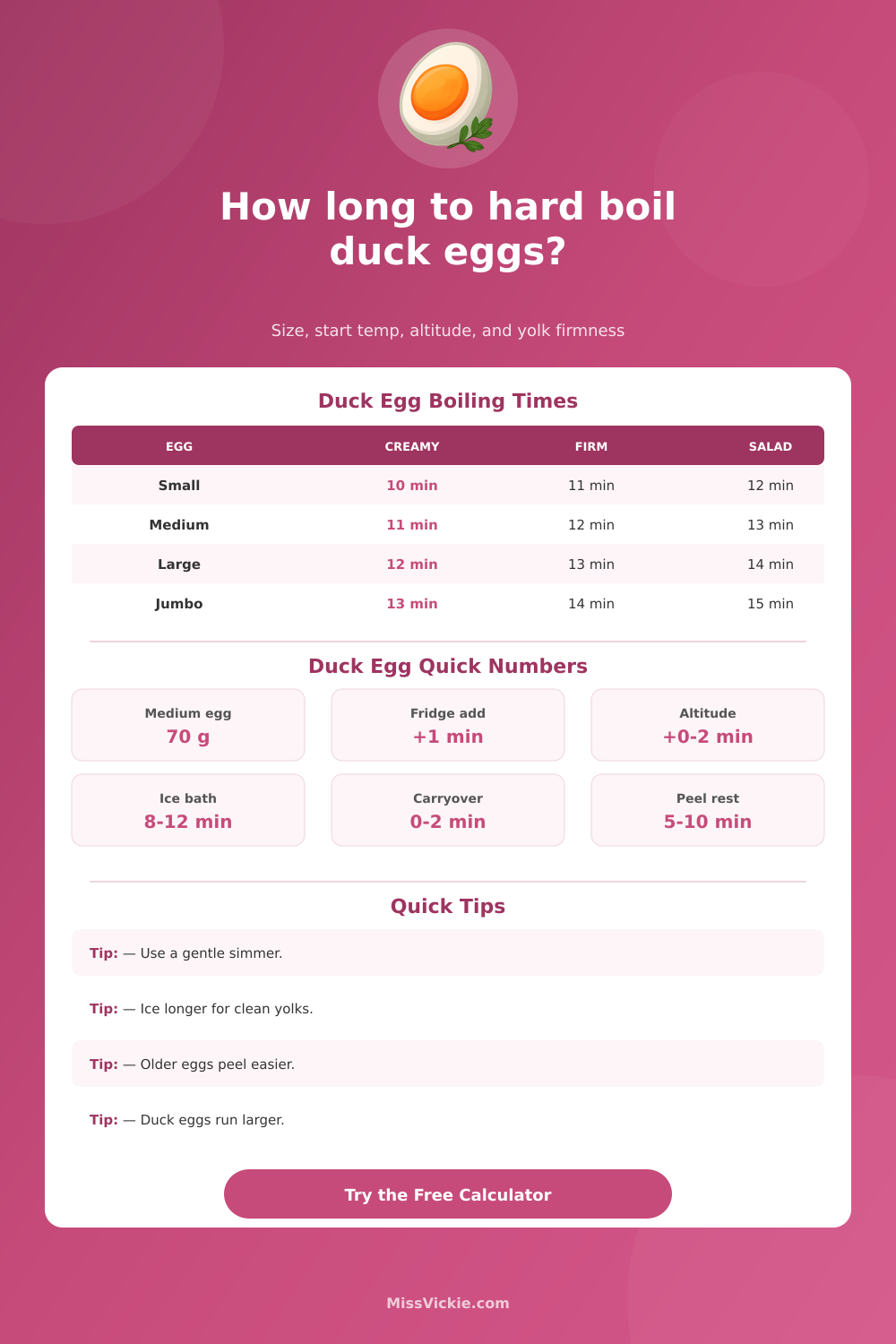
| Duck egg size | Approx. weight | Creamy fully set | Firm hard boiled | Deviled or salad |
|---|---|---|---|---|
| Small duck egg | 55 to 62 g / 1.9 to 2.2 oz | 10 to 11 minutes | 11 to 12 minutes | 12 to 13 minutes |
| Medium duck egg | 63 to 74 g / 2.2 to 2.6 oz | 11 to 12 minutes | 12 to 13 minutes | 13 to 14 minutes |
| Large duck egg | 75 to 88 g / 2.6 to 3.1 oz | 12 to 13 minutes | 13 to 14 minutes | 14 to 15 minutes |
| Jumbo duck egg | 89 to 105 g / 3.1 to 3.7 oz | 13 to 14 minutes | 14 to 15 minutes | 15 to 16 minutes |
Times assume a boiling start at sea level, gentle simmer, and eggs moved straight into ice water.
| Condition | Timing change | Why duck eggs differ | Best kitchen move |
|---|---|---|---|
| Refrigerated duck eggs | Add 45 to 75 seconds | The larger yolk starts colder in the center. | Lower gently and keep the simmer steady. |
| Cold-start pot | Count heat-up plus hold | The shell warms gradually, reducing cracks. | Start timer when water reaches a boil, then simmer or cover. |
| 3,000 to 5,000 ft altitude | Add about 45 seconds | Water boils cooler, so proteins set more slowly. | Use a lid and avoid weak simmering. |
| Over 5,000 ft altitude | Add 75 to 120 seconds | Lower boiling temperature is more noticeable. | Use the high end of the calculated range. |
| Planned use | Yolk target | Ice bath | Peeling/rest note |
|---|---|---|---|
| Snack eggs | Creamy but fully set | 8 to 10 minutes | Peel warm after a short rest for tender whites. |
| Deviled duck eggs | Firm and mashable | 10 to 12 minutes | Rest 5 to 10 minutes so thick shells release cleanly. |
| Duck egg salad | Very firm center | 10 to 14 minutes | Chill fully before chopping for cleaner pieces. |
| Meal prep | Firm yolk, no gray ring | 12 minutes | Store unpeeled if you want better texture later. |
Heavier shells, larger yolks, richer whites, and a bigger center that needs more time.
Standard hard-boil charts usually assume 50 g large chicken eggs, not duck eggs.
Much smaller eggs set quickly and should never use the duck egg timer.
Cook duck eggs by weight class so the smallest eggs do not overcook.
The reason hard-boiled duck eggs don’t work out as well is that duck eggs aren’t like chicken eggs: They are heavier, their shells is often thicker and more porous, and their yolks is significantly larger. Boiling them at the same time as chicken eggs simply doesn’t work. The calculator takes this into account… But knowing what to take into account make your cooking more successful.
Most important is the initial temperature of the egg. An egg straight out of your fridge will have more thermal inertia than one that has been sitting on your counter. Because the white warms faster then the yolk, it will be done before the middle. This means you must cook a bit longer to get everything done but not overdone. The device makes up for this and removes any need to guess how long to cook.
Tips for Cooking Duck Eggs
Water temp also varies with altitude. For instance, in Denver’s high elevation, water will boil at a lower temperature. That means that even though you have hot water, it’s not quite as hot as it looks down at sea level. To accommodate this reduction in heat, the calculator adjust the cook times accordingly. Otherwise you risk having a under-cooked yolk and a tough edge on your eggs.
“Not all duck eggs are created equal. Some have thin shells that break when touched. Others is thick and resist removal. The fresher the egg, the more it will cling to its membrane. To remove the shell from the white you need to boil them then plunge into an ice bath. Plunging the eggs into an ice bath for eight to twelve minutes stops the cooking process immediately. It will also keep the yolk from developing a gray ring around it. Otherwise, removing the shell is a pain in the hiney and takes too long.”
The texture of the egg depends on how you use it. For deviled eggs, it need to be set and dry, maintaining its shape. If making a jammy center or creamy center as part of a snack, the former is probably best suited. See the table below for time recommendations for each texture. There’s no one size fits all. Time will need to be adjusted to match the desired texture.
Cooking duck eggs is tricky; it takes experience to balance moisture and heat levels. Altitude and weight are things a calculator can computes for you. Lower the eggs slowly into the water. Do not boil violently, just maintain a gentle simmer. Afterward, always place them in an ice bath. This allows for even cooking and easy peeling. A properly cooked duck egg taste richer than its chicken counterpart.