🍳 Recipe scaling made simple
Half Recipe Converter
Halve servings, ingredient weights, liquids, eggs, leaveners, pan size, bake time, and nutrition for cakes, cookies, brownies, muffins, pancakes, casseroles, cornbread, and quick breads.
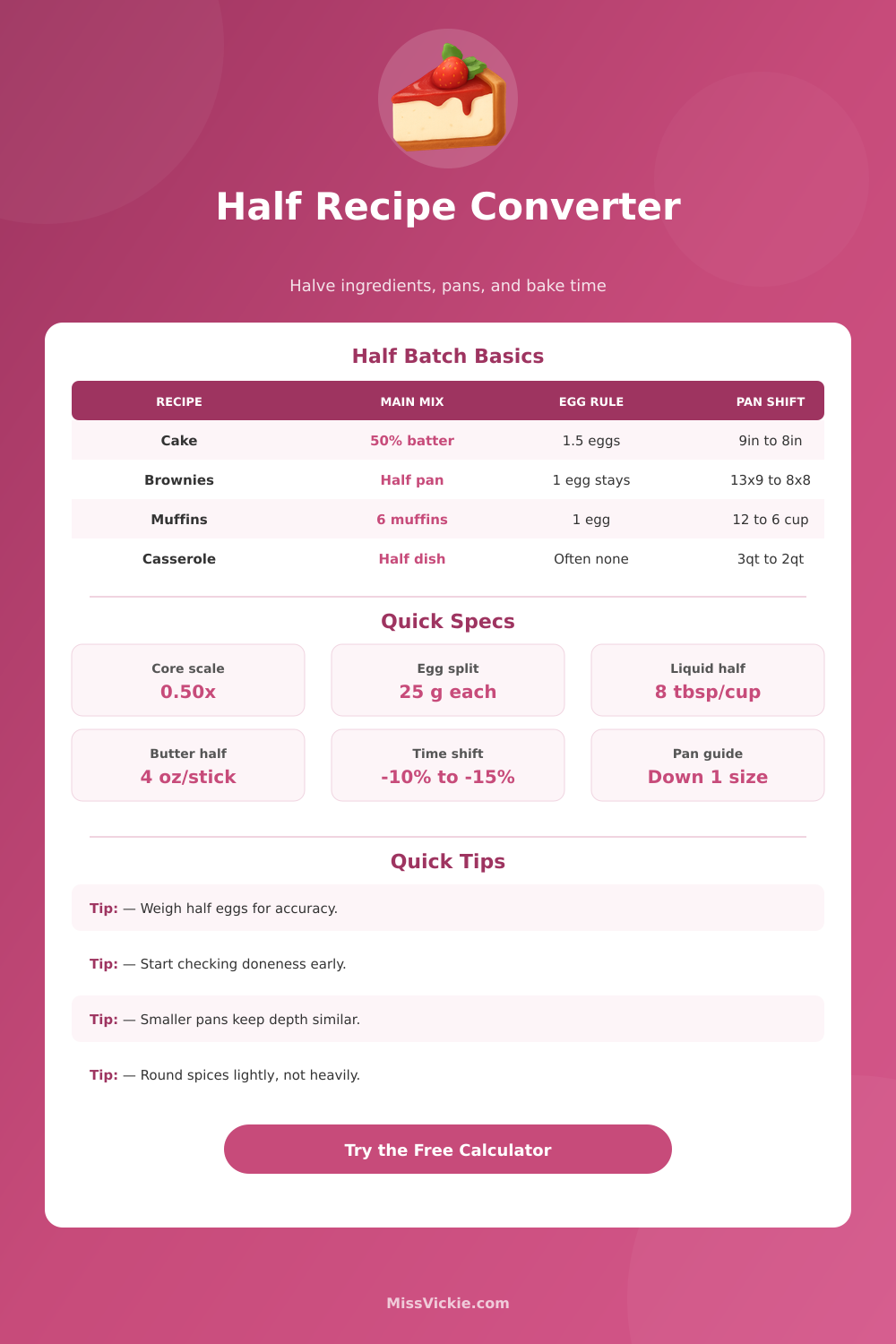
This calculator starts at a true half batch, then adjusts for recipe type, egg splitting, pan depth, and doneness timing so smaller batches stay practical to cook.
Halved Ingredient List
Original Batch
--
Starting servings before halving.
Half Batch
--
Converted servings after scaling.
Batter / Mix Weight
--
Estimated finished mix before baking.
Egg Handling
--
Rounded or weighed egg strategy.
| Recipe Type | Half Batch Rule | Best Egg Approach | Typical Time Change |
|---|---|---|---|
| Cake Batter | Keep batter depth close to original | Weigh half eggs when needed | Check 10% early |
| Brownies or Bars | Move from 13x9 to 8x8 when possible | One whole egg often works well | Check 12% early |
| Cookie Dough | Half dough exactly, scoop same size | Use beaten egg by weight | Usually 0% to 5% less |
| Muffins | Fill 6 cups instead of 12 | One egg suits many half batches | Check 8% early |
| Pancakes or Waffles | Halve batter and keep griddle temp steady | Rounded eggs are usually fine | Cook time stays similar |
| Savory Casserole | Keep filling depth in a smaller dish | Eggs depend on binder role | Check 15% early |
| Cornbread | Use smaller skillet or 8x8 pan | One egg commonly fits | Check 10% early |
| Quick Bread Loaf | Use mini loaf or 8x4 pan | Beat eggs before dividing | Check 12% early |
| Original Amount | Half Amount | Kitchen Equivalent | Best For |
|---|---|---|---|
| 1 cup | 1/2 cup | 8 tbsp | Liquids, flour, sugar |
| 3/4 cup | 3/8 cup | 6 tbsp | Milk, melted butter |
| 2/3 cup | 1/3 cup | 5 tbsp + 1 tsp | Oil, buttermilk |
| 1/2 cup | 1/4 cup | 4 tbsp | Nuts, mix-ins |
| 1 tbsp | 1 1/2 tsp | 4.5 ml | Vanilla, baking powder |
| 1 tsp | 1/2 tsp | 2.5 ml | Salt, soda, spice |
| 1 large egg | 1/2 egg | 25 g beaten egg | Cakes, cookies |
| 1 stick butter | 1/2 stick | 4 tbsp or 57 g | Bars, cakes, cornbread |
| Original Pan | Good Half Pan | Area Ratio | Best Use |
|---|---|---|---|
| 13x9 pan | 8x8 pan | 117 to 64 sq in | Brownies, casseroles |
| 9-inch round | 8-inch round | 63.6 to 50.3 sq in | Cakes, cobblers |
| 9x5 loaf | 8x4 loaf | 45 to 32 sq in | Quick breads |
| 12-cup muffin tin | 6-cup muffin tin | Half cavity count | Muffins, egg bakes |
| 10-inch skillet | 8-inch skillet | 78.5 to 50.3 sq in | Cornbread, skillet bakes |
| 3-quart casserole | 2-quart casserole | Volume downsize | Lasagna, bakes |
| Original Servings | Half Servings | Flour at 2 cups Full | Liquid at 1 cup Full |
|---|---|---|---|
| 4 | 2 | 1 cup | 1/2 cup |
| 6 | 3 | 1 cup | 1/2 cup |
| 8 | 4 | 1 cup | 1/2 cup |
| 12 | 6 | 1 cup | 1/2 cup |
| 16 | 8 | 1 cup | 1/2 cup |
| 24 | 12 | 1 cup | 1/2 cup |
To halve a recipe mean to reduce the amount of ingredient necessary to create a smaller portion of the food. Halving recipes can be difficult, as some ingredients is easily halved while others are not. Ingredients like flour and sugar will easily halve when making a recipe half the strength.
However, ingredients like egg and leaveners require more precision when halving recipes. If a recipe is not halved correctly, the food will have a different texture and flavor. Eggs can be a difficult ingredient to halve.
How to Cut a Recipe in Half
When making recipes, it is impossible to halve an egg. A single large egg weighs 50 grams when beaten. If a recipe call for two eggs, then one egg can be used.
However, if a recipe requires three eggs, you must beat and weigh the eggs. Twenty-five grams of beaten eggs can be used to make one half egg. If eggs are not weighed, the baked goods may not turn out proper.
Pan size can be another difficult aspect of halving recipes. The depth of the food need to be considered if using different sized pans. For example, a nine-inch round pan can be replaced with an eight-inch round pan.
Using pans of different depths can alter the cooking of the recipe. Using a pan that is too deep will cause the food to cook too quick and dry out. Using a pan that is too shallow may cause the outside of the food to burn before the inside is cooked.
Bake times will also change when halving recipes. The bake time will decrease due to the smaller mass of food that will be baking. However, using the original bake time for the halved recipe will not yield the best result.
The food should be baked for approximately ten percent less time than the original recipe’s time. For example, if a recipe require thirty-two minutes of baking time, the halved recipe should be baked for approximately twenty-eight or twenty-nine minutes. It is important to monitor the food as halved recipes may dry out more quickly then the original batch.
Other ingredients to pay special attention to include spices and salt. The flavor of spices can be strong in smaller portion of batter. Care should be taken with the amount of salt and spices that goes into the batter.
Finally, care should be taken with leaveners. Leaveners will activate quickly in the batter, so you must measure the amount added correct. The nutrition for recipes will also halve when halving the recipes.
Halving the ingredients will halve the number of calories, fats, and carbohydrate in the recipe. For example, if a brownie contain three hundred ten calories, the halved portion will contain one hundred fifty-five calories. The protein content will also halve, as the egg will provide half the protein.
Technology allow individuals to halve recipes using presets. Presets allow individuals to select the type of food they are baking. The software will preset the correct pan size and bake time for the food selected.
Additionally, the number of serving can be selected, and the software will display the halved ingredient for the recipe. These time saving tools will help individuals avoid mistake when halving recipes. Overall, by following these steps, individuals can successfully halve recipes and prepare food of the same quality as if they follow the original recipe.