Ground beef, meatiness target, cooked yield, sauce volume, pasta shape, and blend math
Ground Beef for Pasta Sauce Calculator
Estimate how much raw ground beef to brown for pasta sauce from servings, cooked meatiness, beef fat percent, raw-to-cooked yield, sauce volume, pasta shape, simmer reduction, and sausage or mushroom blends.
Start with a common pasta dinner, then adjust the servings, cooked meat per serving, ground beef fat, final sauce volume, pasta shape, simmer loss, and sausage or mushroom blend.
Calculation Breakdown
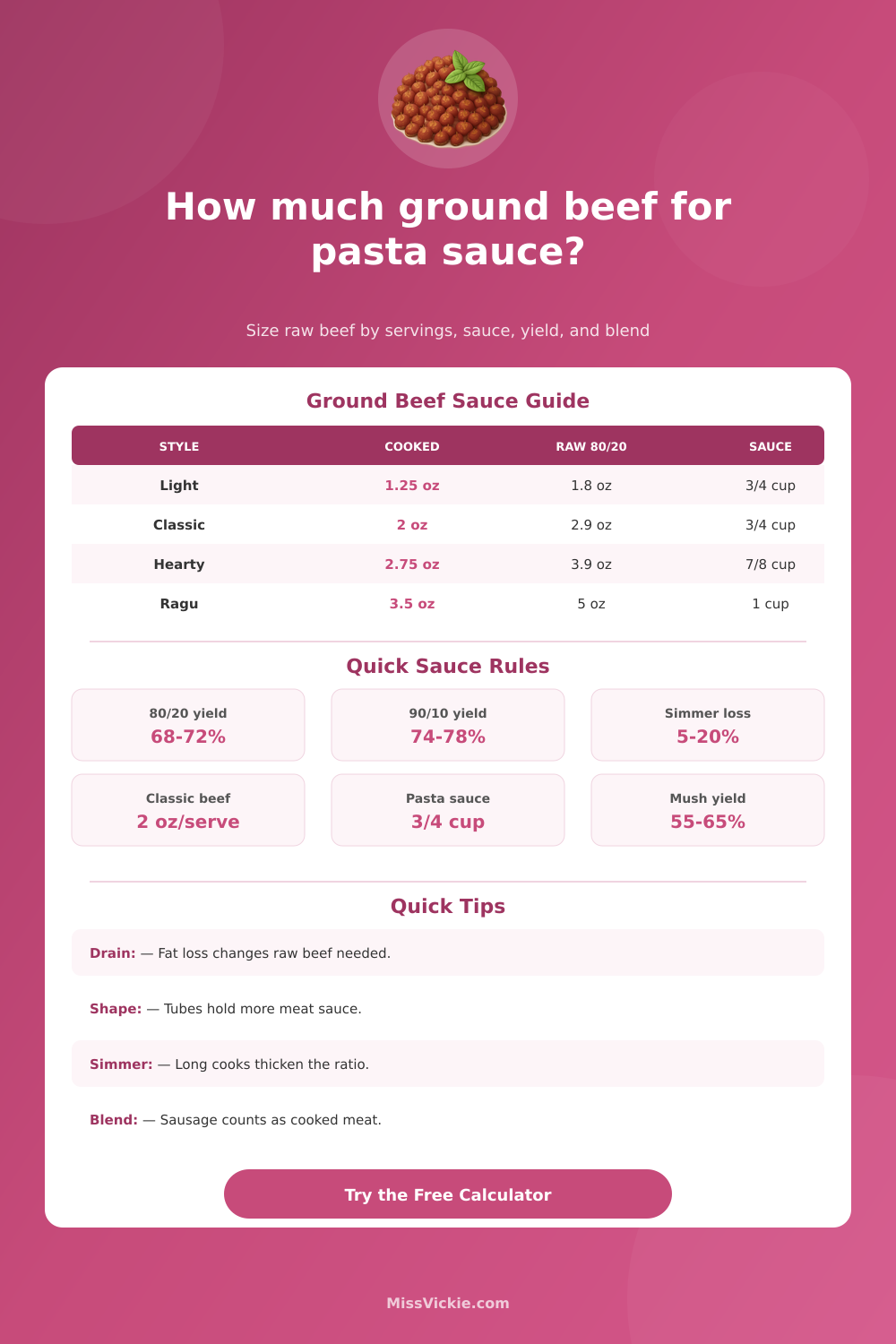
Good when the sauce is mostly tomato and the beef is a background flavor.
A balanced weeknight meat sauce for spaghetti, linguine, or penne.
Works for rigatoni, shells, baked ziti, and sauce served as the main protein.
A thick, meat-forward sauce that needs enough tomato volume to stay spoonable.
| Ground Beef | Typical Cooked Yield | Raw For 8 oz Cooked | Best Sauce Use |
|---|---|---|---|
| 93/7 or 90/10 lean beef | 74 to 80 percent | 10 to 11 oz raw | Cleaner tomato sauces with less draining. |
| 85/15 ground beef | 70 to 76 percent | 10.5 to 11.5 oz raw | Classic meat sauce with moderate richness. |
| 80/20 ground beef | 66 to 72 percent | 11 to 12.25 oz raw | Rich spaghetti sauce when browned and drained. |
| 73/27 ground beef | 58 to 66 percent | 12.25 to 13.75 oz raw | Budget batches where extra fat is drained well. |
| Beef cooked directly in sauce | 78 to 86 percent | 9.5 to 10.25 oz raw | Loose, fine-textured sauce with less browning flavor. |
Yield changes with pan size, browning time, draining, and how much rendered fat you keep in the sauce. Use your measured cooked weight when precision matters.
| Pasta Shape | Useful Sauce Per Serving | Meat Sauce Fit | Cooked Meat Note |
|---|---|---|---|
| Spaghetti or linguine | 0.65 to 0.8 cup | Best with classic or light sauce. | Too much beef can slide off long strands. |
| Fettuccine or tagliatelle | 0.7 to 0.85 cup | Handles a thicker ragu well. | Wider ribbons carry small beef crumbles nicely. |
| Penne or ziti | 0.8 to 0.95 cup | Good for hearty meat sauce. | Tube centers trap sauce and meat bits. |
| Rigatoni or shells | 0.85 to 1 cup | Best for chunky beef blends. | Large openings reward a higher meat density. |
| Lasagna or baked pasta | 0.9 to 1.1 cup | Needs enough sauce to stay moist. | Meat density can be higher because cheese adds moisture. |
| Blend | Beef Share | Addition Yield | Flavor Result |
|---|---|---|---|
| All ground beef | 100 percent | None | Clean beef flavor and easiest yield math. |
| 75 percent beef, 25 percent sausage | 75 percent | Sausage about 72 percent | Classic Italian seasoning without overwhelming tomato. |
| 50 percent beef, 50 percent sausage | 50 percent | Sausage about 72 percent | Richer and saltier, best with larger sauce volume. |
| 80 percent beef, 20 percent mushroom | 80 percent | Mushroom about 58 percent | Stretches beef while keeping a meaty texture. |
| 60 percent beef, 25 percent sausage, 15 percent mushroom | 60 percent | Mixed addition | Layered sauce for rigatoni, ziti, and baked pasta. |
| Servings | Classic Cooked Meat | Raw 80/20 Beef At 70% Yield | Starting Sauce Before 12% Simmer Loss |
|---|---|---|---|
| 4 servings | 8 oz cooked | 11.5 oz raw | 3.4 cups starting sauce |
| 6 servings | 12 oz cooked | 1.1 lb raw | 5 cups starting sauce |
| 8 servings | 1 lb cooked | 1.45 lb raw | 6.8 cups starting sauce |
| 12 servings | 1.5 lb cooked | 2.15 lb raw | 10.2 cups starting sauce |
| 24 servings | 3 lb cooked | 4.3 lb raw | 20.5 cups starting sauce |
Nutrition is a planning estimate for the beef, sausage, and mushrooms only. Tomato sauce, pasta, cheese, and oil are not included.
To calculate how much ground beef to put into the pasta sauce, you need to understand the difference between the raw weight of the ground beef and the cooked weight of the ground beef. Many peoples make the mistake of using the raw weight of the ground beef in there pasta sauce as the measurement for how much ground beef to add to the sauce. However, when the ground beef are cooked, it will lose some of its weight due to the drainage of the fat from the ground beef.
To find the amount of raw ground beef that you need to use in your sauce, you first need to determine the target amount of cooked ground beef that you want in each serving of your pasta sauce. Once you have determined the target amount of cooked ground beef that you would like to use in each portion of your pasta sauce, you can calculate how much raw ground beef you will need by using a calculator. One of the factors that will impact the weight of the ground beef after it is cooked is the fat percentage of the ground beef that you use.
How Much Ground Beef to Use in Pasta Sauce
For instance, ground beef that contains more fat will lose more weight during the cooking process than ground beef that contains less fat. If you use ground beef that is 80/20 which means it contains 80% ground beef and 20% fat, and you drain the fat from the pan in which you cook the ground beef, you will have less cooked ground beef than if you used ground beef that is 90/10 which means it contains 90% ground beef and 10% fat. Thus, the yield percentage of the ground beef changes based off the fat content of the ground beef, as well as based upon how much fat that you drain from the pan in which you cook the ground beef.
If you drain all of the fat from the ground beef that you cook, the yield of the ground beef will be lower than if you cooked the same amount of ground beef with some fat remaining in the sauce. The length of time that the sauce simmers while it is cooking will also have an impact upon the density of the sauce. If you simmer the sauce for a long period of time without the lid of the sauce pot covering the sauce, the liquid in the sauce will evaporate.
As a result, the sauce will become more concentrated. Even if the amount of cooked ground beef that you use in the sauce is the same, the sauce will taste more densly due to the evaporation of the liquid from the sauce. Additionally, the type of pasta that you use will also impact the density of the sauce that you taste with each bite of the pasta.
For example, pasta shapes that are hollow, such as tubes and shells, will hold more sauce than thin strands of pasta. As a result, the same amount of cooked ground beef will feel heavier in tubes and shells than it will in thin strands of pasta. Another factor to consider when making the sauce is the use of meat blends instead of ground beef alone.
For instance, some recipes include the addition of sausage to the sauce. Not only does the sausage add flavor to the sauce, but the sausage also adds its own yield to the sauce. Additionally, mushrooms can also be added to the sauce which also increases the total volume of the sauce without adding much fat to the sauce.
Because meat blends change the total weight and the flavor of the sauce, it is important to use a sauce calculator to test the impact of these ingredients prior to simmering the sauce. The most common error that can be made in the sauce preparation are to only consider the starting volume of the sauce, or to forget all about the drainage of the fat from the ground beef. The recipes for the sauce will likely suggest a certain amount of ground beef to be used in the sauce.
The recipe may not consider the fat that will drain from the ground beef, or the fat percentage of the ground beef that will be used in the sauce. Thus, without knowing the fat percentage of the ground beef that is to be used, and without knowing the drainage of the fat from the pan in which the ground beef will be cooked, it is impossible to accurately calculate the amount of ground beef to be used in the sauce. Thus, you should of use a calculator to calculate the amount of ground beef that is needed for the sauce by inputting the fat percentage of the ground beef, as well as the drainage method for the fat from the pan in which the ground beef will be cooked.
Another consideration prior to cooking the sauce is to decide if you want to cook extra portion of the sauce to allow the sauce to last beyond the meals prepared during the cooking of the sauce. If you would like to ensure that each individual receives an equal portion of the sauce, it is important to add a serving cushion to the total amount of cooked ground beef that will be prepared. By adding a serving cushion, you will have enough sauce to last you and your family for future meals.
However, if you do not add a serving cushion, you may not have enough sauce for each person. Finally, it is important to determine the target amount of cooked ground beef per serving, before calculating the raw weight of the ground beef to be used, the amount of reduction of the sauce that will be simmered, as well as the amount of meat blend (if any) to be added to the sauce.