Ground Beef Freezer Shelf Life Calculator
Estimate the best-quality freezer window for raw or cooked ground beef using grind date, fat level, package seal, freezer temperature, portion thickness, thaw plan, and cooking goal.
🥩 Ground Beef Presets
Pick the closest freezer situation, then adjust the package, fat blend, freezer setting, thickness, thaw method, and quality goal.
📋 Freezer Batch Details
Ground Beef Freezer Forecast
Your quality estimate will appear here.
Quality Loss Factors
Handling Plan
Use Plan Timeline
💡 Quick Quality Markers
📊 Ground Beef Freezer Reference Tables
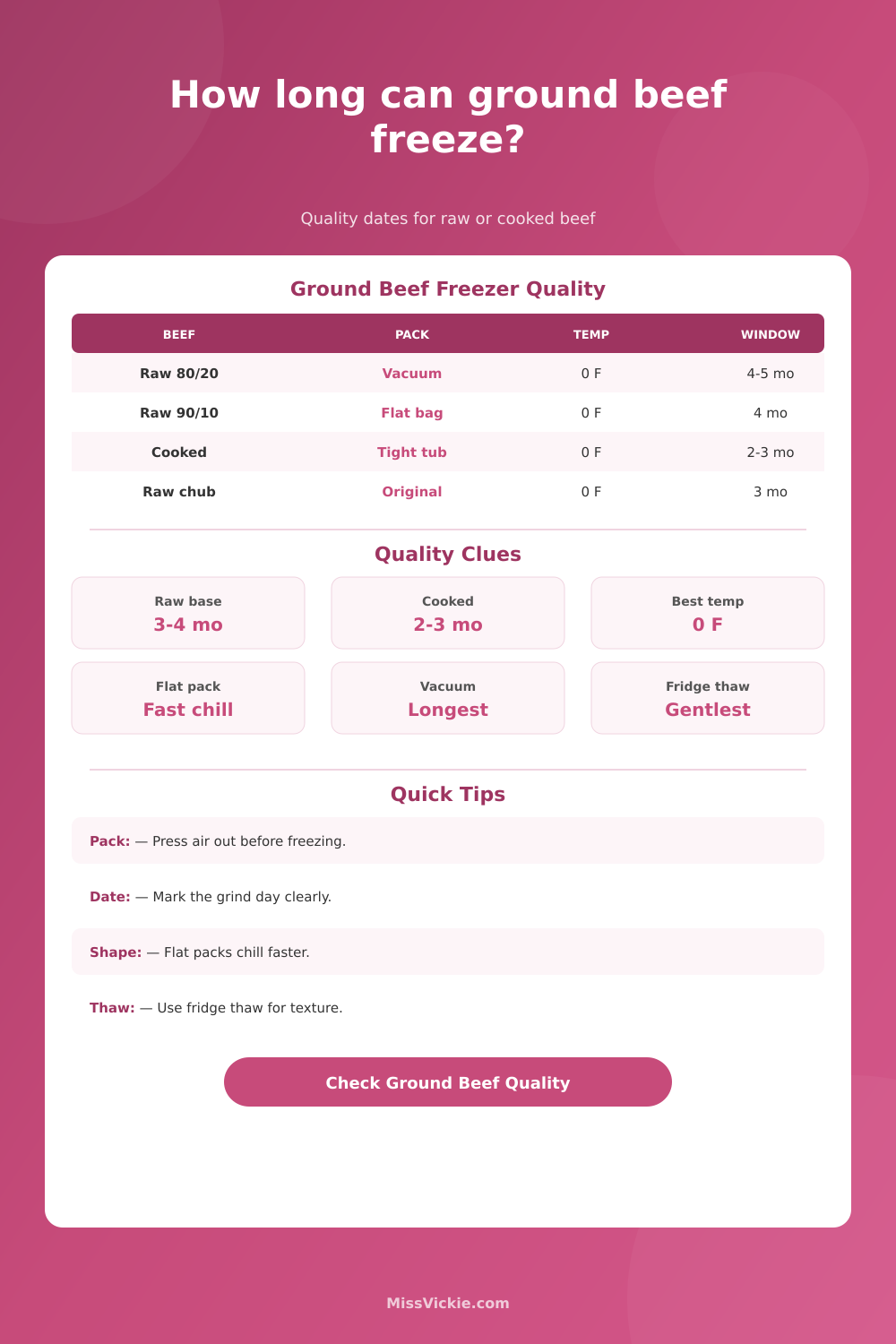
| Ground Beef Form | Best-Quality Baseline | Why It Changes | Best Use Near End |
|---|---|---|---|
| Raw loose ground beef | 3 to 4 months | High surface area exposes fat and lean meat to air | Tacos, pasta sauce, shepherd pie |
| Raw patties or meatballs | 3 to 4 months | Edges dry faster if separated by loose wrap | Burgers with sauce, baked meatballs |
| Cooked ground beef crumbles | 2 to 3 months | Cooked fat and browned edges pick up freezer flavor sooner | Chili, soup, enchilada filling |
| Seasoned raw ground beef | 2.5 to 3.5 months | Salt and spices can shift texture during storage | Stuffed peppers, skillet fillings |
| Package Type | Air Control | Quality Effect | Ground Beef Note |
|---|---|---|---|
| Original tray or chub | Low to moderate | Shortens premium flavor window | Move tray packs into freezer bags for longer storage |
| Butcher paper wrap | Moderate | Good for brief storage | Add a tight outer freezer bag for ground beef |
| Flat freezer bag | Good | Extends quality by fast chilling | Press into thin sheets before freezing |
| Vacuum sealed | Very high | Best protection from dry patches | Great for burger blends and premium mixes |
| Freezer Condition | Typical Setting | Quality Impact | Adjustment |
|---|---|---|---|
| Deep freeze | -10 F / -23 C | Slower ice recrystalization and fat oxidation | Adds quality cushion |
| Standard freezer | 0 F / -18 C | Baseline for published freezer quality charts | Use standard estimate |
| Warmer freezer | 5 F / -15 C | Faster frost growth and surface drying | Use sooner |
| Door shelf or busy freezer | Variable | Temperature swings reduce texture quality | Cook into saucy dishes |
| Thaw Plan | Texture Result | Best Match | Use Timing |
|---|---|---|---|
| Refrigerator thaw | Most even moisture recovery | Burgers, meatballs, browned crumbles | Cook after thawing |
| Cold water thaw | Good when package stays sealed | Flat taco packs and quick dinners | Cook promptly |
| Microwave thaw | Edges can warm and firm up | Crumbles, casseroles, soup meat | Cook immediately |
| Cook from frozen | Fine for thin sheets, slower for chubs | Skillet crumbles and chili bases | Cook through fully |
🧮 Comparison Grid
Use for burger patties, meatballs, and high-quality blends where beef flavor is front and center.
Thin portions chill quickly and stack well, making them useful for tacos and weeknight skillet meals.
Cooked crumbles are handy, but browned fat notes can fade sooner than raw packages.
Store trays are convenient for short storage but usually need extra wrap for longer freezer time.
📝 Ground Beef Freezer Tips
This calculator estimates eating quality, not a spoilage guarantee. Keep ground beef frozen solid, thaw safely, and discard beef with sour odor, sticky texture, or package damage after thawing.
The freezer is a time machine for most folks. The moment you stick that ground beef in there while your fridge overflows, it will be just fine in a month’s time. Guess what? That’s actualy incorrect.
Yes, freezing prevents bacterial growth. But it doesn’t halt chemical change. The fat oxidizes. Water shifts positions. Texture degrades. Before the food freezes, the air got to it, turning a juicy burger into a dry slab of meat. It’s science, not sorcery.
Why Frozen Beef Goes Bad
You input your information, and the calculator does the rest. You find out how long your store tray will last you. And by knowing why these inputs are meaningful, you can make smarter decisions.
Most importantly: The package seal. A big slab of steak has much less surface area than ground beef. When there’s air in an open bag, that air becomes freezer burn (which means both oxidation and dehydration). By pushing the bag down as flat as possible and getting rid of any bubbles, you ensure that meat stays fresh. This matters more then ensuring your freezer is technically at zero degrees rather than 0.1 degrees cooler.
And then there’s that other thing: fat. For many, logic goes that since fat contains oil, leaner meat will freeze better. But what about high-fat blends? An eighty-twenty blend of fat and meat will be slightly more likely to lose flavor if there is a bad seal. The taste are carried by the fat itself, and once that fat starts to oxidize, it’s not pretty. Rich beef can quickly turn metallic or cardboard-like, while lean beef may simply become dried out. Higher levels of fat require fewer compromises on exposure to air, which is why the tool asks for your fat level. For those stashing high-fat blends, vacuum sealing are essential to maintain their taste beyond a couple of month.
There is a shape issue as well. Because a thick brick takes a long time to cool, big crystals forms within the muscle fibers. When thawed, those crystals sever cells and exude juices like little knives. A flat pack cools fast, maintaining cell integrity and limiting the size of those crystals. That’s why the thickness knob on the calculator accommodates that physics factor; it’s a race between heat transfer and time.
But then comes the thaw. The thaw is ignored by most folks right up until it’s too late for them. Oh sure, they leave the beef on the counter so they can make a cup of coffee. It all looks efficient enough, but now the inside remains frozen while the outside become a petri dish for bacterial growth. Thawing in the fridge takes time, but at least the meat isn’t above safety temperature. Moisture doesn’t leak on your dinner plate either, that gets redistributed. That’s why this gentler treatment keeps the texture that freezing was attempting to preserve.
And then there are dates, which aren’t really about food safety as much as they’re about respect for the ingredient: While you may not get ill from a package you bought last winter, what you will likely do is eat something that doesn’t taste very good. For foods like pasta sauce or chili, where powerful flavors can cover up any small change in texture, go ahead and use your old ones. Reserve your fresh, tightly sealed beef for dishes… Like burgers, where attention to detail matters most.
It’s all pretty simple stuff: Keep it cold, keep the air out and you should of used it before it spoils entirely.