
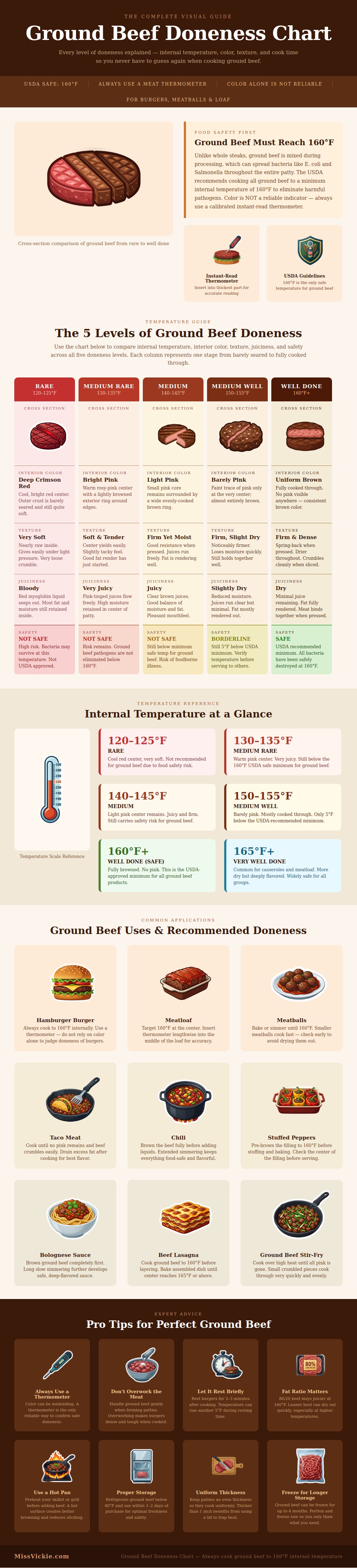
Grinding your own burger doesn’t just mix up bacteria, it distributes them evenly in the ground meat. Since you need to ensure every part of burger reaches a safe temperature, cooking just the surface isn’t enough. To avoid guessing about whether your burger is rare or well done, use this visual guide to determine when it’s ready.
Although these photos will help you judge what you’re looking at, they shouldn’t replace measuring for accuracy. According to the United States Department of Agriculture, all ground beef products must be cooked to an internal temperature of one hundred and sixty degrees Fahrenheit. That goes for everything: burgers, meatloaf, meatballs, etc. Anything less run the risk of having some harmful bacteria present.
How to Cook Safe and Juicy Burgers
As you see in the chart, the deeper into the ground the heat gets, the more interior turns brown (from its initial deep crimson) until it is a solid brown throughout. But don’t rely on appearance: Color is a terrible gauge of whether something is safe to eat. Chemical reactions within the myoglobin can give you pinky-looking beef at any stage of cooking, or make the beef go gray long before it has reached one hundred and sixty degrees. Don’t believe me? How do they think people gets sick? People rely on what looks right.
A digital instant-read thermometer takes the guessing out of cooking ground beef. Insert the probe into center of the thickest section of your patty, let it register, and look for a temperature of one hundred and sixty degrees or above before serving. It’s just as useful when browning small pieces of crumbled meat in a skillet, such as for tacos, or grilling thick burgers over charcoal fire.
When preparing stuffed peppers or a meat loaf, ingredients like egg and breadcrumbs acts as insulators. These extra ingredients create cool spots that might stay well below safe zone. This makes using a thermometer essential. Make sure to use a thermometer and insert it into the thickest part.
There’s also the question of texture. Leaner beef burgers will be firmer and potentially drier when cooked to 160 degrees, which isn’t necessarily wrong, just consider your priorities. If safety comes first, then that might not matter. But if juicy texture matters more to you, select a ratio like eighty percent lean and twenty percent fat so the fat can renders out and baste meat from within.
When cooked, the fat will render out and baste itself inside burger. That’s why many chefs likes slightly higher-fat cuts, though not too high. They won’t get as dry before reaching critical safety mark. The fat also gives them some room to work with. According to the infographic, texture-wise the temperature range shifts from soft and yielding to dense and firm. If you’ve reached correct temperature and see that denseness, that’s a good thing: the proteins has set correctly.
Once it’s time to cook the burgers, how you handle the meat is equally important. If you work the ground beef too much, protein becomes packed and loses its air pockets, resulting in a dense burger that no amount of sauce can save. Season heavily on both sides, use light hands when forming your patties, and allow them to be slightly loose, don’t pack ‘em!
Allow the burgers to rest briefly after cooking to let the inside temperature even out (without the exterior becoming overcooked). This resting time lets the interior heat increase a tiny bit more, making the end result better. It should of been done right from the start. It’s not so much an issue of looks as it is one of risk control and taste.
Here is a helpful chart for visual reference: The point here is that letting the thermometer do the work is better than your eyes; it keeps everyone at the table safe without sacrificing any flavor in the process. When something goes wrong with how you prepared ground beef, the consequences can be serious. Take some time to get it right. Let the numbers speak for themselves. Treat the meat delicately.