Grill to Oven Converter
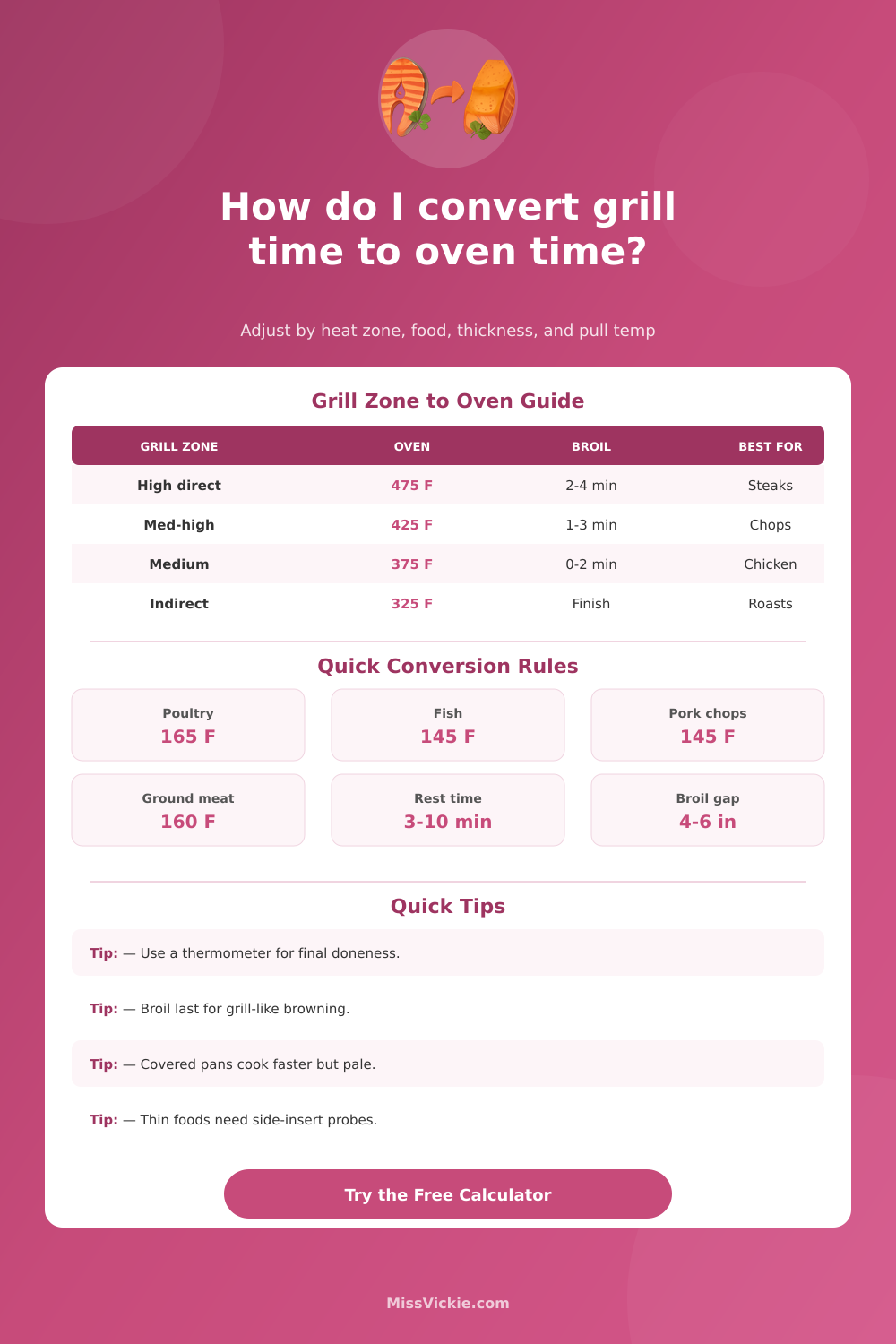
Convert grill heat zones to oven settings with food type, thickness, target internal temperature, covered or uncovered pans, and optional sear or broil finishing time.
Load a common grilled-food scenario, then adjust the food thickness, oven temperature, cover style, broil finish, and internal temperature target.
Conversion Breakdown
| Food | Minimum Internal Temp | Rest | Oven Conversion Note |
|---|---|---|---|
| Beef, pork, veal, lamb steaks, chops, roasts | 145 F / 63 C | 3 minutes | Pull several degrees early only when carryover is expected. |
| Ground meat and sausage | 160 F / 71 C | Short rest | Use steady oven heat; do not rely on browning alone. |
| All poultry, including breasts and thighs | 165 F / 74 C | Short rest | Broil only after the center is close to safe temperature. |
| Fish and shellfish | 145 F / 63 C | Brief rest | Thin fillets move quickly from done to dry. |
| Leftovers, casseroles, stuffed foods | 165 F / 74 C | Serve hot | Use covered oven heat first, then uncover to brown. |
Temperature values follow common USDA and FoodSafety.gov minimum internal temperature guidance. Always verify with a food thermometer at the thickest safe measuring point.
| Food | Thickness | Oven Setting | Estimated Time |
|---|---|---|---|
| Steak or lamb chop | 1 to 1.5 in | 425 to 475 F | 8 to 16 min plus broil or sear. |
| Chicken breast | 1 to 1.5 in | 375 to 425 F | 18 to 28 min to 165 F. |
| Bone-in chicken thigh | 1.5 to 2.5 in | 400 to 425 F | 30 to 45 min, skin up. |
| Pork chop | 1 to 1.5 in | 400 to 425 F | 12 to 22 min plus 3 min rest. |
| Salmon fillet | 0.75 to 1.25 in | 375 to 425 F | 9 to 18 min, broil briefly if desired. |
| Shrimp skewer | large shrimp | 425 to 475 F | 5 to 9 min, turn once. |
| Adjustment | When to Use | Time Effect | Watch Point |
|---|---|---|---|
| No broil | Chicken, fish, covered pans, delicate marinades | Keep all heat in oven time. | Surface will be less grill-like. |
| Quick broil | Thin steaks, salmon, vegetables | Subtract about 1 minute from bake time. | Use a 4 to 6 inch broiler gap. |
| Standard broil | Most grill-to-oven swaps | Reserve 2 to 4 minutes for browning. | Turn or rotate if browning unevenly. |
| Hard char | Steaks, kebabs, sturdy vegetables | Shorten bake time more aggressively. | Can overshoot pull temperature fast. |
| Sear first | Cast iron steaks, chops, sausages | Add skillet sear, then lower oven finish. | Carryover rises after pan searing. |
| Reverse broil | Thicker cuts and gentle centers | Low oven first, broil last. | Dry surface before final broil. |
| Pan Style | Heat Effect | Browning Effect | Best Use |
|---|---|---|---|
| Uncovered sheet pan | Baseline oven conversion | Moderate surface drying | Chicken, chops, fish, vegetables. |
| Rack over sheet pan | Slightly faster air movement | Better all-around edges | Wings, thighs, sausages, kebabs. |
| Cast iron skillet | Hot contact from below | Strong crust without grill marks | Steaks, burgers, pork chops. |
| Loose foil tent | Moist heat, modest speed gain | Less browning until uncovered | Lean poultry or fish that dries easily. |
| Covered pan | Faster, steamier heat transfer | Pale unless uncovered later | Thicker chicken, sausages, saucy foods. |
| Crowded tray | Slower evaporation and airflow | More steaming than roasting | Add time or split into two pans. |
Best when the grill recipe used indirect heat or a closed-lid medium zone.
Best for replacing direct heat because it adds top-side browning at the end.
Best for steaks, chops, burgers, and sausages that need contact browning.
Best for poultry and lean foods, but uncover before the finish if color matters.
When you move a cooking plan from a grill to an oven, you must change the way you apply heat to the food. Ovens does not provide the same heat as grills, and ovens do not naturaly create browning on the food. A calculator can help you to understanding the math behind the necessary temperature adjustments for moving from a grill to an oven; the calculator asks for information about the grill zone, the food thickness, the pan style, and a target temperature for the food.
By using the calculator, you can avoid guesswork in the cooking process; the calculator accounts for factors that may impact cooking time. Grill zones plays an important role in cooking because they help to determine how the heat is applied to the food. Direct heat helps brown the outside of the food while the inside is cooking, while indirect heat cooks the food but doesnt create browning on the food.
Moving Food from the Grill to the Oven
Because an oven does not contain top heat, an oven may require a broiling step to brown the outside of the food. The cooking calculator will ask for the starting grill zone and the desired end zone, as it must account for these factors to calculate proper cooking time. The thickness of the food is one of the variables that will change how the food cooks in the oven.
Thick foods will retain more heat than thin foods, and the heat will help cook the food even after removing it from the oven. The thickness of the food should be measured at the thickest part of the food; the thicker the food then the longer it will cook. Thin foods will dry out quick in the oven; cooking them to the temperature suggested by the cooking calculator will compensate for the effect of carryover cooking.
The pan in which the food will cook can impact both the cooking time and the browning of the food. Cooking in an uncovered sheet pan will allow the food to brown on the edges of the food, but covered pans will cook the food quick but will not brown the food. Crowded food on a baking tray will cause the food to not brown or cook as well as it would if given space on the tray.
Starting temperature is one of the factors that will impact the cooking times for the food. Food that begins in the oven from refrigerated temperatures will take longer to reach safe temperatures than food that has been sitting out of the refrigerator. This difference in temperatures is small for thin foods but can be significant for foods like thick roasts or chicken with bones.
It is possible to allow large foods to reaching room temperature while preheating the oven. Safety temperatures must be reached to ensure the food safety, but these temperatures are not necessarily the same as the taste preferences for food. The cooking calculator will use the recognized minimum temperatures for the different types of food, but may increase the target temperature to accommodate personal food preferences.
The cook should remove the food from the oven a few degrees below the target temperature; carryover cooking will continue to cook the food to the target temperature. The temperature should be taken in the thickest part of the food. The food may be allowed to rest after removal from the oven but for no longer than recommended by the cooking calculator.
Many cooks makes mistakes with the oven because of a lack of understanding of the differences between grills and ovens. Using the cooking calculator will help cooks to understand how mistakes can be made if the oven is treated like a grill; the cooking calculator distinguishes between cooking temperatures and broiling temperatures, and also accounts for the effect of pan on the cooking process. Not all foods require the same level of attention to each of the variables.
For example, thin salmon recipes require less consideration of food thickness and starting temperature, but requirebroiling the food to brown the outside of the salmon. Thick roasts, however, require more consideration for the pan in which the food is cooked and the distance between the food and the tray; this effect determines whether the food will be juicy or steamed. The calculator does not cook the food, but helps cooks to understand each of the variable so that they can make necessary cooking decisions.
The goal in cooking with an oven is to cook the food to a safe temperature and to brown the food. The oven can reach the safe temperature but will require cooks to use the broil function to brown the food; the cooks must treat the oven different than the grill. Once cooks understand how to adjust the cooking plan for food that moves from grill to oven, the oven becomes a more viable cooking alternative.