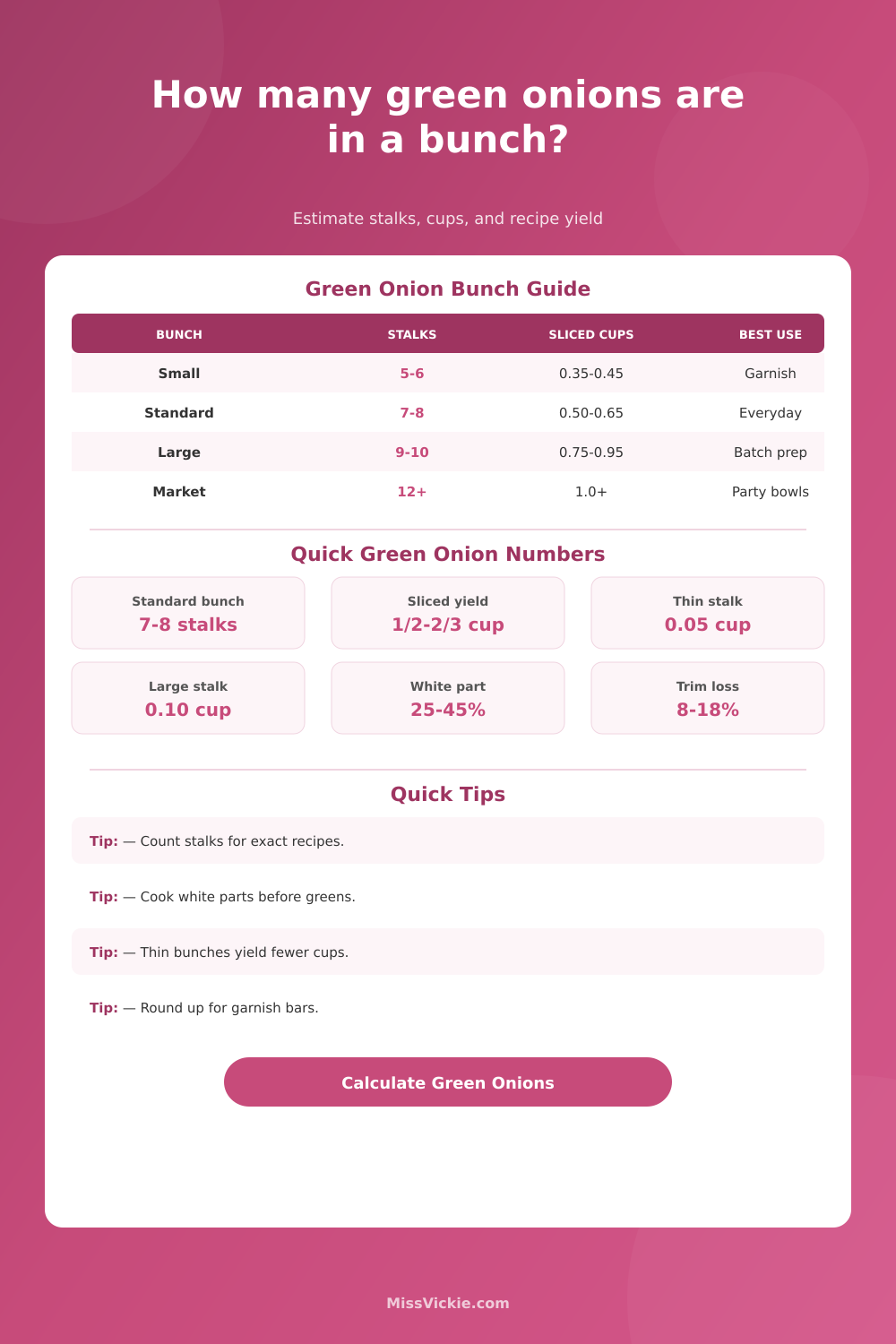
Green Onions Per Bunch Calculator
Estimate stalks per bunch, sliced cup yield, white and green portions, trim waste, cooked or garnish servings, and the bunches needed for a recipe target.
🌿Green Onion Presets
Choose a common kitchen plan, then adjust bunch count, stalk count, size, cup target, white-to-green split, trim waste, use, and flavor strength.
⚖Green Onion Inputs
Green onion bunch estimate
Your green onion yield appears here.
Bunch And Stalk Math
Cup Yield Math
Recipe Plan
📌Fast Bunch Count Cards
🔍Green Onion Comparison Grid
Fine tops, good for ramen, eggs, and small garnish bowls.
Best grocery baseline for dips, fried rice, and salads.
More cup yield, useful for taco bars and meal prep.
Variable size, weigh or count before batch cooking.
Per serving when scallions are a light finish.
Per serving for rice bowls, salads, and noodles.
Per serving when whites are sauteed first.
Per serving when green onion is the main feature.
📊Stalk Size And Bunch Yield Table
| Stalk size | Cups per stalk | Grams per stalk | Standard bunch yield | Best kitchen use |
|---|---|---|---|---|
| Slim pencil stalks | 0.04 to 0.06 cup | 7 to 10 g | 0.30 to 0.45 cup | Fine garnish, ramen, eggs, small salads |
| Standard grocery stalks | 0.06 to 0.09 cup | 11 to 15 g | 0.50 to 0.70 cup | Everyday cooking, dips, fried rice |
| Large market stalks | 0.09 to 0.12 cup | 16 to 21 g | 0.70 to 0.95 cup | Taco bars, soups, noodles, batch garnish |
| Jumbo thick stalks | 0.12 to 0.16 cup | 22 to 28 g | 0.95 to 1.25 cups | Scallion pancakes, grilling, cooked bases |
| Mixed bunch | 0.05 to 0.12 cup | 8 to 22 g | 0.45 to 0.90 cup | Farm boxes and uneven store bundles |
🥄Recipe Use Yield Table
| Use | Volume factor | Serving guide | Best part split | Planning note |
|---|---|---|---|---|
| Raw garnish | 1.00x | 0.06 to 0.12 cup per serving | 25% white / 75% green | Use thin cuts and bright green tops |
| Fresh salad or slaw | 0.98x | 0.10 to 0.18 cup per serving | 35% white / 65% green | Slice on a bias for more visible volume |
| Quick stir-fry finish | 0.88x | 0.12 to 0.22 cup per serving | 45% white / 55% green | Add greens near the end so they stay fresh |
| Cooked aromatic base | 0.78x | 0.15 to 0.25 cup per serving | 55% white / 45% green | Whites cook down and taste sweeter |
| Scallion pancake filling | 0.92x | 0.25 to 0.45 cup per serving | 35% white / 65% green | Use more cups because onion is the feature |
| Dip or creamy salad | 0.95x | 0.08 to 0.16 cup per serving | 30% white / 70% green | Finely sliced scallions spread flavor evenly |
🧪White And Green Portion Table
| Ratio setting | White cups from 1 cup | Green cups from 1 cup | Flavor style | Good use |
|---|---|---|---|---|
| 25% white / 75% green | 0.25 cup | 0.75 cup | Mild and grassy | Garnish, ramen, baked potatoes |
| 35% white / 65% green | 0.35 cup | 0.65 cup | Balanced scallion flavor | Fried rice, dips, salads |
| 45% white / 55% green | 0.45 cup | 0.55 cup | Sharper onion bite | Stir-fry, dumplings, marinades |
| 55% white / 45% green | 0.55 cup | 0.45 cup | Cooked onion base | Soups, sauces, braises |
| Mostly green tops | 0.10 cup | 0.90 cup | Fresh finish | Garnish bars and cold bowls |
| Mostly white bases | 0.75 cup | 0.25 cup | Strong aromatic base | Sauteed starts and brothy dishes |
📋Recipe Quantity Table
| Recipe plan | Sliced cups | Standard bunches | Suggested ratio | Prep note |
|---|---|---|---|---|
| Ramen for 4 | 0.75 to 1 cup | 1 to 2 bunches | 25% white / 75% green | Save fine greens for the top of each bowl |
| Taco or chili bar | 2 to 3 cups | 4 to 5 bunches | 25% white / 75% green | Slice thin so the garnish spreads farther |
| Fried rice for 6 | 1.25 to 1.75 cups | 2 to 3 bunches | 35% white / 65% green | Cook whites first and fold greens in last |
| Potato salad bowl | 1 to 1.5 cups | 2 to 3 bunches | 35% white / 65% green | Use tender inner stalks for a cleaner bite |
| Scallion pancakes | 3 to 4 cups | 5 to 7 bunches | 35% white / 65% green | Pat dry before rolling into dough |
| Large soup pot | 1.5 to 2.5 cups | 3 to 4 bunches | 55% white / 45% green | Cook bases, then reserve greens for serving |
Green onion yield varies with bunch tightness, stalk thickness, root length, wilted tips, slicing width, and how much of the pale base is used.
💡Green Onion Measuring Tips
A recipe calls for half A CUP, SLICED, so you buy some green onions. In the store, the package seems to hold more than enough; there’s a promise of lots of fresh, crunchy goodness to come. You get home and slice up what looked to be a good haul (but then you trim away the dry roots), toss the wilted leaves, and suddenly the pile that once filled out the package hardly reaches bottom of bowl.
This is the green onion illusion. Most of each stalk are an air-filled hollow encased in wispy plant matter that collapses as you slice through. Before you know it, your volume has vanished.
How to Use the Green Onion Calculator
It even calculates this for you. It saves you time guessing on-the-fly conversions. And it doesn’t just ask you for the number of bunches. It makes you examine thickness of the stalks. Bigger is not always better; a skinny stalk will give you less than a fat one. If they’re all about the same size, your dish will be bland or overpoweringly strong.
To adjust for this the calculator let you indicate whether you used regular grocery store stuff or the fat farmer’s market kind. This has a big impact on how much a cup will yield… Because when you measure a hollow vegetable, what counts most isn’t its length, but it’s girth.
The white/green split comes into play. Until it’s too late, most of us just toss everything together, ignoring the difference. But recipes don’t say which portion they desire! You can use this to your advantage: Whites taste sweeter and richer; greens add a grassy note. Depending on what you’re making, you may use more or less of each.
For example, if you’re sauteing a foundation for your stir-fries or soup, you want more of the white pieces. These won’t wilt in the heat and will sweeten during the cooking process. The greens would goes limp and bitter, while the whites hold up to the heat.
On the other hand, when you plan to eat them raw, like in tacos or ramen garnish, you want the greens, since their brighter colors would be lost to wilting. This ratio will guide the calculator to guess your necessary number of bunches, and whether or not any particular piece survive the preparation process.
Trim waste is another volume thief. Potato peels get accounted for, but who thinks there’s any waste with green onions? They’re dainty! But roots have those end bits that tend to get all fibery and dried out, while the tips may be limp and bruised. The outer layer gets tossed in the compost bin.
Planning for eight- to eighteen-percent loss on trim gives enough of a cushion so you don’t fall short by buying just what you “think” will suffice (and still have enough to make it happen). It is a little buffer that makes sure your final count reflect reality, not ideal conditions.
Then there’s the matter of what you intend to do with it: Does the item shrink when you cook it? Garnishes holds their shape; cooked ingredients release liquid, so they don’t occupy as much space. The knife will adjust your serving size accordingly. Green onion is the hero in scallion pancakes, but a supporting role in potato salad. This context prevents overcooking or under-seasoning.
Two bunches seems adequate for feeding a crowd, but two bunches of what? If they’re skinny and you plan to cook them down for broth, you may want four to get enough. But you can’t fit 12 stalks into the fridge without them going limp. And if they go limp, it’s bye-bye to freshness.
The fresher your green onions (or any produce), the longer they will last, since cell breakdown occur when stalks are bruised or otherwise aged. It’s not just about weighing packages: While celery is mostly water, the water portion doesn’t realy “count” when it vanishes from a bruised or older bunch. Instead, look at how many stalks are in each bunch; the stalks provides the actual amount of edible flesh and fiber that lasts longer.
But here’s the thing: It all depends on precision in the kitchen. A cup of chopped green onions is not a constant amount. It changes based off its width, thickness, and even the age of the vegetable itself. That means stopping guessing about amounts by sight and instead trusting measurements that accurately represent your kitchen environment.
The bunch becomes less of a roll-of-the-dice and more like an actual ingredient. You can purchase confidently, knowing just how many bites of crunch will reach the table.