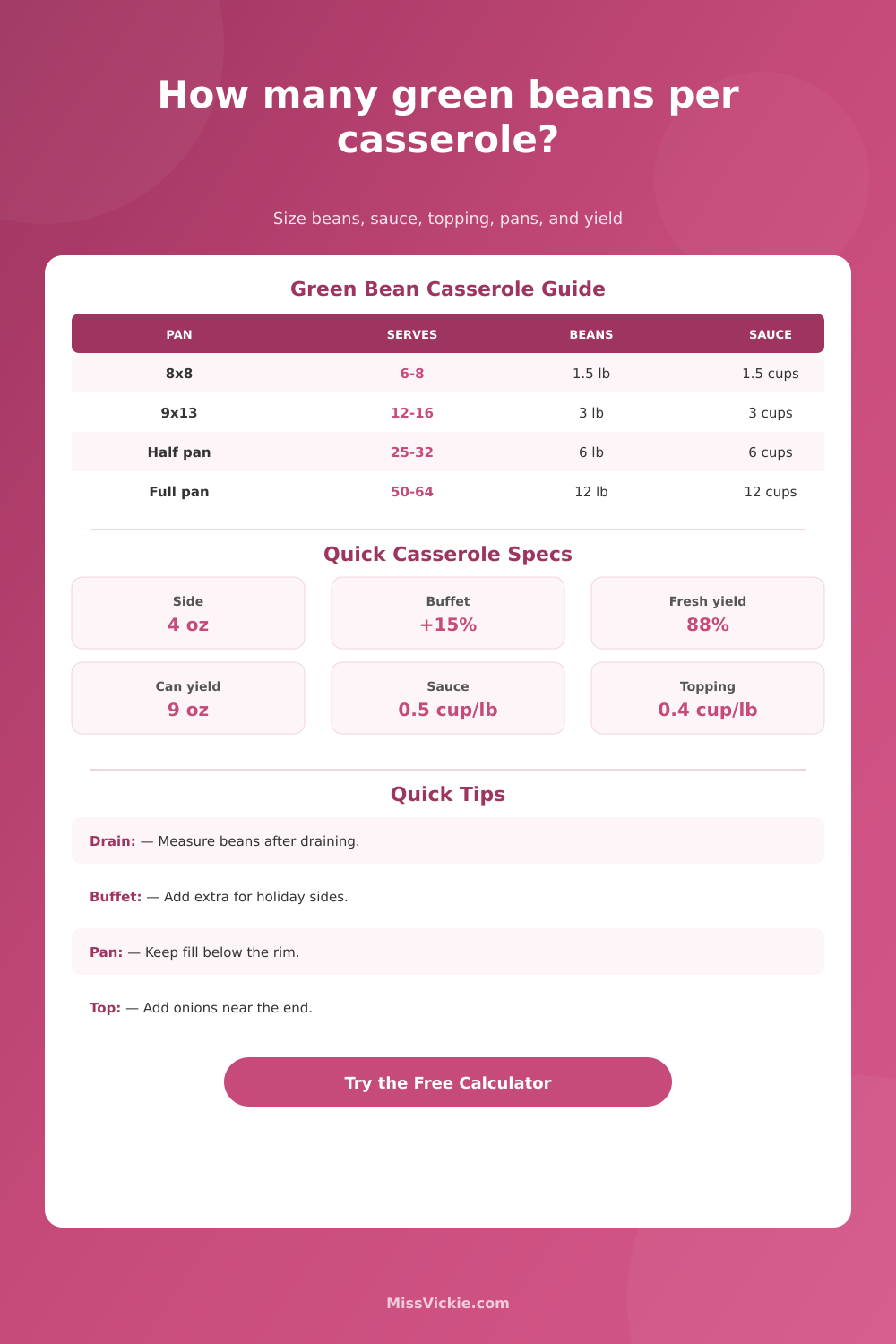
Green bean casserole servings, pan fill, drained yield, sauce, and topping planner
Green Beans Per Casserole Calculator
Estimate green beans for a casserole by serving count, pan size, bean form, drained yield, sauce ratio, crispy topping, and holiday buffet adjustment.
📌Casserole Presets
Start with a common casserole pan or holiday service style, then fine-tune bean form, sauce richness, topping level, serving size, and pan fill.
⚖Servings, Pan, Beans, Sauce, And Topping
Casserole plan
Enter servings and bean details to calculate the casserole.
Bean And Serving Breakdown
Pan, Sauce, And Yield Breakdown
Practical casserole notes
🫘Quick Reference Cards
Drained beans per person before buffet buffer.
Typical drained weight from one standard can.
Classic creamy coating for drained beans.
Classic crispy onion guide before pan-area adjustment.
📋Casserole Reference Tables
| Pan or dish | Typical servings | Drained beans | Classic sauce | Classic topping |
|---|---|---|---|---|
| 8 x 8 inch square | 6 to 8 side servings | 1.5 to 2 lb | 3/4 to 1 cup | 1/2 to 3/4 cup |
| 11 x 7 inch dish | 8 to 10 side servings | 2 to 2.5 lb | 1 to 1.25 cups | 3/4 to 1 cup |
| 9 x 13 inch casserole | 12 to 16 side servings | 3 to 4 lb | 1.5 to 2 cups | 1.25 to 1.75 cups |
| Deep 9 x 13 inch casserole | 18 to 22 side servings | 4.5 to 5.5 lb | 2.25 to 2.75 cups | 1.75 to 2.25 cups |
| Half steam table pan | 25 to 32 buffet servings | 6 to 8 lb | 3 to 4 cups | 2.5 to 3.5 cups |
| Full steam table pan | 50 to 64 buffet servings | 12 to 16 lb | 6 to 8 cups | 5 to 7 cups |
| Bean form | Starting amount | Drained or cooked yield | Best use | Texture note |
|---|---|---|---|---|
| Fresh trimmed beans | 1 lb trimmed | About 14 oz after blanching | Scratch casserole | Firmest bite, needs blanching |
| Fresh untrimmed beans | 1 lb untrimmed | About 12.5 oz ready beans | Holiday fresh prep | Trim loss matters for big pans |
| 14.5 oz canned beans | 1 standard can | About 9 oz drained | Classic pantry casserole | Soft, drain well before saucing |
| Frozen cut beans | 1 lb frozen bag | About 14 oz after thawing | Fast family pan | Pat dry if icy or wet |
| French-style beans | 1 lb prepared | About 14 to 15 oz drained | Thin layered casserole | Needs less sauce by volume |
| Already blanched beans | 1 lb prepared | About 1 lb ready beans | Make-ahead prep | Measure after cooling and draining |
| Serving plan | Drained beans per person | Buffet adjustment | Pan guidance | Sauce feel |
|---|---|---|---|---|
| Light side with many dishes | 3 oz | Usually none or reduced | Shallow pan is fine | Light coating |
| Standard holiday side | 4 oz | Add 8% to 15% | 9 x 13 serves about 12 to 16 | Classic creamy |
| Hearty family side | 5 oz | Add 8% if seconds are likely | Choose a deeper dish | Classic or extra saucy |
| Buffet line service | 3.5 oz | Add 15% to 25% | Half pans hold best | Slightly extra saucy for holding |
| Planned leftovers | 4.5 oz | Add 25% to 35% | Use two pans for even baking | Avoid over-topping before reheating |
💡Casserole Calculation Tips
Reference yields are kitchen planning estimates. Actual drained weight varies by brand, bean cut, thawing, and how firmly the beans are drained.
Whether we call it culinary tradition or comfort food, a lot of us has the green bean casserole at the heart of our family’s holidays. It’s always a hit, crunchy on top, creamy underneath.
But let’s be honest: when faced with a pile of green veggies and an empty baking dish in the kitchen, sometimes it feel more like being in geometry class than preparing a meal. How much will fit into this pan? How much of those beans do I need to use up? What about all of that gooey sauce that holds everything together? And don’t forget: How much do I want to end up eating from this thing?
How to Make Green Bean Casserole Easy
Once you input your pan size and number of servings, the above calculator does the math for you. You won’t have to guess on conversion and coefficient rate. You won’t have to worry about running out of space halfway through, you just plan and then get down to the business of cooking.
Once you’ve selected your primary input type, you start plugging in variables. For me, that means thinking about how many guests I have coming over. One variable might be: Is this a light meal with plenty of sides? Or is this a vegetarian’s hearty main? That determines the amount of drained bean weight on each plate.
For a basic side dish, we’re generally looking at around four ounces of cooked/drain weight per person. When it’s being served as part of a buffet line, however, you’ll probably want to pad the amount slightly. (At a self-serve table, people tend to serve themselves unevenly, while others may return for seconds.) Fifteen percent should account for that variation without leaving you staring at a fridge packed with leftovers.
But depending on what type of green bean you’re using, you’ll get different results and will need to prepare them differently than before. If you’re using fresh beans, you trim them and then also blanch (this will shrink down the weight). Then there are frozen beans, handy, but make sure they aren’t retaining excess water when thawed. Canned beans are the quickest way to add to your final dish, but factor in the liquid the beans arrived in. One normal sized can (fourteen and a half ounces) equals about nine ounces of drained beans once they’ve been drained.
This is where most folks mess up. They shop by can size, and then don’t remember that almost half of it is water or brine. The tool factors in this difference, letting you know just how many ounces of the real thing you need to buy.
That’s where the structure comes from for the casserole: the sauce and topping. The sauce not only flavors things (duh), but it keeps everything stuck to the pan, holding its shape. Not enough sauce leaves dry pockets. Too much sauce? Soup time. This calculator figures out that sweet spot using a weight-based ratio between your cooked/drained beans and the sauce. You might make a version with something saucy like cream, something lighter like a broth base, or maybe even something cheesy. That makes a difference!
And then there’s the topping. It doesn’t contribute any flavor, really, but it does add some texture (and looks, too). Traditional is fried onions, but grated cheese or breadcrumbs will do the trick here, too. As for how much topping to use? Consider your pan’s surface area: a bigger, flatter pan require more topping than a narrower, deeper one.
The last limitation in this equation is the pan size. How big is the casserole? Standard-size dishes is nine inches across and thirteen long (the pan I’m writing about). You can only fit so much sauce and beans in there or it’ll spill over in the oven, baking unevenly, with burned sides but still-soggy middles. It is better to divide a big recipe between two smaller pans, one shallow, so both cook evenly and have a better texture.
The reference table on this page matches ingredient quantities to pan sizes. It also shows approximate serving amounts to help you see what fits inside each piece of cookware.
Once you understand all those factors, though, it’s easy to see that the casserole isn’t a strict recipe anymore: It’s a template. You can make this template with whatever ingredients you happen to have (or whoever happens to be sitting at your table). It’s the same principles whether you’re cooking for four one night after work or for fifty over the holidays. All you need to do is measure out your drained beans, figure out what ratio of sauce you want, account for the size of your pan, and go.
Because when you get the pieces fitting together right, there’s no more math to worry about; just trust your gut. Trust that the onions will brown, that the greens will stay put, and that the sauce will cling. And then you’ll end up with a meal that doesn’t taste like a casserole but instead tastes like someone cared.